GWEIKE One Machine for Sheet and Tube
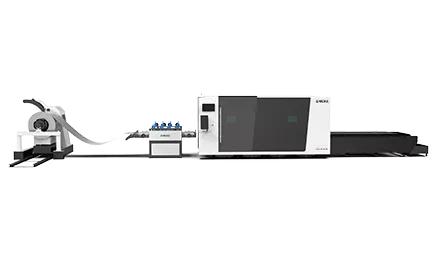
Many fabrication shops reach the same point: you cut sheet metal every week, you cut tube every week, and running two separate workflows (or outsourcing one of them) starts to feel expensive and inefficient. That’s exactly where a sheet + tube “hybrid” fiber laser can make sense—especially in the popular GWEIKE 3015 working format.

First: Should You Buy a Hybrid Machine at All?
A hybrid sheet+tube system is not automatically “better.” It is better only when it matches your business mix and constraints.
A hybrid machine is usually a smart fit when:
You regularly do both sheet and tube (not “once a month” tube).
You are tight on floor space, power, or labor, and don’t want two separate cells.
You want one team to run one control platform, instead of splitting skills.
You frequently quote jobs that include both sheet brackets/panels and tube frames/supports.
A hybrid machine is usually not the best choice when:
Tube is 90%+ of your workload (a dedicated tube laser will usually be more efficient).
Sheet is 90%+ of your workload and tube parts are rare (you’ll likely underuse the tube function).
You need extreme tube capability (very long tubes, heavy structural profiles, or ultra-high throughput tube production).
Practical rule of thumb:
If tube work is consistently around 15–40% of your cutting demand (by jobs or revenue), hybrids often look attractive. If it’s far outside that range, dedicated machines often win.
The Real Hybrid Question: What Will You Trade Off?
Hybrids deliver convenience and cost savings by combining capabilities, but you should be clear on the trade-offs so you don’t feel disappointed later.
Where hybrids save money:
One footprint, one investment plan, one operator training path
Less outsourcing
Less scheduling chaos (sheet job + tube job can be handled in-house)
Faster quoting and faster delivery for mixed assemblies
Where hybrids can “cost” you:
You may not match the peak efficiency of a dedicated sheet-only production line plus a dedicated tube-only production line
Changeover habits matter more (how you switch between sheet and tube work)
Your business must be disciplined about scheduling so the machine doesn’t become a bottleneck for both departments
A hybrid makes the most sense when your shop values flexibility and coverage more than extreme specialization.
What You Must Define Before Choosing LNR vs GAR vs GCR
Before comparing these three models, define five simple inputs. Most “wrong purchases” come from skipping this.
Your dominant work (80% thickness range)
Write your main sheet thickness range and your main tube wall thickness range.Your tube type and tube usage style
Is it mostly square/rectangular tube? Round? How often do you cut tube per week?Your production mode
High-mix / small batches? Or repeat jobs / steady runs?Your biggest bottleneck
Cutting time? Loading time? Operator skill dependence? Rework in assembly?Your space and workflow constraints
Do you have room for separate machines and material staging, or do you need one cell to do everything?
Once you have these inputs, the LNR/GAR/GCR decision becomes much more straightforward.
The Three Practical “Positioning” Choices
These models are typically considered as three different “levels” of hybrid investment. Exact configurations vary by quote and options, so treat this as positioning logic you can use to guide the conversation.
Option A: Entry-level value hybrid (best for SMEs that want coverage without overbuilding)
If your goal is: “We need sheet+tube capability, we are cost-sensitive, and we want a practical starting point,” then an entry-oriented hybrid direction like LF3015LNR is commonly evaluated.
Best fit if:
You are moving from outsourcing to in-house mixed cutting
Your tube demand is real but not extreme
You can accept more manual workflow management (staging, changeovers)
You value payback and simplicity over maximum throughput
Common buyer mindset:
“Give me a reliable hybrid foundation, then we’ll optimize workflow and maybe add automation later.”
Option B: Balanced hybrid for steady production
If your shop already runs mixed sheet+tube jobs regularly, and you want a more stable production rhythm without going into “maximum-spec territory,” a mid-positioned direction like LF3015GAR is typically considered.
Best fit if:
You have steady demand for both sheet and tube
You want more predictable daily output (not only “ability”)
You need a hybrid that feels more like a production asset than a “backup solution”
You want a better balance between flexibility and throughput
Common buyer mindset:
“We’re past the trial phase. This machine must run reliably every week and support quoting and delivery.”
Option C: Higher-efficiency hybrid direction
If your hybrid will be heavily utilized and your shop is sensitive to downtime, scheduling delays, and throughput loss, you may look at a higher-level configuration direction like LF3015GCR.
Best fit if:
Your hybrid cell will run at high utilization (many hours per day)
You want stronger consistency and smoother daily output
You are investing for long-term production stability and a cleaner workflow
Your business model cannot afford frequent “small stoppages”
Common buyer mindset:
“This is not just a hybrid. It’s a core production platform, so stability and efficiency matter.”
A Simple Decision Matrix (Use This When You’re Busy)
Choose LF3015LNR if:
Budget and fast payback are the top priority
Tube work exists, but not at heavy production scale
You are willing to manage workflow more manually at first
Choose LF3015GAR if:
You already run mixed sheet+tube jobs weekly
You want a balanced production tool (not only capability)
You want smoother output without overbuilding
Choose LF3015GCR if:
The hybrid will be heavily utilized
Downtime and scheduling instability are costly
You want the most production-oriented hybrid direction among these options
The Hybrid Risk: Scheduling the Machine Wrong
The most common “hybrid regret” is not technical—it is operational.
If you let every department treat the hybrid as their “always available” machine, you get:
constant interruptions
messy changeovers
long queue times
operators losing rhythm
quality drift because the machine is always switching context
Fix: schedule in blocks.
Sheet blocks (nesting, stable sheet runs)
Tube blocks (stable tube runs)
Priority rules (rush jobs, repeat jobs, and “mixed assembly” jobs)
A hybrid becomes profitable when it is treated like a production cell with a schedule, not a shared toolbox.
Copy-Paste Questions for Vendors (So Quotes Match Reality)
Send vendors this checklist:
Our main sheet materials and thickness range: ________
Our main tube types and wall thickness range: ________
Tube cutting frequency (jobs/week): ________
Our top 5 mixed assemblies (sheet + tube together): ________
Our daily output goal (hours/day or parts/day): ________
What changeover workflow do you recommend between sheet and tube work?
What consumables and maintenance routines are most important for our material mix?
What training time is realistic until a normal operator produces stable results?
What options meaningfully reduce downtime for a hybrid cell?
This turns the conversation into production reality instead of vague “max thickness” talk.
FAQ
Is a hybrid always cheaper than two separate machines?
Purchase price can be lower than two dedicated machines, but the real value is usually floor space, labor simplicity, and avoiding outsourcing. If your volumes get very high in both sheet and tube, two dedicated machines can eventually be more efficient.
Will a hybrid slow down our sheet production?
It can if tube jobs constantly interrupt sheet runs. If you schedule properly in blocks, many shops get stable output while keeping flexibility.
How do I know if I should choose the higher-efficiency option?
If your hybrid will run many hours per day and you cannot tolerate frequent small stoppages, choose a more production-oriented direction (often the logic behind evaluating a configuration like LF3015GCR).
Closing
A hybrid sheet+tube laser is a strategic choice: it reduces complexity and expands capability, but only pays back when it matches your workload and is scheduled like a real production cell. If you want a cost-effective entry into combined cutting, start by evaluating a direction like LF3015LNR. If you need a balanced weekly production tool, look at LF3015GAR. And if high utilization and production stability are critical, a more efficiency-oriented direction like LF3015GCR is often where serious buyers focus.
Post Your Ad Here
Comments