GWEIKE Heavy-Duty Tube Laser Cutting
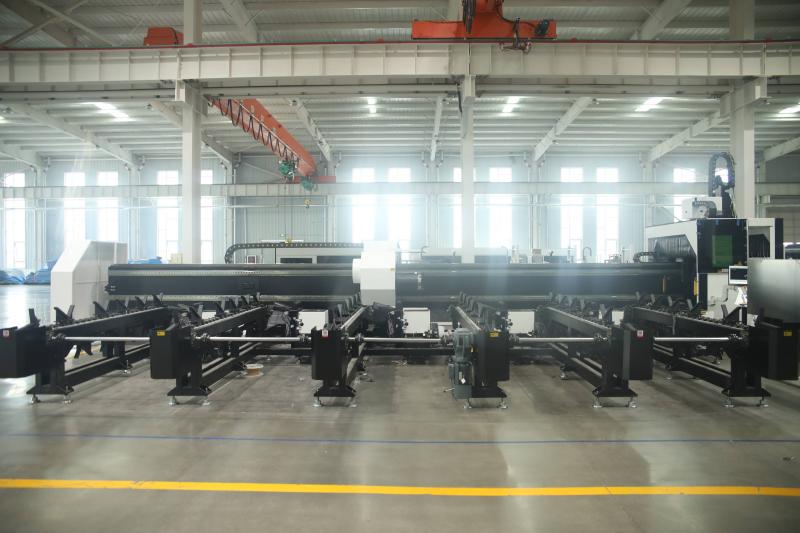
When tube cutting moves from “light fabrication” into heavy-duty production, the buying logic changes. You are no longer only chasing speed or a clean edge. Your real problems become structural:
Long tubes sag and create angle errors.
Thin-wall long tubes vibrate and distort holes.
Heavy tubes are hard to clamp safely, so the operator slows down.
The last section of a tube becomes unstable, causing bad cuts and extra scrap.
Fit-up problems show up during welding and assembly, and rework becomes expensive.
If your business involves long parts—steel structures, trailers, machinery frames, construction components, agricultural equipment, energy projects, large racks, or heavy pipe fabrication—you typically end up choosing between three practical directions:
A long-length solution designed around 12-meter processing and long-part workflow, often referred to as T3L.
A four-chuck (four-clamp) heavy-duty architecture built to control long and heavy tubes more aggressively.
This article explains the differences in plain English, and gives you a simple decision framework you can use immediately.

Why Long and Heavy Tube Cutting Is Hard (Simple Explanation)
Most problems in heavy-duty tube cutting come from physics, not operator skill.
Long tubes sag.
Even a small sag can shift the cutting position, which affects hole accuracy and joint angles. If your parts require tight fit-up, that sag turns into welding rework.
Long tubes vibrate.
Vibration shows up as rough edges, inconsistent holes, or “micro-waves” in the cut. Thin-wall tubes are especially sensitive.
The “end of tube” is the danger zone.
As you approach the last portion of a tube, support and clamping become less stable. That’s where many shops lose time and scrap.
Heavy tubes change your workflow.
You cannot treat a large tube like a small tube. Handling, staging, and safe clamping become part of your cycle time, and your equipment choice should match that reality.
The Real Question: Are You Fighting Length, Weight, or Stability?
Before you compare models, identify your main limiting factor:
Length problem: You frequently run 6–12m parts, and moving/splitting them is killing productivity.
Weight problem: Tubes are heavy enough that safe clamping and movement slow everything down.
Stability problem: You can cut, but your quality and fit-up are inconsistent—holes drift, miters don’t match, rework is high.
Once you know which of these is dominant, the machine direction becomes much clearer.
Option A: T3-Class Industrial Tube Cutter (Best “All-Rounder” for Serious Tube Work)
A T3-class industrial tube cutter is often the correct step when your shop is beyond light fabrication but not yet dominated by ultra-long 12m workflows or extreme heavy-duty constraints.
In plain terms, a T3-style direction fits best when:
Your tube lengths are often standard industrial lengths (commonly up to 6m in many workflows).
You cut a wide mix of round/square/rectangular tube.
You want a stable, production-capable platform without turning the project into a large “line integration” effort.
Your biggest payoff comes from replacing secondary steps (drilling, marking, manual miters) and improving welding fit-up.
Why many heavy shops start here
Because it is a practical balance: enough strength and stability for real production, but still simple enough to integrate into a normal shop floor.
When T3 becomes “not enough”
If your bottleneck is clearly long-length processing (especially full 12m workflow), or if clamping/stability at the tube ends is consistently hurting yield, you may need to move into a long-length or four-chuck direction.
Option B: T3L / 12-Meter Workflow (Best When Your Business Is Built Around Long Parts)
If your shop regularly processes 12m tubes—or if you want to stop cutting long tubes into sections—then the equipment choice is not only about cutting. It is about long-part workflow: loading, support, stable processing across the full length, and minimizing handling steps.
Choose a T3L / 12m direction if:
Your orders include long beams, long frames, long structural parts, long rails, or long supports as a normal workload.
Splitting long parts creates downstream welding/alignment labor that you want to eliminate.
You want a more direct “one-piece manufacturing” process: load long tube, cut, unload—without segmentation.
Why 12m capability is a competitive advantage
For the right business, it changes your quoting and delivery model. You can take jobs that competitors avoid (or they outsource), and you can reduce the hidden cost of joining segmented parts.
What to watch for (important)
A long-length machine only performs well if your shop flow is planned:
You need space to stage 12m stock safely.
You need a clear path for loading/unloading (forklift/crane route planning).
You need finished-part handling so you don’t damage long thin-wall parts after cutting.
If your factory layout is not prepared, a 12m system can feel slow—not because the machine is slow, but because the shop is not organized for long-length flow.
Option C: Four-Chuck Heavy-Duty Architecture
If your core struggle is stability—especially near the end of long tubes, or with heavy tubes that are hard to clamp consistently—then a four-chuck system is often worth serious consideration.
Choose a four-chuck direction when:
You frequently process long tubes where end stability affects quality and scrap rate.
Heavy tubes require stronger control during cutting and rotation.
You care about repeatable geometry for welding fit-up and assembly consistency.
Your business runs high utilization and you want fewer “operator-dependent” outcomes.
Plain-English benefit
More control over clamping and support means:
fewer bad cuts near the tube ends
more consistent holes, slots, and joint angles
better repeatability across shifts and operators
more predictable downstream welding and assembly
The practical trade-off
A heavier, more controlled architecture can require more planning in setup and investment. It is usually chosen by shops that already know their pain is not “cut-through power,” but “stable production geometry.”
The Most Common Buying Mistakes in Heavy Tube Cutting
Mistake 1: Buying for “maximum tube size” instead of daily workload
Choose for your 80% job range. Rare outliers should not define your main investment.
Mistake 2: Underestimating factory layout for long parts
If you buy a long-length system without planning staging, loading routes, and finished-part handling, you lose productivity.
Mistake 3: Chasing speed while ignoring fit-up stability
In heavy fabrication, the fastest cut is not always the cheapest part. Fit-up errors and welding rework destroy margins.
Mistake 4: Not measuring scrap causes
If you don’t track why scrap happens (end instability, sag, mis-rotation, poor support), you cannot choose the right architecture confidently.
FAQ
Do I really need 12m capability?
Only if long parts are a frequent workload or segmentation costs you real money (extra welding, alignment, rework, delayed delivery). If long parts are rare, 12m may be underutilized.
Why does end-of-tube cutting fail so often in heavy shops?
Because support and clamping stability change as the usable tube length decreases. If this causes scrap regularly, a more controlled architecture is usually worth it.
Is “more clamping control” worth the investment?
If your shop’s margin is hurt by geometry inconsistency (holes drifting, joints not matching, rework hours rising), stronger control often pays back through stability rather than raw speed.
What should I prepare before asking for quotes?
Bring: your tube list (sizes, thickness, lengths), your top 10 parts, your daily output goal, and your top 3 quality problems. That is enough to get accurate configuration guidance.
Closing: In Heavy Tube Cutting, the Best Machine Is the One That Makes Fit-Up Predictable
For heavy-duty tube manufacturing, equipment selection is not only about cutting—it is about producing repeatable geometry that your welding and assembly teams trust. If you want a strong industrial baseline, a T3-class direction like GWEIKE GKS6036T3 is often the practical step. If long parts define your business, a 12m workflow direction like GWEIKE GKS9036T3L becomes strategic. And if stability and end-of-tube quality are your daily pain, a four-chuck architecture like GWEIKE T4 is frequently the right solution path.
If you tell me your typical tube length (6m vs 12m), your main tube sizes, and whether your biggest issue is sag, vibration, or end scrap, I can tighten this article even further to match your buyer persona on APSense while keeping the same three embedded links.
Post Your Ad Here
Comments