Artificial Intelligence Trends Reshaping Interior Design Apps
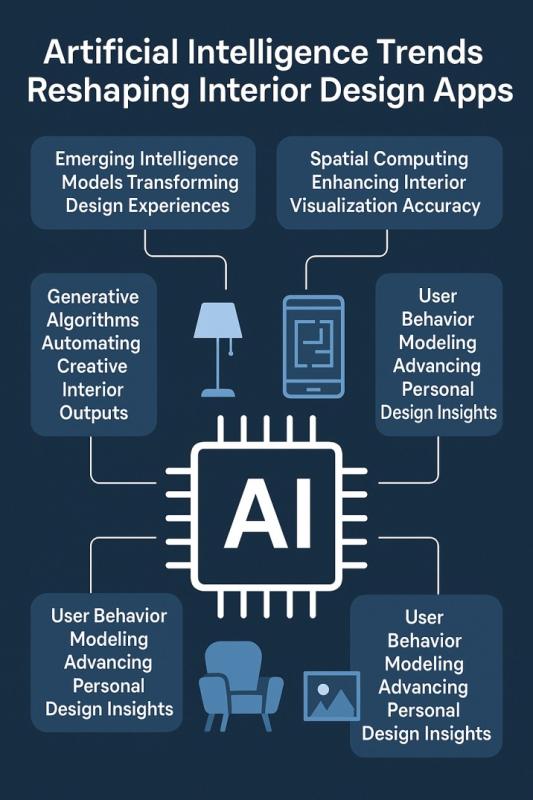
Artificial intelligence is accelerating major shifts across the digital design ecosystem, prompting developers and product teams to rethink how users visualize and plan their living spaces. As demand grows for immersive, intuitive, and personalized home design tools, the role of AI continues to expand. Modern platforms now integrate intelligent recommendations, automation capabilities, and advanced visualization technologies. These innovations demonstrate why interest in AI Interior Design App Development is rising among both established companies and new entrants in the market.
Emerging Intelligence Models Transforming Design Experiences
Artificial intelligence has evolved far beyond rule-based systems and now incorporates sophisticated neural networks capable of learning from millions of design samples. These advanced models enable apps to interpret user inputs, predict preferences, and offer highly specific design options. Developers exploring AI Interior Design App Development increasingly rely on multimodal algorithms that understand text, images, and spatial layouts simultaneously.
One of the most significant improvements is the capacity to analyze room dimensions and instantly generate accurate furniture placements. This capability reduces friction for users who previously relied on manual measurements or static templates. Through real-time inference, modern design applications can recommend decor styles, identify mismatched elements, and propose optimized configurations.
Key improvements driving these models include:
Rapid adaptation to unique home layouts.
Personalized aesthetic recommendations based on behavioral data.
Automated correction of design inconsistencies.
Contextual understanding of lighting, textures, and proportions.
The adoption of intelligent models paves the way for new product experiences that adapt to each user’s design logic while reducing reliance on traditional design workflows.
Spatial Computing Enhancing Interior Visualization Accuracy
Spatial computing has become foundational for the next generation of design applications. By bridging digital and physical environments, it enables precise mapping of indoor spaces and supports advanced visualization techniques. Integration with computer vision allows an app to interpret depth, geometry, and room contours with exceptional accuracy, offering users a realistic understanding of how their design choices will appear.
Spatial mapping engines enable several innovations:
• Automatic detection of walls, windows, and floor boundaries.
• Precise furniture scaling to avoid unrealistic arrangements.
• Real-time measurement extraction with high fidelity.
• Improved compatibility with augmented reality overlays.
Augmented reality benefits significantly from spatial computing enhancements. Instead of static 3D objects placed in approximate positions, users experience accurately grounded visualizations that react to lighting and orientation. These capabilities elevate user trust and minimize the need for trial-and-error decisions.
For developers planning to create an app like home ai, spatial computing provides the foundation for delivering precise, engaging, and contextually responsive visual environments.
Generative Algorithms Automating Creative Interior Outputs
Generative AI has quickly become one of the most influential technologies shaping modern design platforms. By analyzing extensive datasets of interiors, furniture styles, materials, and architectural patterns, generative algorithms create original design outputs that mimic the work of skilled designers. These outputs allow everyday users to explore more creative design directions without needing formal training.
Key innovations made possible by generative technologies include:
Fully automated room redesigns based on a single photo.
Multiple stylistic variations generated instantly for comparison.
Automated palette suggestions that match furniture and decor.
Procedural creation of layouts optimized for space and aesthetic balance.
The creative generation process increases accessibility while enabling faster prototyping for design professionals. Companies investing in AI development services are discovering that generative design dramatically reduces production time for visual assets, mockups, and iterative design scenarios.
Equally important, generative algorithms are becoming more controllable. Users can specify parameters such as color preferences, spatial constraints, or functional needs, ensuring that the generated results align with practical expectations.
User Behavior Modeling Advancing Personal Design Insights
One of the most profound impacts of AI on interior design applications lies in predictive user modeling. By combining behavioral analytics with preference tracking, modern systems anticipate user needs and provide context-aware recommendations. This capability elevates personalization from simple filtering to dynamic, data-driven design guidance.
Advanced user modeling supports:
• Detection of recurring stylistic preferences.
• Prediction of layout choices based on past selections.
• Adaptive user journeys that streamline complex design tasks.
• Intelligent nudges during decision-making processes.
Developers engaged in AI Interior Design App Development increasingly prioritize user modeling engines because of their impact on engagement and retention. When an app can anticipate what a user wants, the design process becomes more fluid and satisfying.
Predictive systems also benefit professional users. Designers can identify client preferences early in the workflow, improving collaboration and reducing revision cycles. As modeling capabilities mature, the interior design ecosystem will likely see more adaptive tools that respond dynamically to changing user intentions.
Real-Time Rendering Innovations Improving Visual Fidelity
Real-time rendering technologies have transformed the visual quality of modern design applications. Through advanced GPU acceleration and optimized rendering pipelines, users can explore photorealistic interiors without waiting for static image outputs. This shift is crucial for platforms delivering immersive and interactive design experiences.
Advancements in rendering encompass:
High-definition texture mapping that enhances realism.
Real-time global illumination for lifelike lighting effects.
Physically based rendering models that replicate material behavior.
Efficient compression techniques enabling smooth performance.
For developers, the challenge lies in balancing visual fidelity with device performance. The most successful platforms employ adaptive rendering layers, allowing the system to adjust detail levels based on hardware capabilities.
This technology also supports more confident decision-making among users. When materials, lighting, and textures appear accurately, users can evaluate design choices with greater precision. The result is a more informed, intuitive, and visually engaging design journey
Voice and Natural Language Interfaces Simplifying Design Tasks
Natural language interfaces have become vital to making interior design applications more accessible. Instead of relying on complex navigation paths or tool palettes, users can communicate their requirements through conversational commands. Voice and text inputs allow users to describe desired styles, modifications, or room attributes, enabling the AI engine to translate those instructions into actionable design outputs.
Benefits of natural language interfaces include:
• Reduced learning curve for new users.
• Faster execution of multi-step design tasks.
• Enhanced accessibility for users with mobility constraints.
• Improved collaboration between human designers and AI systems.
These interfaces also support advanced semantic comprehension. The system can interpret contextual statements, compare styles, and even recommend alternatives based on user feedback. For organizations planning to hire AI developers, natural language processing frameworks represent an essential component for delivering intuitive and frictionless user experiences.
As language models continue to evolve, interior design applications will become even more conversational, allowing users to articulate vision and intent naturally.
Data Integration Ecosystems Powering Smart Design Decisions
Data ecosystems are becoming central to delivering intelligent, responsive design features. By integrating information from product catalogs, material databases, lighting simulations, and spatial analytics, apps can provide data-backed insights to enhance design precision. These integrations transform static design tools into dynamic platforms capable of supporting complex decision-making.
Structured data integration enables:
Automatic retrieval of furniture and material specifications.
Compatibility checks based on dimensions and durability.
Lighting and energy simulations that mimic real-world performance.
Cost estimations and material comparisons for project planning.
Beyond operational efficiency, integrated data ecosystems foster innovation. Developers can incorporate sustainability metrics, ergonomic principles, and building code guidelines, making design choices both aesthetically pleasing and practical.
For product teams pursuing AI Interior Design App Development, the ability to unify disparate data sources into a cohesive platform represents a major competitive differentiator. As data ecosystems grow more interconnected, users will have access to richer insights and more sophisticated design analytics.
Cross-Platform Experiences Enabling Seamless Design Workflows
The modern design landscape demands seamless transitions across devices, and interior design applications are increasingly incorporating cross-platform capabilities. Users expect to begin a design on a mobile device, refine it on a desktop interface, and visualize it through augmented reality without losing data or context.
Cross-platform innovations include:
• Unified design states synchronized across cloud services.
• Device-optimized interfaces that preserve performance.
• Collaborative workspaces that support multi-user input.
• Streamlined export formats compatible with professional tools.
This shift creates more flexible and continuous workflows. Homeowners, architects, and designers can collaborate in real time, bridging conceptual and technical phases of a project. As expectations for fluid design ecosystems rise, developers must ensure that design data remains consistent and accessible.
Cross-platform functionality also enhances user satisfaction by providing context-aware interfaces tailored to each device’s capabilities. Whether used for on-site planning or professional presentations, modern interior design apps are evolving into comprehensive multi-environment systems.
Intelligent Automation Streamlining End-to-End Design Processes
Automation is becoming a critical component of interior design applications, enabling faster and more efficient execution of complex design tasks. Intelligent automation combines machine learning, rule-based systems, and workflow orchestration to eliminate repetitive steps and deliver end-to-end support across the design journey.
Automation supports several high-value functions:
Room segmentation and object classification.
Auto-generation of layout alternatives.
Instant modification of materials, colors, and configurations.
Photo enhancement and background cleanup for room inputs.
Task-specific assistance for documentation and specification lists.
Developers who create an app like home ai often incorporate automation layers early in the design architecture because these systems significantly improve scalability. For professionals, automation reduces manual workload and enables more time for conceptual and creative tasks.
As automation engines become more refined, interior design applications will increasingly serve as intelligent co-creators, guiding users through structured yet flexible workflows that support both creativity and precision.
Conclusion
Artificial intelligence is redefining how interior environments are imagined, planned, and brought to life. Continuous advancements in modeling, rendering, automation, spatial computing, and data integration are expanding the capabilities of digital design tools. As these technologies mature, interior design applications will continue to evolve into comprehensive platforms that empower users with deeper insights, greater flexibility, and more immersive experiences. The future of digital interior design will be shaped by thoughtful application of intelligent systems that enhance creativity and support informed decision-making.


Comments