A Clear Roadmap to Transform Ideas Into a Successful MVP App Launch
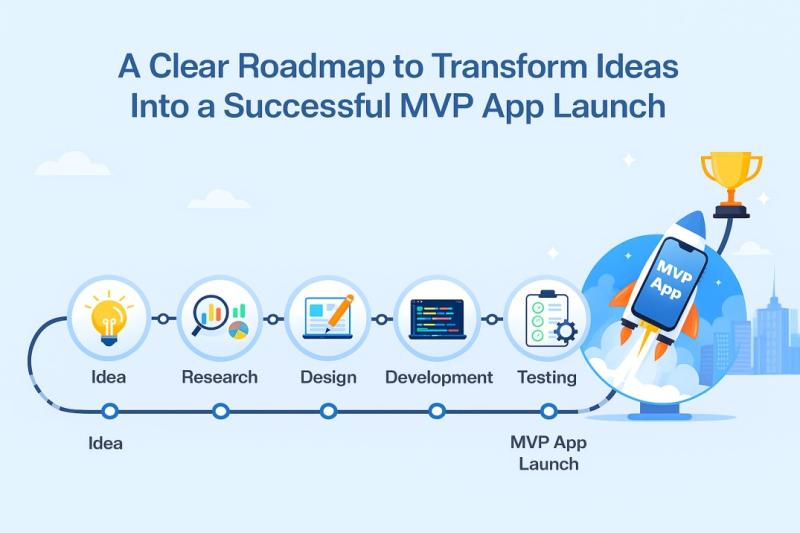
Turning an idea into a functional digital product requires a thoughtful and structured approach. Building a minimum viable product, commonly known as an MVP, is one of the most reliable ways to validate assumptions while reducing risks. Many teams work with an experienced MVP app development company because the strategy behind an MVP emphasizes focus, iteration, and insights drawn from real users rather than speculation.
An MVP centers on delivering only the essential features that solve a clearly defined problem. This approach helps businesses avoid unnecessary complexity and stay aligned with genuine market demand. Instead of investing substantial resources into a full-scale build, teams can learn faster by observing how users interact with the initial version and then refining the product based on real behavior.
By keeping the early product lean and purpose-driven, businesses can maximize efficiency, test for market readiness, and uncover opportunities that might shape the next phases of development. The clarity gained through early learning is often more valuable than any assumptions made during planning.
Defining the core problem your digital product will meaningfully solve
Every successful MVP is anchored in a well-defined problem. Before writing requirements or designing features, teams must invest time in analyzing the challenge they aim to solve. A clearly understood problem ensures that the solution is purposeful, precise, and relevant.
To define the core problem effectively, teams can:
Conduct structured interviews with potential users
Analyze existing industry gaps and unmet needs
Review competitor products and their limitations
Identify the most frequent user pain points
Assess how the problem affects user behavior or business operations
The objective is not just to gather data but to understand the deeper motivations behind user frustrations. A strong problem definition becomes the foundation of the entire MVP, shaping decisions about features, design, user flows, and the product’s long-term direction.
Translating validated insights into a focused and testable MVP feature plan
Once the central problem is defined and validated, it becomes possible to outline which features truly matter in the first iteration. An MVP is intentionally limited in scope. It does not attempt to be a complete product; instead, it includes only the functionality required to test the core hypothesis.
Teams should categorize features into three groups:
Essential features that directly solve the problem
Helpful features that enhance convenience but are not required immediately
Future features that can be added after initial validation
The essential features form the core of the MVP. This prioritization ensures that development remains efficient and aligned with the product’s strategic objectives. Focusing on fewer features also reduces the MVP app development cost, which enables businesses to allocate resources more intelligently across future iterations.
A well-defined feature plan provides clarity for designers, developers, and stakeholders while ensuring that all efforts are directed toward a meaningful early outcome.
Estimating resources and outlining realistic MVP development timelines
Careful planning is necessary to ensure the MVP progresses smoothly from concept to launch. Estimating resources involves understanding team structure, technical complexity, required integrations, and the timeline for research, design, development, and testing.
A typical MVP timeline includes:
Discovery and planning
Design and prototyping
Development and integration
Testing and quality assurance
Deployment and early feedback collection
Each phase has its own challenges and dependencies. Teams must ensure that timelines remain flexible enough to accommodate adjustments while still maintaining momentum. Overly optimistic schedules may overlook unforeseen obstacles, while overly extended timelines may diminish the benefits of fast learning.
Working with a capable MVP app development company helps teams avoid unrealistic expectations because experienced professionals understand how to balance speed with quality. They can also identify potential constraints early and suggest effective solutions to keep development on track.
Structuring the design workflow to support clarity, speed, and usability
Design plays a critical role in the success of an MVP. While the product is limited in features, it must still offer a smooth and intuitive experience. Effective MVP design focuses on clarity, consistency, and usability rather than elaborate aesthetics or advanced interface elements.
A strong design workflow typically includes:
Creating user personas and journey maps
Sketching early concepts and low-fidelity wireframes
Developing interactive prototypes for quick validation
Testing flows with a small user group
Refining elements based on insights and feedback
Designers should emphasize the primary user journey and remove distractions that do not contribute to the core value. Minimalism in MVP design is not a limitation but a strategic choice that helps users understand the purpose of the product quickly.
By grounding decisions in user experience principles, teams can deliver a product that feels coherent and helpful even in its earliest form.
Executing development processes that align with lean product principles
Development is most effective when it adheres to lean methodologies. The objective is to build efficiently, test consistently, and incorporate feedback with minimal friction. Agile practices are particularly useful because they support iterative progress and frequent communication.
Lean-aligned development practices include:
Breaking tasks into manageable sprints
Conducting regular progress evaluations
Maintaining clear documentation
Collaborating closely with designers and testers
Addressing issues early to avoid technical debt
Efficient development also involves selecting appropriate technologies that meet the product’s needs without unnecessary complexity. Scalability is important, but premature optimization can slow down the initial build. Instead, teams focus on delivering a stable and functional version that supports core features effectively.
Many organizations choose to collaborate with an MVP app development company to ensure that the development process remains streamlined and focused on the outcomes that matter.
Testing methods that ensure technical quality and user experience value
Testing is a crucial phase that validates whether the MVP works as intended and offers a smooth experience. Even though the product contains limited features, quality standards must remain high. Users are more likely to trust and adopt a product that feels stable and thoughtful.
Testing approaches for MVPs include:
Functional testing to ensure features work correctly
Usability testing to evaluate ease of navigation
Performance testing for speed and responsiveness
Compatibility checks across devices and platforms
Feedback-based improvements from early testers
Early testing helps uncover issues before the product reaches a wider audience. It also provides insights about how users interact with the app, which features they value most, and where adjustments may be needed.
High-quality testing is essential for positioning the MVP as a reliable digital solution. It also strengthens the foundation for future iterations and improvements.
Preparing for a successful MVP launch with iterative learning strategies
A well-planned launch plays a significant role in the MVP lifecycle. Launching an MVP is not the end of the process; rather, it is the beginning of a learning journey. The primary focus during this stage is gathering meaningful user feedback and interpreting the data to drive improvement.
Key launch considerations include:
Identifying a suitable target audience
Monitoring user behavior and engagement metrics
Collecting structured feedback
Assessing early adoption patterns
Updating the product based on real insights
The goal is not to reach the largest possible audience at once. Instead, the aim is to reach the right audience who can provide relevant feedback. Clear communication about the MVP’s purpose helps set appropriate expectations and encourages constructive input.
Launch preparation also involves ensuring that technical environments are stable, documentation is ready, and support channels are defined. These steps contribute to a launch that is both smooth and insightful.
Scaling beyond the MVP stage using data-driven product growth decisions
After gathering enough data and analyzing user behavior, teams can begin planning how to scale the product. Scaling decisions should be based on evidence rather than assumptions. Insights from the MVP phase guide teams in determining which features to enhance, which to remove, and which new capabilities to introduce.
Growth planning may involve:
Refining existing features based on usage patterns
Adding new functionalities requested by users
Enhancing performance and stability
Optimizing workflows and interfaces
Preparing infrastructure for larger user volumes
At this stage, businesses may evaluate broader mobile app development solutions that support scalability, efficiency, and long-term evolution. The lessons learned from the MVP help shape a more complete and competitive product. Scaling becomes a structured effort driven by real-world evidence rather than guesswork.
Conclusion
Building a successful MVP requires clarity, focus, and disciplined execution across research, design, development, testing, and launch. When teams prioritize learning and user value, they reduce risks and set a strong foundation for future growth. A thoughtfully planned MVP transforms ideas into practical solutions, empowering businesses to innovate with confidence and make informed decisions as the product evolves.
Post Your Ad Here
Comments