Why the AEC Industry Is Shifting from 2D Drafting to 3D BIM Modeling
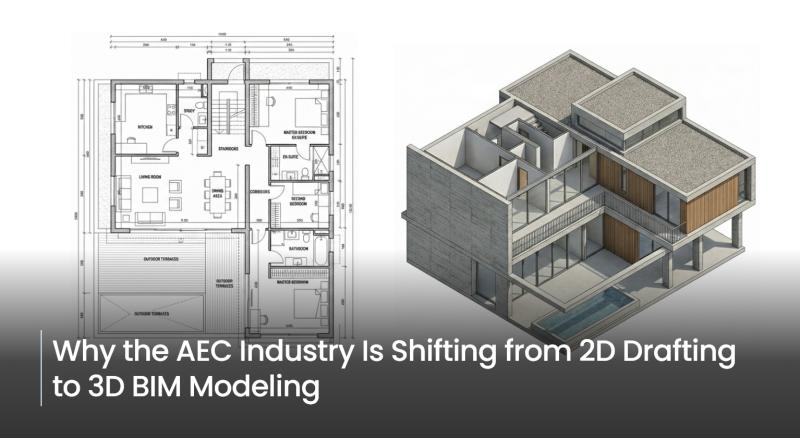
Architects, engineers, and other professionals in the AEC industry have faced numerous design challenges, ranging from complex projects to tight project deadlines. Traditionally, the AEC sector relied on manual methods that were time-consuming, prone to errors, and led to cost overruns, documentation difficulties, and more. These challenges were significant enough to alter the project's overall outcome. However, with key technologies and the adoption of innovation in the architecture and construction industry, professionals had the opportunity to improve efficiency and accuracy in the complex infrastructure design project. Nonetheless, it is evident to adopt the latest approach as it enables the AEC sector to remain ahead of the market and ensure seamless project outcomes as desired. Meanwhile, manual project processes cannot bring beneficial results for complex design obstacles.
While AEC professionals faced complex challenges with traditional methodologies, the gradual shift from paper sketches to digital screens enabled them to explore a more creative approach to design. This is where 2D CAD drafting played a crucial role for AEC experts, helping to minimize the traditional practice errors. 2D CAD drafting quickly became a powerful approach for AEC professionals, enhancing the overall construction process and ensuring design accuracy. With time and innovation, the AEC landscape slowly evolved into modern architecture, where demand for sleek, aesthetic designs grew.
As a matter of fact, AutoCAD in the architecture and construction industry marked a revolutionary shift in the drafting and design industries. It altered how experts work on architectural drawings, engineering design, and construction documents. As a vital CAD tool, AEC professionals leveraged the power of 2D CAD; however, they faced some limitations in complex designs. Although due to limitations, CAD plays a crucial role along with Revit BIM modeling services.
With that came 3D BIM modeling in the industry, transforming how architects, engineers, and other professionals plan and execute the project. This pushed professionals to shift from 2D drafting to 3D BIM modeling, which offered greater benefits, an efficient approach, and a significant solution to overcome CAD challenges. Let’s quickly understand in detail how 2D CAD has evolved into 3D BIM, its impact on the landscape, and its sheer importance.
Traditional Approach of 2D CAD Drafting to BIM
Architects, designers, engineers, and other professionals heavily relied on hand-drawn sketches or, in some cases, blueprints. These drawings were a key part of the beginning of any construction project, enabling experts to understand the project design. As a manual work process, it was prone to errors and consumed significant time, which were the key limitations in the modern AEC landscape. Therefore, with technological transformation, 2D CAD drafting methodology shifted experts from paper to the computer screen with AutoCAD as a major tool. As a matter of fact, 3D BIM models facilitate energy simulation and optimize green building performance to meet the current standards of the industry.
2D CAD drawings were technical and conveyed design ideas to architects and engineers. As a matter of fact, this transformation took a sharp turn in the architecture and construction industry, resulting in enhanced outcomes, improved workflow, and precise project completion. Although CAD drafting or 2D technical drawings came with some limitations, such as;
Visualization difficulties: Static 2D drawings often lead to miscommunication and make it hard for non-professionals to visualize the final product.
Coordination issues: Coordinating separate 2D plans (architectural, structural, MEP) is prone to errors and data repetition, requiring time-consuming manual checks.
Limited data: 2D drawings lack embedded intelligence and metadata about components (e.g., material type, cost, manufacturer data), which limits analysis and lifecycle management.
Rework and delays: Design errors and clashes are often found on-site, leading to costly rework, change orders, and project delays.
Despite these limitations, AEC experts sought novel ways to address the challenges. Here, the role of CAD to BIM modeling services becomes a significant practice for architects, designers, engineers, and other professionals. The industry's digital transformation has enabled BIM to deliver accuracy and efficiency, key to construction project success. Building information modeling is a comprehensive and strategic process that involves creating projects in a common digital format accessible to involved project experts.
This 3D model includes all the specific data, including the project's physical and functional characteristics. As 2D CAD drawings had their own limitations, Revit BIM modeling services enabled AEC professionals to enhance visualization, communication, coordination, and more. Explore in detail why AEC professionals adopt 2D to 3D BIM conversion.
Understanding the Importance of CAD to BIM Services Importance
The shift from 2D drafting to 3D BIM modeling in AEC (Architecture, Engineering, Construction) is a major digital transformation driven by Building Information Modeling (BIM) and advanced software, moving from flat drawings to intelligent, data-rich models that enhance visualization, collaboration, accuracy, and lifecycle management, though 2D remains relevant for specific uses.
This transition enables better clash detection, automated quantity takeoffs, improved facility management, and integrated workflows, replacing isolated CAD drawings with a holistic digital twin of the building. The following are some of the major key drivers & benefits of the shift
Data-Rich Models: 3D models contain comprehensive data (materials, costs, stages) beyond simple geometry, unlike traditional 2D CAD.
Enhanced Visualization: Realistic 3D models improve understanding and communication for all stakeholders, including clients.
Improved Collaboration: Cloud-based BIM platforms (such as BIM 360) enable real-time collaboration, breaking down silos.
Automation & Efficiency: AI and machine learning help audit models, detect errors (clashes), and automate design compliance.
Better Planning: Simulation of construction sequences, accurate material takeoffs, and cost estimation become more precise.
Lifecycle Management: Models serve as digital assets for future operations, maintenance, and renovations.
These are some of the major drivers for AEC professionals to shift from 2D drafting to 3D BIM modeling. Moreover, in the modern architecture and construction realm, sleek, sustainable, and efficient designs are in trend, where BIM accuracy enables successful project completion. Nonetheless, with advancing technology, 3D BIM services are more than just technology; they are an approach to enhancing efficiency, precision, coordination, and communication. CAD to BIM conversion is vital because 3D modeling offers improved visualization and a data-centric platform for making strategic decisions in the construction process. Above all, it offers significant advantages throughout the entire project lifecycle compared to traditional 2D drawings. From enhanced visualization to improved facility management, Revit BIM modeling goes a long way in the modern architecture and construction realm.
In the End
3D BIM modeling services have rapidly become a key industry standard after the transformation from paper to digital screens. 2D drafting to 3D BIM modeling isn't just a technological shift but a change in approach, workflow, and process, resulting in precise project outcomes.


Post Your Ad Here
Comments