AutoCAD vs. BIM: Key Differences Every Architect & Engineer Should Know
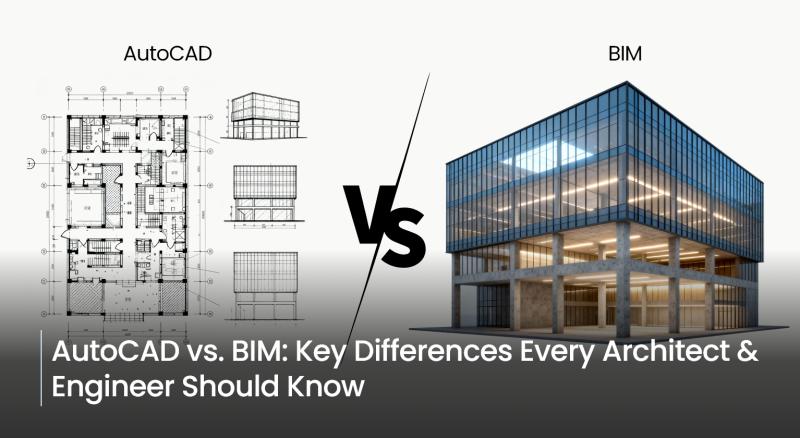
The architecture and construction landscape has undergone significant transformation over the years, resulting in a changed approach, workflow, and even outcomes. The increasing demand for modern architecture and sleek design, along with a sustainable approach, has become a key part of the AEC industry. Nonetheless, the evolving state has altered the approach for architects, engineers, and other professionals. Traditionally, in the AEC industry, every factor and every stage were manually processed. Over a period of time, technology has enhanced the way architects and designers execute projects, resulting in improved efficiency, accuracy, and overall process for construction projects.
This was made possible when professionals adopted the transition from paper sketches to computer screens, facilitated by revolutionary technology called CAD. Computer-aided design that transformed the working approach from paper sketches to screens in 2D and 3D views. This marked a turning point in the architecture and construction industry, enabling professionals to create high-quality and accurate building designs with precision. CAD services in the architecture and construction landscape have simplified the critical process of architecture, although they have their own limitations.
While the architecture industry was constantly evolving, it eventually underwent a revolution with the advent of Building Information Modeling (BIM). The industry was facing challenges with CAD services when BIM modeling enabled seamless, collaborative, precise, and efficient construction practices, leading to the overall success of the project. Architects, designers, engineers, and other professionals adopted this transition for complex infrastructure design. This was a transitional shift from AutoCAD to BIM services, enabling AEC experts to improve communication, collaboration, streamline workflows, and more.
Both concepts vary from each other; however, they play a crucial role in the AEC realm, helping with the design of simple to complex infrastructure. CAD provides a precise and efficient method for creating geometric designs. Whereas BIM modeling offers a 3D, data-rich model that enhances project outcomes and improves workflow efficiency. As technology is vital in the modern architectural landscape, there is a significant difference between AutoCAD and BIM that enables professionals to make informed decisions. Let’s thoroughly understand the difference and which technology is preferred by AEC experts.
AutoCAD and BIM Comparison
CAD, or computer-aided design, has revolutionized the architecture and construction industry, transitioning professionals from manual to digital methods. This particular concept is backed by powerful software known as AutoCAD. It is a renowned CAD program that eventually became a standard for the AEC industry. This particular program enables CAD drafters to create 2D and 3D models for precise architectural and mechanical projects, which can be quickly modified, easily shared, and utilized as generic construction documentation. Over the years, AutoCAD's limitations have become a challenge for AEC experts, especially in large and complex construction projects. Yet, today, this software is helpful in various industries, including civil engineering, architecture, and product design. Not just this, but AutoCAD 2D drafting offers multiple benefits, such as;
Accuracy
Flexibility
Compatibility
Foundation skills
Being a powerful tool, it had its own limitations for complex projects. Which is where building information modeling comes into play. Today, no AEC professional can imagine beginning a construction project without BIM. It goes beyond creating an intelligent, data-rich model, as it enables AEC professionals to facilitate the entire project lifecycle.
This makes it a powerful tool compared to AutoCAD for architects, engineers, and other professionals, due to a variety of benefits that make the BIM modeling approach smarter, more efficient, and more reliable. Here’s a brief description of the difference between BIM and AutoCAD that highlights key points for a better choice.
Core Function
AutoCAD: A computer-aided design (CAD) tool for creating precise 2D and 3D drawings and schematics.
BIM: A process for creating and managing intelligent, data-rich 3D models of a building's lifecycle.
Workflow
AutoCAD: Drawing-based, often used by individual designers or small teams.
BIM: 3D Model-based, facilitating simultaneous work and real-time updates for all project stakeholders.
Information
AutoCAD: Contains geometric data (lines, curves) with limited additional information.
BIM: Includes data on building components such as materials, performance characteristics, and maintenance schedules.
Collaboration
AutoCAD: Changes may need to be communicated manually, potentially leading to inconsistencies between drawings.
BIM: Allows multiple stakeholders to work on the same model, with changes reflected in all views automatically.
Project Lifecycle
AutoCAD: Primarily used for the design and documentation phase.
BIM: Supports the entire project lifecycle, from concept and design through construction and maintenance.
Error Detection
AutoCAD: Does not have automated error detection.
BIM: Has functions to detect clashes and errors based on set parameters before construction begins.
These are significant differences that make each technology unique in its core role and the right implementation of AutoCAD to BIM services. However, in modern architecture, where sleek, curvy, and complex designs are in high demand, BIM and Revit are much more preferable technologies to leverage for accurate outcomes. Explore why BIM software for designers, architects, and engineers is a preferable and potential choice for any construction project.
Why BIM is Considered for AEC Projects
The true power of BIM modeling lies in its intelligence. In AutoCAD, drawing a wall is just drawing four lines. In BIM software, such as Revit, drawing a wall means placing an intelligent object that recognizes it as a "wall." This object contains data such as material properties, thermal and structural properties, cost, and quantity data for the automatic creation of bills of materials and more. All this adds up to an intelligent, data-rich model for AEC professionals to execute their construction projects wisely. As discussed in the AutoCAD and BIM comparison, BIM 3D modeling offers greater leverage, efficiency, precision, and ease of managing the project lifecycle. The following are some of the benefits of BIM modeling that highlight the importance of adopting 3D BIM services.
1. Collaboration and Coordination (Clash Detection)
BIM allows all disciplines (architects, structural engineers, MEP engineers) to work on or refer to the same centralized model. This enables clash detection—the software can automatically flag when a duct is running through a structural beam or a pipe is interfering with an electrical conduit—before construction begins. This level of coordination is virtually impossible with separate 2D CAD files.
2. Project Lifecycle Management (4D/5D)
BIM extends its utility far beyond the design phase, following are:
4D BIM (Time): Linking the model to project schedules to visualize the construction sequence and timeline.
5D BIM (Cost): Automatic, highly accurate quantity take-offs and cost estimations generated directly from the model data. Changes update the cost in real-time.
6D/7D BIM (Sustainability/Facilities Management): Models can be used for energy performance analysis during design and then handed over to facility managers for maintenance planning and operation after construction.
3. Visualization and Simulation
While AutoCAD can produce 3D models, BIM's integrated models are inherently better for realistic visualization and performance analysis. AEC professionals can easily simulate daylighting, energy consumption, and structural integrity directly within the modeling environment, leading to more sustainable and efficient designs. Shifting from AutoCAD to BIM services proves to be a beneficial approach for today’s demand and achieving efficiency and accuracy at each stage.
Concluding Thoughts
AutoCAD and BIM are crucial approaches in the architecture and construction industry. For every construction project, efficiency and accuracy are paramount to project success. As each technology plays its individual role, BIM is the preferred choice among AEC professionals.



Post Your Ad Here
Comments