Comparing 3D, 4D, and 5D BIM Modeling: Benefits and Applications
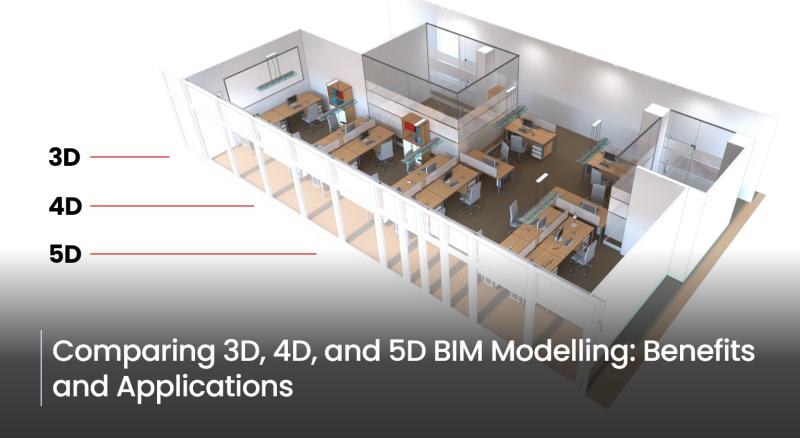
The AEC landscape is driven by technology, accuracy, and efficiency. Considering the growing significance and requirement of modern building design, architects and professionals look for novel ways. Efficiency and accuracy are the primary aspects of any construction project that measure the success of the project. It is highly important for AEC experts to ensure that every stage of the construction project is accurate and according to the design intent.
This is where building information modeling technology is leveraged for multiple uses. From digital representation of the project to managing facilities after the construction, BIM has become a mandatory aspect in the architecture and construction landscape. From the era of manual process to today's digital environment, architects, designers, engineers, and other professionals harness the power of BIM technology.
BIM modeling services have revolutionized the construction project by providing a comprehensive digital representation of the physical and functional characteristics of the infrastructure. BIM modeling consists of a variety of stages where information is added in each layer. The BIM model is rich in data that allows AEC experts to enhance collaboration, communication, and visualize the project briefly.
Typically, BIM technology begins with 3D modeling, known as 3D BIM modeling. To put it simply, building information modeling is a process of digital information to deliver, design, operate, and manage building projects. Due to significance and endless possibilities of benefits, it is increasingly becoming popular in the AEC realm.
However, BIM is not only about digital representation of the building; it also consists of various dimensions that offer intricate insights of the project to professionals. The variety of dimensions in the BIM project depicts the level of understanding and clarity that helps in the entire project lifecycle. As a matter of fact, these increasing dimensions offer structural data of the project, allowing professionals to make informed decisions and minimize the scope of errors. Let's briefly discuss BIM dimensions and various dimensions.
Understanding BIM Dimensions
The architecture and construction industry has undergone drastic changes in its approach, technologies, and ability to deliver accurate and efficient outcomes. Since manual processes in construction projects are usually time-consuming and prone to significant errors, a revolutionary leap came forward with BIM applications. Building information modeling brought drastic changes in designing, managing, and constructing the project, helping AEC professionals to streamline the complex process, enhance accuracy, efficiency, communication, and collaboration.
The 3D data-rich model offers specific insights for managing the complexities in construction. However, BIM is not only limited to 3D dimensions but extends up to 8D dimensions that provide users with detailed information of every stage in the project, facilitate seamless execution of design, and maintain utmost accuracy. Starting from 2D BIM, the range extends up to 8D, serving unique purposes and benefits.
The predefined specific purpose that includes parameters of the project is known as BIM dimensions. As a matter of fact, dealing with a variety of dimensions offers key insights and detailed information that not only enhances the quality of the project but also streamlines the complex workflow and brings desirable results. The BIM technology has evolved from 3D to BIM 4D to 5D and beyond.
This particularly enhanced the future of the AEC realm and offered the most precise construction outcomes. In any construction process, different stages offer different information; hence, 3D BIM modeling to 5D entails different purposes. Let's understand each in detail.
Exploring 3D to 5D BIM Modeling
Beginning from 2D BIM, these dimensions have a unique purpose, benefits, as well as applications. Every dimension provides insights into the project, including cost, schedule, timeline, and other information, enabling AEC professionals to make informed decisions and predict the approximate project completion time. As the dimension increases, the amount of information in the particular dimension is added to the previous.
For example, 4D BIM dimension information is further added into 5D BIM modeling that enhances the level of detail. This benefits architects, designers, engineers, and other professionals by enabling them to understand the completion of stages in a digital view. Since 2D models fall under CAD, let's begin with 3D BIM modeling services to 5D, along with benefits.
3D BIM: Dimensional Model
It is commonly used and represents three dimensions of building structure. This particularly helps to visualize the infrastructure in a 3D view before the project is built and allows stakeholders to collaborate effectively. The 3D BIM model acts as a central system for design data that is accessible through CDE, resulting in enhanced collaboration. Moreover, the 3D view allows AEC professionals to detect early clashes and resolve them within the model, which saves time, effort, labour, cost, and resources. Some of the 3D BIM benefits are;
Reduce rework
Saves time and cost
Enhanced 3D visualization
Streamlined communication
Seamless project execution
Better collaboration
4D BIM: Duration, Timeline, and Scheduling
In 4D BIM modelling, this involves planning the project on site by incorporating project scheduling. Typically, this helps in outlining the project completion timeline, from the installation of equipment in the infrastructure. As a matter of fact, project scheduling in BIM depicts the time needed to make the project operations, manage information status, and help in the entire life cycle of the project. The following are some of the perks of 4D BIM.
Seamless coordination between AEC professionals
Enhanced safety and efficiency
Specific timelines of the plan
Streamlined preparedness for next steps
Improve site planning
Optimized scheduling
5D BIM: Cost Estimation, Analysis, and Budget Tracking
This is the most vital dimension in the BIM project as it is useful in cases of budget analysis and cost estimation. Throughout the project, cost estimation with BIM aids in analyzing resource use and ensuring proper usage in the construction process. It aids in planning resource allocation beforehand, enabling professionals to manage budgets and project activities by predicting budgetary requirements, changes in scope, materials, manpower, and equipment. This allows them to stay prepared and ensure the project doesn't go over budget.
Minimize budget overshoot
Regular cost reporting
Real-time cost validation and visualization
Count of systems, components, and equipment
Simple cost analysis
Predicted time
The dimensions mentioned above are standard in BIM; however, they extend to 8D BIM, providing deeper and more detailed product insights. Moreover, this concept in building information technology shapes the future of the AEC market by offering budget visualization, streamlined process, cost analysis, facility management, and more.
Architects, engineers, designers, collaborators, and other professionals can seamlessly manage complex projects, including aspects such as completion timeline, resource allocation, and schedule optimization. Leveraging the power of BIM technology, AEC experts can significantly enhance the project outcome and stay ahead of the market curve while minimizing the scope of errors.
Final Thoughts
BIM modeling services deliver exceptional quality outcomes and ease the complexity in design, planning, managing, and execution. BIM dimensions allow professionals to make better decisions and streamline the process within the given timeline.




Post Your Ad Here
Comments (1)
Shivam7
Premium Baby Products in India
Comparing 3D, 4D, and 5D BIM Modeling: Benefits and Applications, Great