How Revit MEP Families Streamline Building Systems Design and Coordination
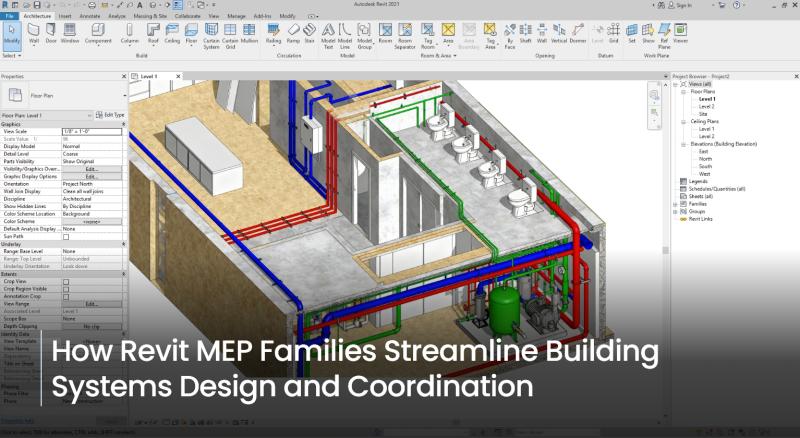
Digital transformation in the architecture and construction industry has revolutionized the way work is approached. Manual processes that required labour-intensive work, hand-drawn sketches, manual measurements, and more were prone to human error. This was a time-consuming and costly approach that slowly became a challenge in the AEC industry. As technology advanced, it reshaped the industry by eliminating traditional workflows through the introduction of building information modeling. BIM has become a go-to tool for modern construction projects due to various benefits. In the traditional approach, time-consuming methods led to terribly costly errors that also delayed project completion.
BIM technology has transformed workflows and processes for designers, architects, engineers, contractors, and other professionals. Every infrastructure is built differently; however, the construction framework remains the key aspect that allows the success of construction projects. Architectural, structural, and MEP are the aspects that are crucial for any building project, regardless of size, nature, or type.
Nonetheless, the architecture project is a complex approach that demands accuracy and efficiency in managing every aspect of construction to maintain safety. The most crucial aspect of any architecture project is MEP (mechanical, electrical, and plumbing), which requires seamless coordination, synchronization, and harmony among all disciplines and other infrastructure frameworks. With the help of building information modeling, MEP systems are well coordinated, which brings enhanced outcomes without any errors, clashes, or conflicts.
Although it isn't the only novel approach, MEP BIM modeling is a vast subject in the AEC field. To ensure components have the right and accurate elements in the 3D model, their role in Revit family creation services is a game-changer, enabling AEC professionals to precisely curate MEP components with precision and as per project requirements. As a matter of fact, MEP is the heart of any project, which is why it is important to maintain harmony and coordination.
BIM, as the most vital technology for modern architecture projects, MEP Revit families are a beneficial approach for ensuring the accuracy and efficiency of components. As a matter of fact, Revit MEP also brings various beneficial checklists, enabling the streamlining of the overall architecture project and coordination. Let's explore in more detail about building systems design and how it can enhance project coordination.
What are Revit MEP Families?
Revit is a powerful software tool that has transformed AEC professionals' workflows. It is a well-known BIM software that has become a go-to tool for architects and designers, as it enables the creation of detailed 3D models of infrastructure. Being an essential technology in the AEC realm, it offers numerous benefits. Although this isn't the only reason, Revit is BIM modeling software that also focuses on family creation for construction framework components, such as MEP Revit families, structural elements, and more. As a matter of fact, Revit MEP families are intelligent, parametric components of MEP in the 3D BIM model. This helps in coordinating different elements in the design layout, ensuring coordination and seamless workflow.
With the help of Revit MEP modeling, it is able to represent key building systems such as ducts, pipes, lighting fixtures, and mechanical equipment. Precision and collaboration are the key pillars of project success. These families are typically recognized as system families, loadable families, and in-place families. Revit MEP families are data-rich and coordinated across disciplines, allowing every AEC professional to curate precise, standardized layout designs without conflicts or errors. Some of the benefits of Revit family creation services are as follows;
Design efficiency
Streamline workflows
Enhanced collaboration
Better performance
Accuracy and efficiency
Flexibility and customization
Reduced errors
These are some of the significant advantages that depict the importance of the Revit MEP family. Moreover, these families streamline the design of infrastructure systems and help maintain coordination. Explore in detail how BIM MEP coordination is possible with the Revit family.
Coordination with Revit MEP Modeling
Revit family creation services streamline design by using intelligent, parametric components (like pipes, ducts, fixtures) that contain data, automatically updating across disciplines when changes occur, and enabling early, automated clash detection for better coordination between architects, structural, and MEP engineers, drastically reducing errors, rework, and improving project efficiency from concept to construction. As a matter of fact, MEP Revit family creation streamlines design in various novel ways.
Data-Rich & Parametric: Families aren't just geometry; they contain embedded data (dimensions, flow rates, power) and dynamically adjust to design changes, ensuring accuracy and consistency.
Automated Updates: Modifying a single part of a system (e.g., changing a duct size) automatically updates related components and eliminates manual adjustments.
Standardization: They enforce consistent component types, reducing human errors and ambiguity in design.
Accurate Modeling: Revit MEP Families accurately represent real-world objects, enabling precise sizing and material takeoffs for more accurate cost estimation.
Centralized Model: All MEP components, architectural, and structural elements are in a single BIM environment, providing visibility to all teams.
Intelligent Connections: Automated connectors ensure proper alignment for pipes, ducts, and electrical circuits, preventing misalignment.
Automated Clash Detection: The software identifies conflicts (e.g., a duct hitting a beam) early, allowing for resolution before construction.
Real-time Visibility: Teams can see how their systems integrate, resolve conflicts through walkthroughs, and ensure systems fit as intended.
Building system designs demands for precision and above all coordination is a key aspect for project success. Nonetheless, it ensures that AEC professionals can accurately design the layout without any conflict or error.
As technology advances in the architecture and construction sector, AI integration into the process has transformed how Revit families are created, managed, and optimized, improving overall project performance. The following are some benefits of integrating AI into Revit family creation services.
Automated family creation
Optimization of MEP routing
Early clash detection and resolution
Quality control scanning
This efficiently reduces rework scope and accelerates the modeling process, improving design performance and on-time delivery of the project. Due to the industry's significance, Revit creation demands expertise and knowledge to achieve the desired goals. Here, the comprehensive solution for AEC firms is to outsource Revit family creation.
Partnering with a reliable outsourcing service provider enables us to bring accurate solutions, cost-effective project efficiencies, business-aligned goals, and more. Outsourcing Revit MEP modeling has become an indispensable tool for accurate, coordinated building system design, as professionals optimize workflows and enhance project efficiency. The following are some of the key perks of outsourcing Revit Families;
Dedicated resources
On-time project delivery
Reduced errors
Collaboration across projects
Cost efficiency
Final Thoughts
Revit family creation services are a crucial aspect of AEC projects, ensuring efficiency, accuracy, and coordination in building design. MEP components are complex and require precise dimensions for the design layout. This reduces the complexity and rework, leading to successful project completion.

Post Your Ad Here
Comments