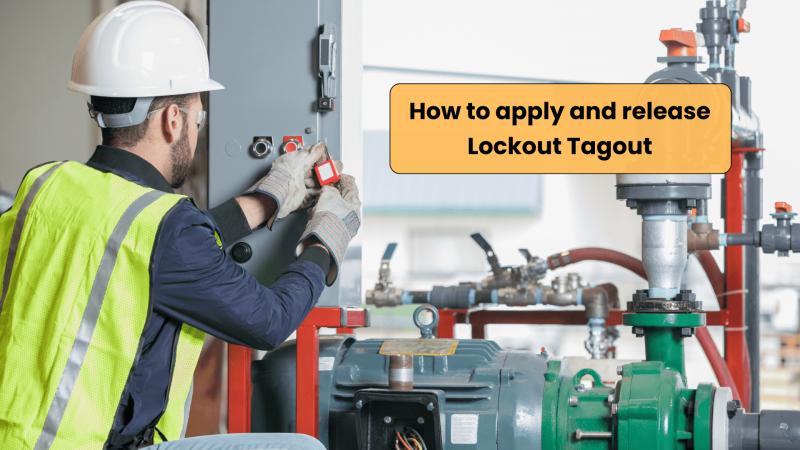
How to apply and release Lockout Tagout
In the wake of social, political, technical, and economic developments,
the significance of workplace safety and health, particularly Lockout Tagout,
has steadily and continually changed. Everybody has become aware of the
tremendous dangers associated with industrial machinery. For this reason, most
industrial machinery is built with safety features. Lockout tagout procedures
are a crucial component of a successful hazardous energy control programme and
are governed by OSHA CFR 1910.147 to maintain energy controls.
The Lockout Tagout regulation calls for the establishment and usage of
methods and procedures to turn off equipment, separate it from its energy
source(s), and stop the release of potentially harmful energy while maintenance
and servicing tasks are being carried out. Following systematic procedures to
release the Lockout Tagout devices from the machines is just as important as
its application. It includes specific guidelines for creating a successful
programme for the management of hazardous energy as well as basic performance
requirements. Employers, however, have the freedom to develop lockout tagout
procedures that are appropriate for their specific facilities.
How to Apply Lockout
Tagout:
Even the world's most comprehensive and in-depth written procedure won't
be beneficial if the user can't comprehend it. To simplify, ensure uniformity
in how equipment is labelled and processes are defined. Although OSHA
prescribes minimum requirements for companies to establish LockoutTagout procedures, every business can customise its own set of safety
procedures using the following LOTO safety steps -
Preparation for shut-down
Preparation is the key before beginning any procedure, especially when it comes to safeguarding people’s lives. Before starting the maintenance procedure, the authorised employee needs to -
- Analyse the work environment and conduct a risk analysis
- Identify which precautionary measures need to be implemented
- Notify all nearby employees
- Ascertain if the repair work requires Lockout
Turn-off machines
All the machines and equipment being maintained need to be turned off. While turning off machines, the authorised employee needs to keep in mind that -
· Every machine has written
shut-down steps
· All energy sources have
been shut-down
· Step-by-step established
procedures are used to shut-down machine
· Consult supervisors or
machine’s manual for guidance
Isolation
Energy isolation is a crucial part of the service system that
enables activities to be conducted safely and without unexpected loss of
control that might harm the surrounding environment of a facility,
employees or piece of equipment. The authorised employee must -
· Locate all the hazardous
energy sources
· Detect all energy isolating
devices in a machine
· Ensure all possible energy
sources have been isolated
· Follow proper procedures to
isolate the machine
LOTO application
Lockout Tagout devices like hasps, valve lockout, fuse lockout etc.,
along with padlocks and tags, need to be applied to energy isolating devices by
-
· Ensuring that every energy
isolating device has been locked out
· Applying the lockout device
according to the energy isolating point
· Tags should identify the
authorise employee applying the lock
· If multiple employees are
working, each worker needs to apply an individual padlock
Release store energy
Often, machines or equipment retain energy in the form of stored
electrical, mechanical, pneumatic, or potential energy. This needs to be
dissipated -
· By using proper systematic
steps
· After making sure the area
is clear of employees
· Secure moving equipment
· Render machine to zero
energy state if possible
Verification
This step of verifying that all energy has been isolated is frequently
overlooked or implemented incorrectly by the authorised employee.
· Make sure no employee is
present in or near the machine
· Can be done through visual
inspection, testing equipment or restarting by machine controls
· Procedure is deemed
successful if the machine does not start again
How to Remove LOTO:
After the maintenance has been completed, the authorised employee needs to restore the machine so normal production operations can continue. But this can also be a dangerous task if implemented carelessly, so before restarting the machine, the authorised employee must -
· Make sure he has removed
all the tools or scraps from the machine
· Check the work area and
notify employees about the resumption of operations
· Remove the Lockout Tagout
devices. The person who applied the padlock is the only one who should remove
it.
· Re-energise the machine and
restore the normal everyday operations of the machine
Conclusion
The foundation of a safety programme is the prediction, identification,
evaluation, and management of dangers that may arise in or from
the industry and endanger workers' health and well-being. LockoutTagout specifications that are more unique to a particular site,
location, or activity would need to be included in established procedures,
worker safety guidelines, manuals, handbooks, or unique standards. No matter
what position you hold within the company - whether you're a maintenance
worker, a health and safety representative, or the president - it helps to be
knowledgeable about these basic best practices for an efficient LOTO programme.
Post Your Ad Here
Comments