Challenges and Solutions in Testing Electric Drive Systems for New Energy Vehicles
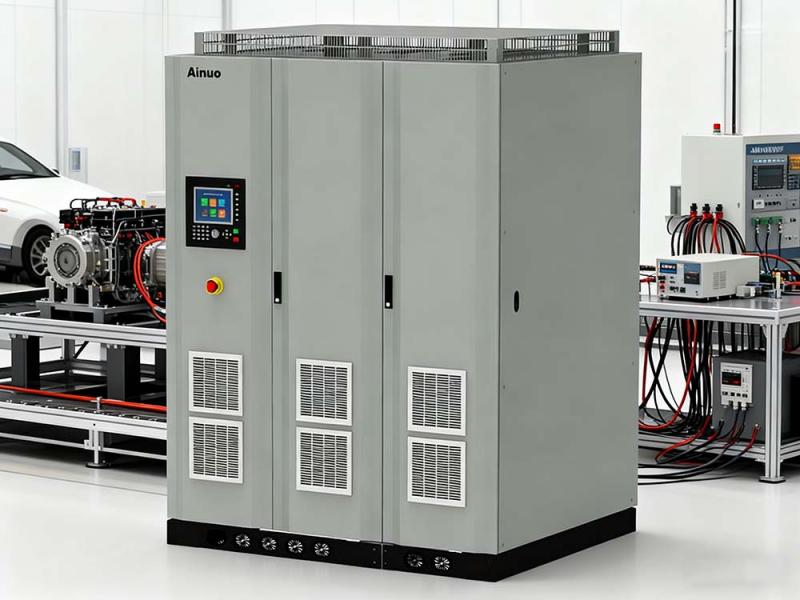
Using ordinary power supplies (typically standard industrial programmable DC power supplies or laboratory power supplies) to test the electric drive systems (motor + inverter + reducer) of new energy vehicles faces a series of fundamental limitations. These limitations can lead to inaccurate testing, failure to conduct tests, or even equipment damage.
Challenges
1. Severe Insufficient Power and Current Capacity
Huge Peak Power Gap: A typical electric drive
system boasts power outputs exceeding 100kW, with peak power reaching
200-300kW. Ordinary laboratory power supplies, however, typically operate at
tens of kilowatts, making it impossible to provide such massive power.
Inability to Meet
Instantaneous Current Requirements: During motor startup, acceleration, or
sudden load changes, the inverter requires an extremely large instantaneous
current (up to hundreds or even thousands of amperes). The current output
capability of ordinary power supplies is negligible in comparison, causing the
power supply to enter current-limiting or overload protection states, making
testing impossible.
Result: The actual operating
conditions of the electric drive system cannot be simulated, especially under
high load and high dynamic conditions.
2. Lack of Energy Recovery (Regeneration) Capability
A key characteristic of
electric drive systems in new energy vehicles is regenerative braking, where
the motor acts as a generator to charge the battery.
Ordinary power supplies are
"unidirectional": they can only output energy, not absorb it.
Testing Risk: When the
electric drive system is in generator mode, it generates reverse current, which
flows into the ordinary power supply. Most ordinary power supplies cannot
handle this reverse energy, potentially triggering overvoltage protection shutdown
or even permanently damaging the internal circuitry.
Result: No energy
recovery-related tests can be performed; test conditions are incomplete, and
there is a high risk of equipment damage.
3. Slow Dynamic Response Speed
The inverter in the electric
drive system operates using high-frequency PWM (Pulse Width Modulation), with
switching frequencies exceeding 10kHz. This means that the DC demand
fluctuates rapidly and drastically.
Ordinary Power
Susceptibility: The feedback loop and output capacitor design of ordinary power
supplies are intended to provide stable, clean DC power; their response speed
(typically in milliseconds) is far inferior to the microsecond-level current
changes required by the electric drive system.
Impact: This can cause a
significant drop or overshoot in the DC bus voltage, making it impossible to
maintain stability. This not only distorts test results but may also trigger
the undervoltage or overvoltage protection of the electric drive system itself,
leading to test interruption.
Result: It cannot accurately
simulate the transient characteristics of a battery in a real vehicle,
rendering dynamic performance tests invalid.
4. Output Characteristics Mismatch with Real Batteries
Batteries are not ideal
voltage sources; they have unique output characteristics.
Internal Resistance
Characteristics: Batteries have internal resistance, and their terminal voltage
decreases as the load current increases. Ordinary power supplies in constant
voltage mode strive to maintain a constant voltage, which does not match the actual
behavior of batteries.
Test Bias: Data such as
system efficiency and performance boundaries obtained using ideal voltage
sources deviate from actual vehicle conditions and are not accurate enough.
Result: Test data cannot
accurately reflect the performance of the electric drive system in a real
vehicle environment.
5. Cost and Reliability Issues
While a single high-power
ordinary power supply may be cheaper than professional testing equipment,
multiple power supplies often need to be used in parallel to achieve sufficient
power, which increases system complexity and cost. More importantly, forcing a power supply under incompatible conditions will significantly reduce its
reliability and shorten its lifespan.
What is a professional solution?
To address these limitations,
the industry commonly uses "battery simulators" or "feedback
grid simulators."
These professional devices
have the following key characteristics:
Bidirectional energy flow: They can act as a source to
power the electric drive system and as a sink to absorb energy fed back from
the electric drive system, feeding it back to the grid, resulting in energy
savings and high efficiency.
High power and high dynamic
response:
Designed specifically for power electronics testing, with power reaching
megawatt levels and extremely fast dynamic response (<100μs), accurately
simulating transient battery conditions and DC bus voltage fluctuations.
Simulated battery
characteristics:
Programmable to simulate battery V-I (voltage-current) curves at different SOC
(state of charge) and temperatures, making the testing environment closer to
reality.
In Summary
Testing the electric drive
system of a new energy vehicle using a conventional power supply is like
testing a car headlight with a single AA battery—although both provide power in
principle, there are orders of magnitude differences in power, energy flow, and
dynamic performance, making it completely unsuitable for core testing
requirements and extremely risky. For the development and verification of
electric drive systems, a professional bidirectional DC power supply/battery
simulator is an indispensable testing tool.
Post Your Ad Here
Comments