How Comprehensive Electrical Safety Analyzer Improve the Efficiency of a Home Appliance Production Line?
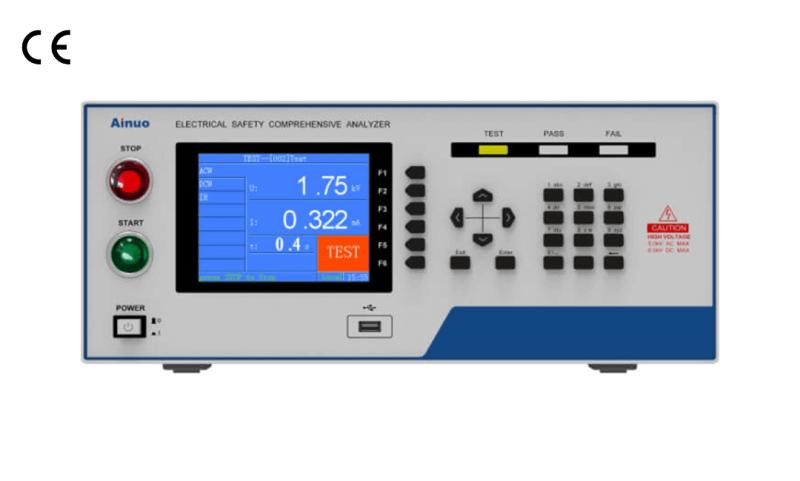
In home appliance production
lines, safety testing is an essential process, a key link in improving overall
production efficiency, reducing costs, and ensuring product quality. Using a
comprehensive electrical safety tester instrument is one of the most crucial and direct
means to improve production line testing efficiency. So, how does a
comprehensive safety testing instrument improve the efficiency of a home
appliance production line?
The High-Efficiency Characteristics of the Comprehensive Electrical Safety Analyzer itself
First, it's important to
understand its inherent efficiency advantages compared to traditional
stand-alone instruments:
One-button sequence testing:
This is the core function. All safety testing items (withstand voltage,
insulation, grounding, leakage current, power, etc.) are programmed into a test
sequence, which can be automatically completed with the press of a single
button. This eliminates the time spent manually switching instruments and
changing wiring.
Integration and space saving:
One device replaces multiple devices, making the testing station layout more
compact and reducing cable clutter and equipment maintenance points.
Rapid measurement technology:
Modern comprehensive testing instruments use high-speed sampling and signal
processing technology, resulting in extremely short single-test times (for
example, grounding resistance testing may only take tens of milliseconds).
Built-in Judgment Criteria:
Upper and lower limits for various tests can be preset, and test results are
automatically judged as "PASS" or "FAIL," eliminating human
error.
How to Configure and Operate to Improve Efficiency
1. Programmed Management and Quick Recall
Pre-store Test Programs for
All Product Models:
Pre-set the corresponding test programs (including all test parameters,
standards, and sequences) for each product model on the production line in the
tester's memory or connected computer.
Achieve Quick Recall
Optimal Method - Barcode
Scanning: Equip the workstation with a barcode scanner. The operator scans the
product barcode, and the tester automatically recalls the corresponding test
program. This is the fastest and most error-proof method.
Secondary Method-Program
Number: The operator recalls the program by entering a several-digit program
number via the instrument panel or knob. Faster than manually setting
parameters, but slower than barcode scanning.
2. Optimized Test Interface and Connection
Use Dedicated Test
Fixtures/Tooling: This is key to achieving a qualitative leap.
- A dedicated test fixture is designed and manufactured for each product, integrating all necessary probes (such as L/N/PE terminals and metal housing probes).
- Simplified Operation: The operator simply places the product into the fixture or plugs in a multi-functional connector; all electrical connections are completed in one step. This eliminates the tedious and error-prone manual wiring process, significantly reducing operator skill requirements and increasing speed several times over.
3. Integrated Automation and Data Management
- Production
Line Integration
- Automatic Start: Through a PLC or sensor, once the product is pushed to the test station and positioned, a start signal is automatically sent to the tester to begin testing.
- Result Output: After testing,
the tester outputs a "PASS/FAIL" signal. This signal can be used to:
- Trigger green/red indicator lights.
- Drive a pneumatic mechanism to push qualified products to the next station and unqualified products to the rework area.
- Control the start and stop of the production line.
- Data
Recording and Traceability
- All test results (including specific values, timestamps, product serial numbers, and operator IDs) are uploaded in real-time to the MES (Manufacturing Execution System) or database via RS232, LAN, or GPIB interfaces.
- Efficiency Benefits
- Paperless: Completely replaces manual recording, saving time.
- Rapid Diagnosis: When a test fails, maintenance personnel can immediately see detailed data on the computer (e.g., "Grounding resistance 0.25Ω, exceeding the standard"), rather than a simple "FAIL" indicator light, thus quickly locating whether the problem lies with the cable, connector, or internal connection.
- Statistical Analysis: By analyzing the data, "chronic problems" on the production line can be discovered, such as a batch of power cords with generally high grounding resistance, allowing tracing back to supplier issues, reducing the defect rate at the source, and indirectly improving testing efficiency (because fewer failed products).
Implementation Process and Best Practices
Requirements Analysis and Selection
- Identify the items to be
tested (ACW/DCW, IR, GB, LL, etc.).
- Determine the required test
voltage, current, and accuracy range.
- Select a model with
sequential testing capabilities and abundant I/O interfaces (for automation).
Program Design and Verification
- Work with R&D/Quality
departments to strictly adhere to product safety standards when setting each
test parameter.
- Perform thorough verification
of the program in the laboratory to ensure accuracy.
Workstation Design and Integration
- Design efficient, ergonomic
workstations, rationally arranging the tester, barcode scanner, test fixtures,
and indicator lights.
- Work with production and
equipment departments to complete integration with the production line PLC and
data system.
Personnel Training and SOP Development
- Train operators to master
basic operation of the new equipment (mainly barcode scanning and product
placement).
- Train maintenance and quality
control personnel on how to interpret test results and handle common faults and
alarms.
- Develop standard operating
procedures (SOPs).
Summary
The comprehensive electrical safety
tester is a powerful tool in itself, but it must be deeply integrated with
barcode systems, dedicated test fixtures, data management systems, and
production lines to fully unleash its potential for efficiency improvement and
achieve the transformation from "measurement" to "efficient
process control".
Post Your Ad Here
Comments