Weather Forecasting Services Market Size, Share & Growth Analysis 2026-2034
Market Overview:
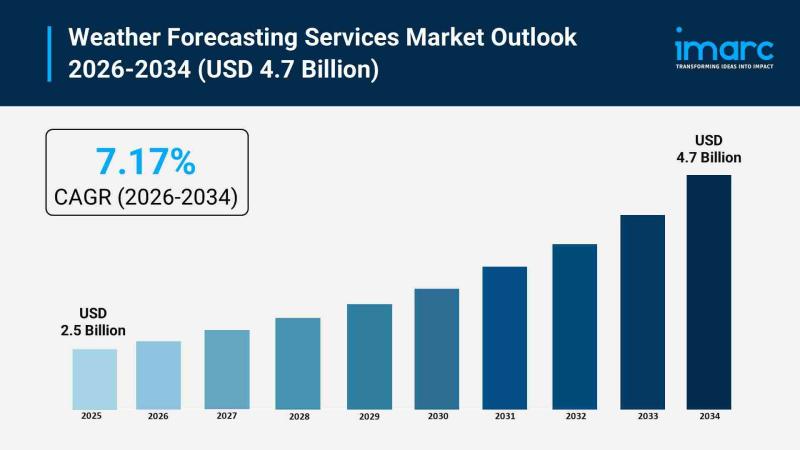
The weather forecasting services market is experiencing rapid growth, driven by intensifying climate volatility and disaster resilience, integration of high-performance ai-driven modeling, and expanding operational dependency in commercial sectors. According to IMARC Group's latest research publication, "Weather Forecasting Services Market Size, Share, Trends and Forecast by Forecasting Type, Purpose, Organization Size, End User, and Region, 2026-2034", the global weather forecasting services market size was valued at USD 2.5 Billion in 2025. Looking forward, IMARC Group estimates the market to reach USD 4.7 Billion by 2034, exhibiting a CAGR of 7.17% from 2026-2034.
This detailed analysis primarily encompasses industry size, business trends, market share, key growth factors, and regional forecasts. The report offers a comprehensive overview and integrates research findings, market assessments, and data from different sources. It also includes pivotal market dynamics like drivers and challenges, while also highlighting growth opportunities, financial insights, technological improvements, emerging trends, and innovations. Besides this, the report provides regional market evaluation, along with a competitive landscape analysis.
Download a sample PDF of this report: https://www.imarcgroup.com/weather-forecasting-services-market/requestsample
Our report includes:
- Market Dynamics
- Market Trends and Market Outlook
- Competitive Analysis
- Industry Segmentation
- Strategic Recommendations
Growth Factors in the Weather Forecasting Services Market
- Intensifying Climate Volatility and Disaster Resilience
The escalating frequency and severity of extreme weather events, such as hurricanes, wildfires, and catastrophic flooding, serve as a primary catalyst for the expansion of the weather forecasting services sector. In 2024 alone, the United States experienced 27 separate weather-related disasters that each exceeded $1 billion in damages, with total agricultural losses in Texas surpassing $3.4 billion for the third consecutive year. To mitigate these multi-billion-dollar economic disruptions, government agencies like the National Oceanic and Atmospheric Administration (NOAA) are aggressively modernizing their infrastructure to transition from assumption-based risk models to evidence-based scientific analysis. These initiatives are bolstered by United Nations and World Meteorological Organization reports indicating that impact-based early warning systems can reduce disaster-related damage by up to 30% with only 24 hours of notice. Consequently, public and private sectors are prioritizing investments in high-resolution predictive modeling to strengthen national resilience and safeguard critical infrastructure.
- Integration of High-Performance AI-Driven Modeling
A fundamental shift in forecasting methodology is currently underway as the industry moves from traditional physics-based simulations to hyper-efficient artificial intelligence and machine learning architectures. Organizations are deploying groundbreaking tools like the Artificial Intelligence Global Forecast System (AIGFS), which generates comprehensive 16-day forecasts using only 0.3% of the computational resources required by legacy systems. This technological leap allows for the delivery of critical guidance in roughly 40 minutes, significantly reducing the latency that previously hindered rapid response. Major technology firms are also contributing to this growth by introducing open-stack ecosystems that provide pre-trained models to national meteorological agencies and startups alike. By drastically lowering the barrier to entry for high-fidelity climate science, these AI-driven platforms enable a wider range of participants to build sovereign, local forecasting systems. This democratization of data ensures that even resource-constrained regions can access sophisticated meteorological insights to protect life and property.
- Expanding Operational Dependency in Commercial Sectors
The commercial landscape is witnessing an unprecedented reliance on precise weather intelligence to optimize supply chains and manage operational risks across diverse industries. Within the logistics and transportation sector, weather is responsible for 23% of all roadway delays, costing trucking companies between $2.2 billion and $3.5 billion annually due to lost vehicle hours. To combat these losses, large enterprises are increasingly adopting tailored weather services that provide real-time updates on fog, ice, and flood conditions to adjust routes dynamically. Similarly, the energy sector’s transition toward renewable sources like wind and solar has created a critical need for specialized forecasts to manage grid load fluctuations and anticipate generation variability. Agriculture also represents a massive growth vertical, as farmers utilize precision data to make real-time decisions regarding irrigation and fertilization. This deep integration of meteorological data into the core workflows of global industries ensures sustained demand for high-resolution, sector-specific forecasting solutions.
Key Trends in the Weather Forecasting Services Market
- The Rise of Hyperlocal "Nowcasting" for Urban Safety
Urban centers and smart city planners are increasingly adopting "nowcasting" services to manage short-term, localized weather events that impact public safety and municipal infrastructure. Unlike traditional regional forecasts, these services provide high-resolution data for specific city blocks or transport hubs within a window of one to three hours. Real-world applications include the use of IoT-enabled weather stations and ground-based sensors to detect micro-scale phenomena such as hail, sudden wind gusts, or flash flooding. In 2026, many local marine zones are expanding their monitoring reaches to 60 nautical miles offshore to better protect coastal urban populations. Municipalities leverage this granular data to automate flood prevention systems and coordinate emergency services with pinpoint accuracy. This trend is particularly evident in Europe, where integrated weather intelligence is being embedded into digital twins of cities to simulate how extreme heat or rain will affect specific buildings and transit networks.
- Democratization of Climate Science Through Open-Source AI
A significant shift toward transparency and collaboration is occurring as major technology players release open-source AI weather and climate prediction stacks. New architectures such as Atlas and StormScope are now accessible to independent researchers and tech startups via platforms like GitHub and Hugging Face, allowing them to predict over 70 different weather variables including pressure, humidity, and wind speed. This move toward an "open stack" environment allows nations to develop their own sovereign forecasting systems without the need for the massive, multi-million-dollar supercomputers historically owned only by the wealthiest governments. By utilizing these foundational building blocks, smaller entities can fine-tune global models with local data to create highly accurate, regionalized weather products. This collaborative ecosystem is accelerating the pace of innovation, as a global community of developers can now contribute to the refinement of ensemble-based models and atmospheric observational platforms simultaneously.
- Automated Weather-Responsive Smart Environments
The integration of real-time weather data into the Internet of Things (IoT) is transforming residential and commercial buildings into autonomous, weather-responsive environments. Advanced forecasting services are no longer just delivering information to screens; they are feeding directly into smart thermostats, automated irrigation systems, and weather-responsive windows. For example, a smart home can now proactively adjust its heating and lighting systems in anticipation of an approaching heatwave or storm, rather than reacting after the temperature has already shifted. In the entertainment and sports sectors, event organizers use lightning detection systems and real-time precipitation sensors to automate safety protocols for marathons and music festivals. This transition from passive information to active decision support allows for a more sustainable and convenient lifestyle, where infrastructure adapts to the atmosphere automatically. This trend emphasizes the growing role of weather data as a fundamental utility for modern, climate-resilient living.
Leading Companies Operating in the Global Weather Forecasting Services Industry:
- AccuWeather, Inc.
- AEM
- Climavision
- CustomWeather, Inc.
- DTN
- Pelmorex
- Spire Global
- StormGeo
- The Tomorrow Companies Inc.
- The Weather Company LLC
- Vaisala
Weather Forecasting Services Market Report Segmentation:
By Forecasting Type:
- Short-range Forecasting
- Medium-range Forecasting
- Long-range Forecasting
Medium-range forecasting leads the market with 29.6% share in 2024, balancing accuracy and planning needs for sectors like agriculture, aviation, logistics, and energy, covering three to ten days.
By Purpose:
- Operational Efficiency
- Safety
- Others
Operational efficiency driven by industries aiming to streamline processes and reduce costs through accurate weather forecasts, enhancing productivity in agriculture, logistics, and energy.
By Organization Size:
- Large Enterprises
- Small and Medium-Sized Enterprises
Large enterprises dominate with 71.2% market share in 2024, requiring high-precision forecasts for critical operations across various sectors, investing in advanced weather monitoring technologies.
By End User:
- Transportation
- Aviation
- Energy and Utilities
- Banking, Financial Services and Insurance (BFSI)
- Agriculture
- Media
- Manufacturing
- Retail
- Others
Transportation utilizes weather forecasts for route optimization and safety, minimizing delays and accidents through proactive adjustments.
Regional Insights:
- North America (United States, Canada)
- Asia Pacific (China, Japan, India, South Korea, Australia, Indonesia, Others)
- Europe (Germany, France, United Kingdom, Italy, Spain, Russia, Others)
- Latin America (Brazil, Mexico, Others)
- Middle East and Africa
North America holds the largest market share at 28.9% in 2024, driven by technological advancements and reliance on accurate weather data across key industries like aviation and agriculture.
Note: If you require specific details, data, or insights that are not currently included in the scope of this report, we are happy to accommodate your request. As part of our customization service, we will gather and provide the additional information you need, tailored to your specific requirements. Please let us know your exact needs, and we will ensure the report is updated accordingly to meet your expectations.
About Us:
IMARC Group is a global management consulting firm that helps the world’s most ambitious changemakers to create a lasting impact. The company provide a comprehensive suite of market entry and expansion services. IMARC offerings include thorough market assessment, feasibility studies, company incorporation assistance, factory setup support, regulatory approvals and licensing navigation, branding, marketing and sales strategies, competitive landscape and benchmarking analyses, pricing and cost research, and procurement research.
Contact Us:
IMARC Group
134 N 4th St. Brooklyn, NY 11249, USA
Email: sales@imarcgroup.com
Tel No:(D) +91 120 433 0800
United States: +1-201971-6302
Post Your Ad Here
Comments