Commercial Kitchen Appliances Market Size, Growth, and Forecast 2026-2034
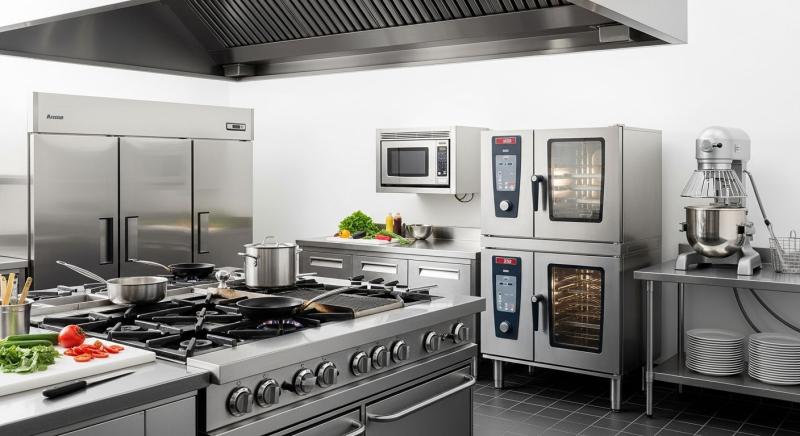
Market Overview:
The commercial kitchen appliances market is experiencing rapid growth, driven by expansion of the foodservice and hospitality sector, rise of cloud kitchens and delivery-only models, and focus on energy efficiency and sustainability. According to IMARC Group's latest research publication, "Commercial Kitchen Appliances Market Size, Share, Trends and Forecast by Type, Distribution Channel, Application, and Region, 2026-2034", The global commercial kitchen appliances market size was valued at USD 109.2 Billion in 2025. Looking forward, IMARC Group estimates the market to reach USD 166.3 Billion by 2034, exhibiting a CAGR of 4.75% during 2026-2034.
This detailed analysis primarily encompasses industry size, business trends, market share, key growth factors, and regional forecasts. The report offers a comprehensive overview and integrates research findings, market assessments, and data from different sources. It also includes pivotal market dynamics like drivers and challenges, while also highlighting growth opportunities, financial insights, technological improvements, emerging trends, and innovations. Besides this, the report provides regional market evaluation, along with a competitive landscape analysis.
Download a sample PDF of this report: https://www.imarcgroup.com/commercial-kitchen-appliances-market/requestsample
Our report includes:
- Market Dynamics
- Market Trends and Market Outlook
- Competitive Analysis
- Industry Segmentation
- Strategic Recommendations
Growth Factors in the Commercial Kitchen Appliances Market
- Expansion of the Foodservice and Hospitality Sector
The most significant driver is the continuous expansion of the global foodservice industry, encompassing quick-service restaurants (QSRs), full-service restaurants (FSRs), and the growing hospitality sector, which includes hotels and resorts. For instance, QSRs alone accounted for a substantial 33.56% share of the industry's revenue demand in 2024, emphasizing their importance as key purchasers of high-volume cooking and refrigeration equipment. This demand is further intensified by rising international and domestic tourism, which prompts hotels and catering services to upgrade their kitchen facilities to accommodate varied culinary requirements and high-capacity needs. Major chains often implement standardized build-outs, requiring routine refreshment and replacement of their current appliance inventory with the latest, more efficient models. This ongoing investment cycle in new establishments and modernization projects across the sector fuels consistent industry growth.
- Rise of Cloud Kitchens and Delivery-Only Models
The proliferation of cloud kitchens, also known as ghost kitchens or virtual restaurants, represents a high-growth application segment for commercial appliance manufacturers. These delivery-focused operations are projected to experience the fastest growth rate among end-users, underscoring a significant shift in the market structure. Cloud kitchens require specialized, compact, and high-throughput appliances, such as modular combi ovens and heated holding cabinets, which are crucial for maintaining food quality during the final stages before courier pickup. The business model prioritizes speed and efficiency with less emphasis on a customer-facing area, driving demand for equipment specifically designed for rapid, high-volume production in smaller footprints. This new application is creating fresh demand for dedicated equipment, independent of traditional restaurant construction, thus accelerating market expansion.
- Focus on Energy Efficiency and Sustainability
Strict global and regional energy efficiency standards are compelling foodservice operators to replace older, less efficient equipment with modern, sustainable appliances. This regulatory pressure, combined with rising energy costs, makes financially efficient and energy-proficient items highly desirable. For example, a major revenue segment like commercial refrigeration, which held a 36.21% share in 2024, is heavily influenced by the global phase-down of high-Global Warming Potential (GWP) coolants, necessitating timely replacement with systems using natural refrigerants. Government bodies often set energy consumption benchmarks, prompting manufacturers to innovate with features like smart sensors that cut down water and power use in prep tables and dishwashers, strengthening the return on investment (ROI) for operators. This mandatory and economic shift towards green equipment is a powerful, non-cyclical factor driving sales.
Key Trends in the Commercial Kitchen Appliances Market
- Integration of IoT and Smart Automation
A significant emerging trend is the pervasive integration of the Internet of Things (IoT) and smart automation into commercial kitchen equipment. This transformation goes beyond simple connectivity, with appliances being developed to increase operational efficiency and consistency. Concrete examples include connected combi ovens and programmable fryers that can be monitored and controlled remotely, simplifying workflows and reducing the need for constant human supervision. The cooking appliances segment is witnessing high growth, partially because labor shortages are pushing kitchens towards these automated solutions, as programmable fryers capable of producing high volumes of product per hour free up staff for other tasks. This technological shift is turning commercial kitchens into data-driven facilities, with smart appliances providing real-time data on maintenance needs and energy consumption.
- Demand for Multi-Functional and Compact Units
The trend toward smaller kitchen footprints, driven by the real estate costs for new restaurants and the rise of space-constrained cloud kitchens, is fueling demand for multi-functional and compact appliances. Operators are increasingly favoring versatile units that can perform multiple cooking tasks, thereby maximizing limited kitchen space and optimizing equipment investment. A prime example is the growing popularity of modular combi ovens, which combine the functions of a convection oven, steam cooker, and often a grill, all in one unit. The demand for such space-saving solutions is particularly strong in Asia-Pacific, the fastest-growing region, where rapidly expanding domestic food service markets and urbanization require efficient, high-density cooking lines. This focus on multi-utility equipment directly addresses the operational constraints of modern commercial settings.
- Customization and Personalization of Equipment
The market is seeing an increasing trend toward highly customized and personalized appliance solutions, moving away from off-the-shelf equipment. This involves designing specific configurations and integrating bespoke features to match the unique menu, volume, and workflow of individual foodservice operations. Manufacturers are collaborating closely with restaurant groups, particularly QSR chains, to develop appliances tailored to their proprietary food preparation methods and speed requirements. For instance, a major coffee chain might commission a customized oven designed to perfectly heat their specific food items consistently across all locations. This trend ensures appliances are perfectly optimized for the operator’s exact needs, enhancing brand-specific food quality and reducing waste. Furthermore, manufacturers are responding to consumer demand for aesthetics and personalization by offering different colors, finishes, and modular designs.
Leading Companies Operating in the Global Commercial Kitchen Appliances Industry:
- Alto-Shaam Inc.
- American Range Corporation
- Carrier Global Corporation
- Duke Manufacturing Company
- Electrolux AB
- G.S. Blodgett Corporation (The Middleby Corporation)
- Hamilton Beach Brands Inc.
- Hoshizaki Corporation
- Interlevin Refrigeration Ltd.
- MEIKO Maschinenbau GmbH & Co. KG
- The Vollrath Company LLC
- True Manufacturing Co. Inc.
Commercial Kitchen Appliances Market Report Segmentation:
By Type:
- Refrigerators
- Cooking Appliances
- Cooktop and Cooking Ranges
- Ovens
- Dishwashers
- Others
Refrigerators lead the market in 2024 with 16.8% share, valued for their ability to keep food fresh, energy efficiency, and customizable capacities.
By Distribution Channel:
- Offline
- Online
Offline sales dominate with 78.7% market share, driven by product availability, customer experience enhancements, and the ability to test products before purchase.
By Application:
- Quick Service Restaurant (QSR)
- Railway Dining
- Institutional Canteen
- Resort and Hotel
- Hospital
- Full Service Restaurant (FSR)
- Others
Quick Service Restaurants (QSR) capture 30.2% market share, focusing on quick service, minimal preparation, menu innovation, and competitive pricing.
Regional Insights:
- North America (United States, Canada)
- Asia Pacific (China, Japan, India, South Korea, Australia, Indonesia, Others)
- Europe (Germany, France, United Kingdom, Italy, Spain, Russia, Others)
- Latin America (Brazil, Mexico, Others)
- Middle East and Africa
North America holds over 35.0% market share, fueled by the growing number of food establishments and the adoption of advanced kitchen appliances for efficiency and reduced waste.
Note: If you require specific details, data, or insights that are not currently included in the scope of this report, we are happy to accommodate your request. As part of our customization service, we will gather and provide the additional information you need, tailored to your specific requirements. Please let us know your exact needs, and we will ensure the report is updated accordingly to meet your expectations.
About Us:
IMARC Group is a global management consulting firm that helps the world’s most ambitious changemakers to create a lasting impact. The company provide a comprehensive suite of market entry and expansion services. IMARC offerings include thorough market assessment, feasibility studies, company incorporation assistance, factory setup support, regulatory approvals and licensing navigation, branding, marketing and sales strategies, competitive landscape and benchmarking analyses, pricing and cost research, and procurement research.
Contact Us:
IMARC Group
134 N 4th St. Brooklyn, NY 11249, USA
Email: sales@imarcgroup.com
Tel No:(D) +91 120 433 0800
United States: +1-201971-6302
Post Your Ad Here
Comments