Food Safety Testing Market Size, Share & Growth Analysis 2026-2034
Market Overview:
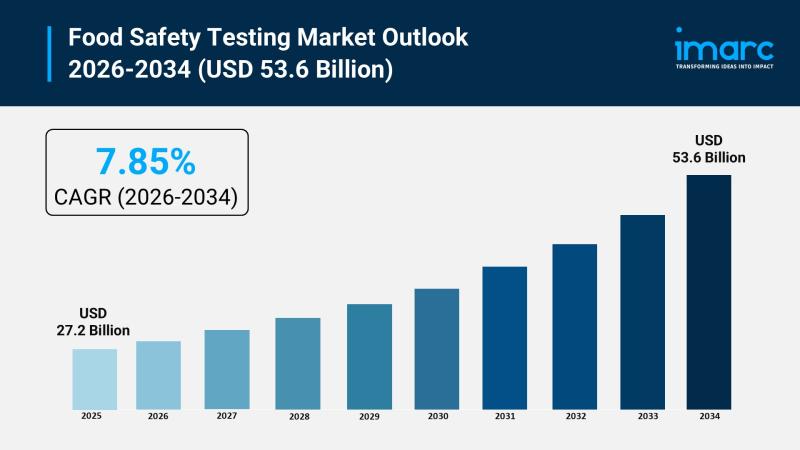
The food safety testing market are experiencing rapid growth, driven by stringent global regulatory frameworks, escalating demand for convenience and processed foods, and globalization of the food supply chain. According to IMARC Group's latest research publication, "Food Safety Testing Market Size, Share, Trends and Forecast by Type, Food Tested, Technology, and Region, 2026-2034", The global food safety testing market size was valued at USD 27.2 Billion in 2025. Looking forward, IMARC Group estimates the market to reach USD 53.6 Billion by 2034, exhibiting a CAGR of 7.85% from 2026-2034.
This detailed analysis primarily encompasses industry size, business trends, market share, key growth factors, and regional forecasts. The report offers a comprehensive overview and integrates research findings, market assessments, and data from different sources. It also includes pivotal market dynamics like drivers and challenges, while also highlighting growth opportunities, financial insights, technological improvements, emerging trends, and innovations. Besides this, the report provides regional market evaluation, along with a competitive landscape analysis.
Download a sample PDF of this report: https://www.imarcgroup.com/food-safety-testing-market/requestsample
Our report includes:
- Market Dynamics
- Market Trends and Market Outlook
- Competitive Analysis
- Industry Segmentation
- Strategic Recommendations
Growth Factors in the Food Safety Testing Market
- Stringent Global Regulatory Frameworks
The primary driver for market expansion is the implementation of rigorous food safety laws and mandatory compliance standards across major economies. In the United States, the Food and Drug Administration (FDA) has modernized its oversight through the Food Safety Modernization Act (FSMA), which emphasizes preventive controls rather than just responding to contamination. Similarly, the European Food Safety Authority (EFSA) maintains some of the world's strictest limits on pesticides and veterinary drug residues. Government bodies are also intensifying inspections; for instance, the Food Safety and Standards Authority of India (FSSAI) recently deployed mobile food testing labs to ensure hygiene at large-scale public gatherings. These regulatory pressures force food manufacturers to invest in continuous testing to avoid heavy fines and ensure their products meet international export standards, effectively making safety testing a non-negotiable operational cost.
- Escalating Demand for Convenience and Processed Foods
The global shift toward urbanization and fast-paced lifestyles has led to a massive increase in the consumption of packaged, ready-to-eat, and frozen food products. These items often undergo complex multi-stage processing, which significantly increases the risk of microbial contamination or the accidental inclusion of undeclared allergens. For example, the meat, poultry, and seafood segment accounts for a substantial portion of the market revenue due to its high susceptibility to pathogens like Salmonella and Listeria. To mitigate these risks, large-scale processors are integrating high-throughput testing systems directly into their production lines. Current industry data indicates that microbiological testing leads the market in revenue share, as companies strive to verify the safety of processed goods before they reach retail shelves, thereby protecting brand reputation and reducing the frequency of costly product recalls.
- Globalization of the Food Supply Chain
As food products increasingly cross international borders, the complexity of supply chains creates numerous points where contamination or food fraud can occur. A single food item might contain ingredients sourced from multiple continents, requiring standardized testing protocols to ensure safety at every transition. This globalization has prompted companies to adopt international safety standards such as ISO 22000 and HACCP. Leading testing firms like Eurofins Scientific and SGS have expanded their global laboratory networks to provide localized testing services that align with both regional and international requirements. The need to detect chemical pollutants, heavy metals, and genetically modified organisms (GMOs) in imported goods has turned food safety testing into a critical component of global trade logistics, ensuring that products originating in one region meet the specific health and safety criteria of the destination market.
Key Trends in the Food Safety Testing Market
- AI-Driven Predictive Diagnostics
The integration of Artificial Intelligence (AI) is transitioning the industry from traditional "test-and-react" methods to predictive safety modeling. AI algorithms now analyze vast datasets, including historical contamination patterns, weather conditions affecting crop growth, and real-time sensor data, to identify potential hazards before they manifest. For example, companies like Neogen and Clear Labs utilize AI-powered image analysis and genomic sequencing to interpret pathogen tests with greater speed and precision than manual methods. This trend allows laboratories to process much higher sample volumes while significantly reducing the margin for human error. By identifying "weak signals" in the supply chain, AI enables food producers to take preventive actions, such as rerouting raw materials or adjusting storage temperatures, effectively preventing outbreaks before they reach the consumer.
- Blockchain-Enabled Traceability and Transparency
Blockchain technology is becoming a cornerstone of food safety by providing an immutable, decentralized ledger that records every step of a product's journey from farm to fork. This trend addresses the growing consumer demand for "clean labels" and transparency regarding food origins. In the event of a contamination incident, blockchain allows for "precision recalls" where the specific affected batch can be identified in seconds rather than weeks. Real-world applications include the IBM Food Trust network, used by major retailers like Walmart to track leafy greens and poultry. By digitizing the supply chain, blockchain not only combats food fraud—such as the mislabeling of organic products—but also provides regulators and consumers with verifiable proof of a product's safety history, building deeper trust in the global food ecosystem.
- Rapid On-Site Pathogen Detection
There is a significant shift toward rapid testing technologies that provide results in minutes or hours, as opposed to the several days required by traditional culture-based methods. Polymerase Chain Reaction (PCR) and biosensors are at the forefront of this trend, offering high sensitivity and portability. Modern food laboratories and processing plants are increasingly using handheld DNA-based devices that allow for on-site testing of pathogens like E. coli and Campylobacter. These rapid kits enable manufacturers to release products to market faster without compromising safety. Furthermore, the development of "smart packaging" equipped with time-temperature indicators and chemical sensors provides a final layer of protection, alerting retailers and consumers to spoilage or unsafe storage conditions in real-time, thereby reducing waste and preventing the consumption of compromised food.
Buy the Latest 2026 Edition: https://www.imarcgroup.com/checkout?id=4582&method=1670
Leading Companies Operating in the Global Food Safety Testing Industry:
- ADPEN Laboratories Inc.
- ALS Limited
- AsureQuality Limited
- Bio-Rad Laboratories Inc.
- Bureau Veritas
- DNV AS (Stiftelsen Det Norske Veritas)
- Eurofins Scientific
- Intertek Group plc
- Mérieux NutriSciences
- NEOGEN Corporation
- NSF International
- SGS SA
- TÜV SÜD
Food Safety Testing Market Report Segmentation:
By Type:
- Pathogen
- Genetically Modified Organism
- Chemical and Toxin
- Others
Pathogen accounts for the majority of shares (44.0%) on account of the high risk associated with pathogenic contaminations leading to serious health issues and rising incidence of diseases caused by harmful bacteria and viruses.
By Food Tested:
- Meat and Meat Products
- Dairy and Dairy Products
- Cereals, Grains and Pulses
- Processed Food
- Others
Processed food dominates the market with 36.1% share due to high vulnerability to contamination from extensive handling, multiple processing stages, and longer shelf lives increasing risks of microbial growth and chemical contamination.
By Technology:
- Agar Culturing
- PCR-Based Assay
- Immunoassay-Based
- Others
PCR-based assay leads with 48.0% market share owing to unmatched accuracy, sensitivity, and speed in detecting contaminants at molecular levels, widely used for identifying pathogens, GMOs, and allergens.
Regional Insights:
- North America (United States, Canada)
- Europe (Germany, France, United Kingdom, Italy, Spain, Russia, Others)
- Asia Pacific (China, Japan, India, South Korea, Australia, Indonesia, Others)
- Latin America (Brazil, Mexico, Others)
- Middle East and Africa
North America enjoys the leading position with 40.3% market share owing to stringent regulatory standards, advanced testing technologies, high consumer awareness, and increasing prevalence of foodborne illnesses, particularly in the United States which holds 81.4% of regional market.
Note: If you require specific details, data, or insights that are not currently included in the scope of this report, we are happy to accommodate your request. As part of our customization service, we will gather and provide the additional information you need, tailored to your specific requirements. Please let us know your exact needs, and we will ensure the report is updated accordingly to meet your expectations.
About Us:
IMARC Group is a global management consulting firm that helps the world’s most ambitious changemakers to create a lasting impact. The company provide a comprehensive suite of market entry and expansion services. IMARC offerings include thorough market assessment, feasibility studies, company incorporation assistance, factory setup support, regulatory approvals and licensing navigation, branding, marketing and sales strategies, competitive landscape and benchmarking analyses, pricing and cost research, and procurement research.
Contact Us:
IMARC Group
134 N 4th St. Brooklyn, NY 11249, USA
Email: sales@imarcgroup.com
Tel No:(D) +91 120 433 0800
United States: +1-201971-6302

Comments