Global Ammunition Market Size, Growth & Trends Report 2026-2034
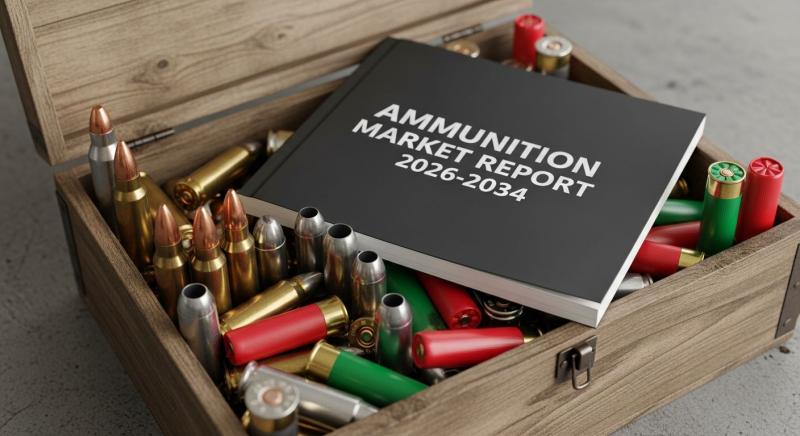
Market Overview:
The ammunition market is experiencing rapid growth, driven by surge in global defense expenditures and stockpile replenishment, government initiatives for indigenous production and self-reliance, and modernization of law enforcement and security infrastructure. According to IMARC Group’s latest research publication, “Ammunition Market Size, Share, Trends, and Forecast by Product, Caliber, Guidance, Lethality, Application, and Region, 2026-2034”, the global ammunition market size was valued at USD 26.7 Billion in 2025. Looking forward, IMARC Group estimates the market to reach USD 36.3 Billion by 2034, exhibiting a CAGR of 3.49% from 2026-2034.
This detailed analysis primarily encompasses industry size, business trends, market share, key growth factors, and regional forecasts. The report offers a comprehensive overview and integrates research findings, market assessments, and data from different sources. It also includes pivotal market dynamics like drivers and challenges, while also highlighting growth opportunities, financial insights, technological improvements, emerging trends, and innovations. Besides this, the report provides regional market evaluation, along with a competitive landscape analysis.
Download a sample PDF of this report: https://www.imarcgroup.com/ammunition-market/requestsample
Our report includes:
- Market Dynamics
- Market Trends and Market Outlook
- Competitive Analysis
- Industry Segmentation
- Strategic Recommendations
Growth Factors in the Ammunition Market
- Surge in Global Defense Expenditures and Stockpile Replenishment
The escalation of regional conflicts and heightening geopolitical tensions have compelled nations to significantly increase their defense budgets to ensure combat readiness. In 2024, global military expenditure reached a record $2,718 billion, a trend that continues to intensify in 2025 as countries shift from "just-in-time" to "just-in-case" procurement models. This fiscal expansion is directly fueling the replenishment of depleted stockpiles, particularly in the artillery and small-caliber segments. For example, the United States Army has committed nearly $5 billion to upgrade its manufacturing facilities with the objective of producing 100,000 artillery shells per month. Similarly, Poland recently announced a $665 million investment to quintuple its domestic production of 155mm shells. These massive capital injections reflect a global movement to secure immediate munitions availability, ensuring that manufacturing capacities can meet the high-intensity consumption rates observed in contemporary warfare environments across Eastern Europe and the Middle East.
- Government Initiatives for Indigenous Production and Self-Reliance
Governments are increasingly implementing policies to reduce dependence on foreign supply chains and bolster domestic defense industrial bases. In India, the Ministry of Defence has introduced the "Defence Procurement Manual 2025," which simplifies procedures for private sector entry into ammunition manufacturing and removes mandatory no-objection certificates for critical munitions. This initiative has already led to record domestic defense production valued at ₹1.54 lakh crore in the 2024–25 fiscal year. By fostering a "hybrid" supply chain model that integrates private firms like Tata and L&T, nations are mitigating the risks of international export restrictions and logistical bottlenecks. European countries are following a similar trajectory through the "Czech Ammunition Initiative," a government-led project that has successfully consolidated regional resources to source millions of shells. These state-led strategic shifts ensure that the ammunition industry remains a core pillar of national security, driving long-term industrial growth through localized manufacturing hubs.
- Modernization of Law Enforcement and Security Infrastructure
Beyond traditional military applications, the growth of the ammunition market is heavily supported by the comprehensive modernization of global law enforcement and homeland security agencies. Facing rising urban crime rates and more sophisticated domestic threats, police forces are transitioning to specialized, high-performance ammunition designed for superior stopping power and reduced collateral damage. The "bullets" segment currently accounts for approximately 29.5% of the market share, driven by the essential role of small-caliber rounds in routine patrols and specialized tactical operations. Many agencies are replacing legacy 9mm stocks with advanced hollow-point or frangible rounds that offer enhanced safety in densely populated environments. Furthermore, the integration of digital inventory management systems, such as the e-module launched by Indian police in late 2024, is optimizing procurement cycles. This consistent demand from the civilian and law enforcement sectors provides a stable revenue foundation that complements the more volatile, project-based military demand.
Key Trends in the Ammunition Market
- Integration of Smart and Precision-Guided Technologies
A transformative trend in the market is the shift toward "smart" ammunition, which incorporates miniaturized sensors, microprocessors, and guidance systems to adjust trajectories mid-flight. These precision-guided munitions (PGMs) are designed to hit moving targets with extreme accuracy, significantly reducing the volume of fire required to achieve mission objectives. For instance, the "ATOM" system, unveiled in October 2025, utilizes AI-driven algorithms to counter fast-moving drones and loitering munitions, showcasing how sensors are now embedded directly into small-arms and medium-caliber rounds. The United States Army recently awarded a $720.1 million contract for the production of precision-guided air-to-ground missiles, highlighting the massive scale of investment in this area. This trend reflects a broader doctrinal shift toward "accuracy-centric" warfare, where the higher unit cost of intelligent ammunition is offset by its superior effectiveness and its ability to minimize unintended casualties in complex urban environments.
- Adoption of Sustainable and Eco-Friendly Materials
Environmental sustainability is becoming a critical priority in ammunition manufacturing, driven by both regulatory pressures and the need to mitigate the long-term toxicity of training grounds. The development of "green" ammunition involves replacing traditional lead cores with non-toxic materials like copper, tungsten, or bismuth and utilizing biodegradable polymers for casings. Manufacturers are also innovating in propellant chemistry to produce "smokeless" powders that leave fewer chemical residues in the environment. In 2025, the pursuit of lead-free projectiles has gained significant traction, especially in the civilian hunting and sport shooting sectors where environmental regulations are becoming increasingly stringent. Companies are now marketing these products not just as compliant alternatives, but as high-performance rounds that offer consistent ballistics without the ecological footprint. This trend toward "green" munitions is reshaping the research and development priorities of major industry players as they align with global industrial sustainability goals.
- Advancements in Hybrid and Polymer Casing Solutions
The industry is moving away from traditional brass casings in favor of hybrid and polymer materials to improve soldier mobility and reduce logistics costs. Polymer-cased ammunition can be up to 30% lighter than its metallic counterparts, allowing personnel to carry more rounds without increasing their physical burden. This trend is exemplified by the U.S. Army’s Next Generation Squad Weapons program, which utilizes a 6.8mm round designed to provide better range and stopping power while maintaining a manageable weight profile. Beyond weight reduction, polymer casings offer superior thermal insulation, reducing the heat transferred to the firearm and extending the lifespan of the barrel. These material advancements are particularly valuable in high-volume combat scenarios where thermal management and load-bearing capacity are critical. As manufacturing techniques for high-strength polymers continue to improve, the adoption of non-metallic casings is expected to become a standard feature across both military and high-end civilian ammunition lines.
Leading Companies Operating in the Ammunition Industry:
- Ammo Inc.
- Arsenal 2000 AD
- BAE Systems PLC
- CBC Ammo LLC
- Denel SOC Ltd
- Hanwha Corporation
- Herstal Group
- Hornady Manufacturing Company
- Nammo AS
- Nexter Group KNDS
- Northrop Grumman Corporation
- Nosler Inc.
- Remington Outdoor Company Inc
- Rheinmetall AG
- Sierra Bullets (Clarus Corporation)
Ammunition Market Report Segmentation:
By Product:
- Bullets
- Aerial Bombs
- Grenades
- Mortars
- Artillery Shells
- Others
Bullets dominate due to widespread military, law enforcement, and civilian use, with key players like Winchester and Federal Premium driving innovation in rifle and handgun ammunition segments.
By Caliber:
- Small
- Medium
- Large
Small caliber leads owing to its versatility across military, law enforcement, and recreational shooting applications, with popular cartridges like .223 Remington and 9mm driving demand.
By Guidance:
- Guided
- Non-Guided
Non-guided ammunition maintains dominance as traditional bullets and shells remain standard-issue for militaries worldwide, though guided munitions are gaining traction for precision applications.
By Lethality:
- Less-Lethal
- Lethal
Lethal ammunition holds the largest share, with defense forces prioritizing high-performance rounds, while less-lethal options grow for law enforcement crowd control scenarios.
By Application:
- Defense
- Military
- Homeland Security
- Civil and Commercial
- Sporting
- Hunting
- Self-Defense
- Others
Defense applications lead overwhelmingly due to global military modernization programs and homeland security needs, dwarfing commercial uses like hunting and sport shooting.
Regional Insights:
- North America (United States, Canada)
- Asia Pacific (China, Japan, India, South Korea, Australia, Indonesia, Others)
- Europe (Germany, France, United Kingdom, Italy, Spain, Russia, Others)
- Latin America (Brazil, Mexico, Others)
- Middle East and Africa
North America dominates, fueled by massive U.S. defense spending, civilian gun culture, and presence of major manufacturers responding to both military and commercial demand.
Note: If you require specific details, data, or insights that are not currently included in the scope of this report, we are happy to accommodate your request. As part of our customization service, we will gather and provide the additional information you need, tailored to your specific requirements. Please let us know your exact needs, and we will ensure the report is updated accordingly to meet your expectations.
About Us:
IMARC Group is a global management consulting firm that helps the world’s most ambitious changemakers to create a lasting impact. The company provide a comprehensive suite of market entry and expansion services. IMARC offerings include thorough market assessment, feasibility studies, company incorporation assistance, factory setup support, regulatory approvals and licensing navigation, branding, marketing and sales strategies, competitive landscape and benchmarking analyses, pricing and cost research, and procurement research.
Contact Us:
IMARC Group
134 N 4th St. Brooklyn, NY 11249, USA
Email: sales@imarcgroup.com
Tel No:(D) +91 120 433 0800
United States: +1-201971-6302

Comments