Why SaaS Startups Prefer Coworking Spaces in Pune Over Traditional Offices
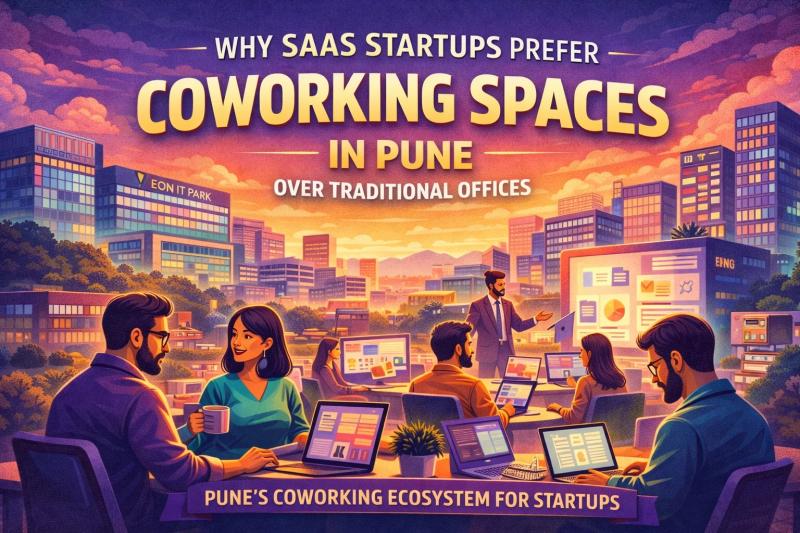
India’s SaaS startup ecosystem has matured rapidly over the last decade. As founders move beyond early experimentation into scale, their priorities around talent, cost efficiency, speed, and flexibility have fundamentally changed. These shifts are directly influencing where SaaS companies choose to operate — and how they use office space.
Increasingly, SaaS startups are choosing Pune and opting for coworking environments instead of traditional office leases. This preference is not driven by trend alone; it is rooted in structural advantages that align closely with how modern SaaS businesses are built and scaled.
SaaS Startups Need Agility, Not Fixed Infrastructure
Unlike traditional businesses, SaaS startups operate in cycles of rapid iteration. Team sizes change frequently, product roadmaps evolve, and go-to-market strategies are often refined every few quarters.
Long-term office leases, fixed seat counts, and high upfront setup costs work against this reality.
Coworking spaces offer SaaS founders:
-
Shorter commitment periods
-
The ability to scale teams up or down quickly
-
Ready-to-use infrastructure without capital expenditure
This flexibility allows leadership teams to focus on product development, customer acquisition, and fundraising rather than facilities management.
Pune Offers a Strong Talent-to-Cost Advantage
For SaaS startups, talent is the single biggest cost driver. Pune provides access to a deep pool of:
-
Software engineers
-
Product managers
-
QA and DevOps professionals
-
Customer success and support talent
At the same time, Pune’s operating costs remain significantly lower than India’s largest tech hubs. This combination allows startups to:
-
Build high-quality teams at sustainable burn rates
-
Extend runway without compromising on talent quality
-
Reduce attrition through better work-life balance
When paired with flexible coworking setups, this cost efficiency becomes even more pronounced.
Coworking Aligns with Modern SaaS Team Structures
Most SaaS startups today operate with a mix of:
-
Core in-office teams
-
Hybrid or remote employees
-
Distributed sales and customer success teams
Coworking environments in Pune are well-suited to this structure. They provide:
-
Private cabins for core teams
-
Shared collaboration zones for cross-functional work
-
Meeting rooms for client calls, demos, and reviews
Instead of maintaining underutilized office space, startups can match workspace usage with actual team presence.
Faster Go-to-Market for Early and Growth-Stage Startups
Speed matters in SaaS. Founders often need to:
-
Set up teams quickly after funding rounds
-
Enter new markets without long delays
-
Onboard hires in batches
Coworking spaces remove the traditional office setup timeline, enabling startups to become operational in days rather than months. This speed-to-market advantage is particularly valuable for early and growth-stage SaaS companies navigating competitive landscapes.
Community and Network Effects Matter More Than Ever
Beyond infrastructure, coworking spaces offer something SaaS startups increasingly value: ecosystem access.
Being part of Pune’s broader startup and technology community enables:
-
Peer learning from other founders
-
Easier access to service providers, advisors, and early talent
-
Informal networking that leads to partnerships and hiring
This community-driven environment reinforces the appeal of Pune’s coworking ecosystem for startups, especially for founders building companies in competitive global markets.
Reduced Risk in an Uncertain Growth Environment
SaaS growth is rarely linear. Market conditions, customer adoption, and funding cycles can change quickly. Traditional offices lock startups into fixed costs, while coworking spaces provide a hedge against uncertainty.
By choosing flexible workspaces, startups reduce:
-
Long-term financial exposure
-
Exit and relocation risk
-
The operational burden of unused office space
This risk mitigation is a key reason many SaaS founders view coworking as a strategic choice rather than a temporary solution.
Pune vs Traditional Office Markets: A Strategic Shift
What’s notable is that many SaaS startups that begin in coworking spaces continue using them even as they scale. Some expand into managed offices, while others maintain a hybrid footprint combining coworking hubs with remote teams.
This shift reflects a broader rethinking of what an “office” means for SaaS companies. Instead of static headquarters, offices are becoming collaboration hubs that support culture, productivity, and growth without unnecessary rigidity.
Conclusion
SaaS startups prioritise speed, flexibility, and efficient capital deployment — and their workspace choices reflect these priorities. Pune offers the right mix of talent availability, cost efficiency, and business maturity to support SaaS growth, while coworking spaces provide the adaptability modern startups need.
As the SaaS ecosystem continues to evolve, cities and workspaces that enable founders to stay lean, agile, and connected will attract the next wave of innovation. Pune, backed by a strong coworking landscape, is clearly emerging as one of those cities.
Post Your Ad Here
Comments