How Remote-First Companies Are Using Pune as Their India Hub
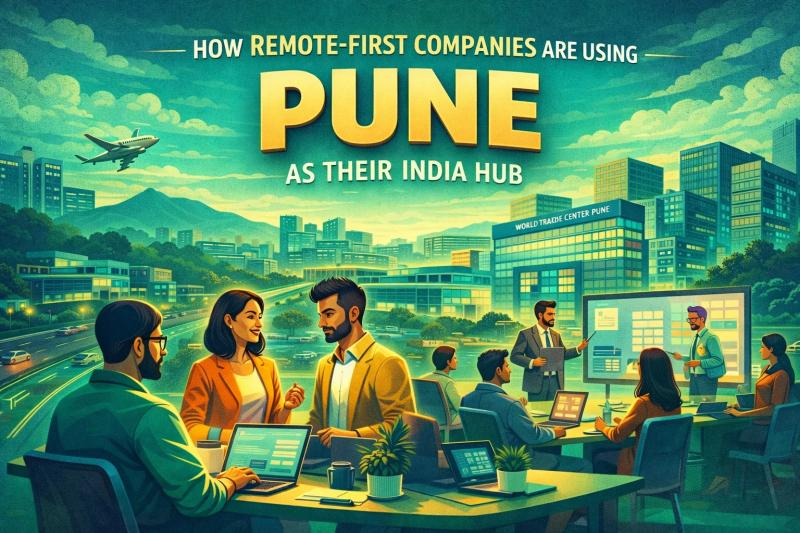
Remote-first work has moved from being a pandemic-driven experiment to a long-term operating model for companies across SaaS, IT services, fintech, and product engineering. As organizations decentralize teams and move away from single-HQ strategies, a new question has emerged: Which Indian cities best support distributed, high-performance teams?
Increasingly, the answer is Pune.
Once viewed primarily as an IT services and manufacturing city, Pune has evolved into a strategic hub for remote-first companies that want access to talent, infrastructure, and flexibility—without the cost and complexity of India’s largest metros.
Why Remote-First Companies Still Need Physical Hubs
Despite being “remote-first,” most global and India-headquartered companies have realised that fully virtual operations come with limits. Teams still need:
-
Collaboration spaces for sprints, planning, and onboarding
-
Secure environments for enterprise and client work
-
A physical presence to anchor culture, leadership, and hiring
As a result, many remote-first companies are adopting hub-and-spoke models, where distributed employees are supported by regional hubs rather than a single central headquarters.
Pune fits this model exceptionally well.
Pune’s Talent Ecosystem Aligns Perfectly with Remote Teams
One of Pune’s strongest advantages is its deep and diverse talent pool. The city produces a steady pipeline of engineers, designers, data analysts, and operations professionals from its universities and technical institutes, while also attracting experienced professionals who prefer Pune’s quality of life over denser metros.
For remote-first companies, this means:
-
Easier hiring across experience bands
-
Lower attrition compared to larger IT hubs
-
Teams that are already accustomed to hybrid and flexible work models
This talent maturity allows companies to build self-managed, outcome-driven teams, which is essential for remote-first success.
Cost Efficiency Without Compromising Capability
Remote-first organisations are typically disciplined about cost structures, especially when scaling in new markets. Pune offers a compelling balance:
-
Office and workspace costs are meaningfully lower than Tier-1 alternatives like Bengaluru or Mumbai
-
Salary expectations remain competitive while maintaining strong talent quality
-
Operational costs (infrastructure, travel, facilities) are more predictable
This cost advantage allows companies to invest more in people, tooling, and global collaboration rather than long-term real estate commitments.
Flexible Workspaces Enable Distributed Operations
Instead of leasing large offices, remote-first companies in Pune are increasingly using flexible and coworking environments as operational hubs. These spaces support a wide range of use cases:
-
Core leadership and management teams
-
Engineering pods and product squads
-
Client-facing or compliance-sensitive teams
-
Periodic team meetups, onboarding, and training sessions
By leveraging scalable coworking solutions in Pune, companies can align physical space usage with actual team needs—expanding, contracting, or reconfiguring without friction as business priorities change.
Pune’s Infrastructure Supports Hybrid Collaboration
Beyond talent and cost, Pune’s urban infrastructure has quietly become a major enabler for remote-first operations:
-
Strong internet and telecom reliability across key business corridors
-
Proximity between residential zones and commercial hubs, reducing commute fatigue
-
Growing airport connectivity supporting leadership travel and global coordination
This infrastructure allows distributed teams to come together seamlessly when needed, without disrupting remote workflows.
Culture, Retention, and the “Second-HQ” Advantage
For many remote-first companies, Pune is not just a delivery location—it becomes a cultural anchor in India.
Teams use Pune hubs to:
-
Onboard new hires into company culture
-
Run leadership offsites and innovation sprints
-
Build team cohesion that complements remote collaboration
Because Pune offers a high quality of life, employees are more likely to stay long-term, helping companies preserve institutional knowledge and team stability—two challenges that remote-first organisations often face at scale.
Pune as a Strategic, Long-Term Bet
What makes Pune particularly attractive is that it works equally well for:
-
Startups building their first India teams
-
Mid-size global companies decentralising from a single HQ
-
Mature organisations optimising for hybrid and distributed delivery
As remote-first models mature, companies are no longer choosing cities purely based on scale. They are choosing locations that offer flexibility, resilience, and sustainability—and Pune increasingly checks all three boxes.
Conclusion
Remote-first companies are redefining how and where work happens in India. In this new landscape, Pune has emerged as a city that supports distributed teams without forcing trade-offs between talent, cost, or capability.
By combining a strong workforce, business-friendly economics, and access to flexible work environments, Pune is becoming the default India hub for organisations that want to stay agile while scaling responsibly.
As remote-first strategies continue to evolve, cities that enable adaptability—not just expansion—will lead the next phase of growth. Pune is clearly positioning itself at the center of that shift.
Post Your Ad Here
Comments