Why Modern Enterprises Are Adopting Coworking Spaces in Pune?
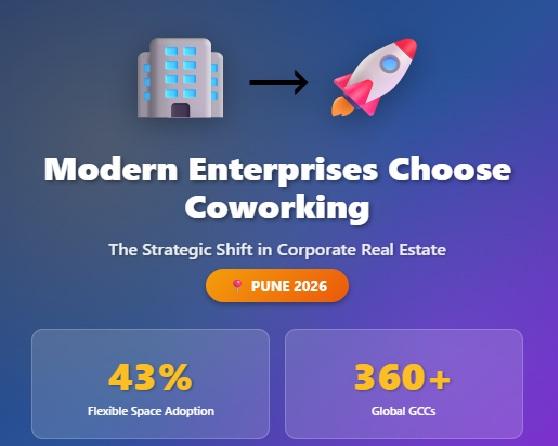
The era of enterprises signing 10-year leases for sprawling corporate campuses is quietly ending. In its place, a more agile model is emerging—one where global capability centers, multinational corporations, and established enterprises are increasingly choosing enterprise coworking spaces in Pune over traditional office infrastructure. The data tells a compelling story: with flexible workspaces now accounting for 43% of Pune's total leasing activity in Q1 2025, corporate India has fundamentally reimagined what workspace means.
This isn't just a trend. It's a strategic transformation driven by market forces, technological evolution, and the urgent need for operational agility in an uncertain business landscape.
The Enterprise Exodus from Traditional Real Estate
Remember when owning floors in prime business districts was the ultimate corporate status symbol? That playbook is being rewritten in 2026. Enterprises have discovered what startups knew all along: flexibility isn't just convenient—it's essential for survival.
The numbers validate this shift dramatically. By 2026, industry analysts project that 30% of office space globally will operate under flexible leases, up from just 8-10% pre-pandemic. In Pune specifically, flexible office spaces captured 1.6 million square feet in Q1 2025 alone—the highest adoption rate among India's Tier-1 cities. That's not satellite offices for remote workers; that's entire GCC operations, R&D divisions, and enterprise innovation labs choosing purpose-built managed office spaces in Pune as their primary infrastructure.
What changed? Everything. The pandemic shattered the assumption that employees need to be desk-bound 40 hours weekly. The economic uncertainty of recent years taught CFOs that capital tied up in real estate depreciates faster than invested in core business operations. And the war for talent revealed that rigid headquarters in single locations limit hiring to specific geographies—a losing proposition when competitors can recruit globally.
Why Pune's Enterprises Are Making the Switch
Pune's 91% year-over-year surge in office leasing during Q1 2025 wasn't driven by traditional office absorption—it was powered by enterprises demanding workspace solutions that match how business actually operates in 2026.
Cost efficiency without compromise: Here's the CFO perspective: why commit ₹50-100 crores in CAPEX for a build-out with 5-7 year lease commitments when you can access Grade-A infrastructure through coworking memberships in Pune with zero capital expenditure? The math is straightforward. Traditional offices require massive upfront investments in furniture, IT infrastructure, security systems, and interior design. Flexible workspaces eliminate these costs entirely while providing enterprise-grade amenities that often exceed what companies could build independently. And when market conditions shift—as they inevitably do—enterprises can scale up or down in weeks, not years.
The hybrid work reality: With 73% of companies operating hybrid models globally, the Monday-to-Friday office occupancy model is dead. Why maintain 50,000 square feet when actual utilization hovers around 60%? Smart enterprises are right-sizing their footprints through managed coworking spaces, using hub-and-spoke models where a smaller headquarters is supported by distributed satellite offices across Hinjewadi, Kharadi, Magarpatta, and Viman Nagar. Employees get workspace closer to home, companies reduce overhead, and productivity often increases as commute fatigue decreases.
Speed to market for GCC expansion: When HSBC, Bosch, or Credit Suisse decide to establish new GCC operations in Pune—as hundreds have—they face a choice: spend 12-18 months on traditional office procurement and build-outs, or onboard teams in enterprise-ready Pune coworking spaces within 2-3 weeks. In competitive talent markets where the best engineers have multiple offers, speed wins. Flexible workspaces provide immediate, turnkey infrastructure that allows operations to launch while recruitment ramps.
Innovation through ecosystem access: Corporations aren't just buying desks; they're buying into ecosystems. Enterprise-grade coworking hubs in Pune host hundreds of companies—from early-stage startups to established multinationals—creating organic collaboration opportunities that traditional isolated offices can't replicate. When your data science team sits floors away from an AI startup, your product managers share lounges with fintech innovators, and your recruiters network with regional talent pools, serendipitous innovation happens. Multiple corporations, including Accenture and PwC, have publicly credited flexible workspace models with increased productivity and improved retention rates.
The Infrastructure That Matters to Enterprises
Not all coworking spaces can serve enterprise needs. The ones capturing corporate market share deliver infrastructure that matches or exceeds traditional office standards:
Security and compliance: Biometric access control, CCTV surveillance systems, cyber-secure networks, and ISO-certified operations that meet multinational compliance requirements. For GCCs handling sensitive data or financial operations, these aren't luxuries—they're non-negotiables.
Technology infrastructure: 99.9% uptime internet connectivity with redundant failover systems, dedicated bandwidth options, advanced AV equipment in meeting rooms, video conferencing infrastructure that supports global collaboration, and 24/7 IT support. When your Pune team is collaborating with counterparts in San Francisco and Singapore, infrastructure reliability becomes business-critical.
Scalability with stability: The ability to start with 20 seats and scale to 200 without changing locations or renegotiating terms. Private floors for teams requiring confidentiality alongside shared amenities for cross-pollination. Custom branding options that maintain corporate identity even within shared environments.
Wellness and retention: Ergonomic workstations, wellness rooms, fitness centers, and hospitality-grade amenities that help enterprises compete for talent. When 68% of employees prioritize sustainable, well-designed workspaces according to IBM research, these features become recruitment and retention tools.
The 2026 Enterprise Reality
Here's what separates forward-thinking enterprises from those clinging to legacy models: recognition that workspace is a service, not an asset class. India's flexible workspace market, valued at USD 3.98 billion in 2025 and projected to reach USD 7.71 billion by 2030, reflects institutional confidence that this model isn't temporary—it's the new baseline.
Pune's role in this transformation is pivotal. With 360+ GCCs currently operating and projections reaching 500+ by 2030, the city has become ground zero for enterprise workspace innovation. The 20-30% cost advantage versus Bangalore, coupled with comparable talent quality, makes Pune the logical choice for companies optimizing both growth and efficiency.
Major real estate consultancy JLL reports that enterprises now constitute the fastest-growing customer segment for flexible workspaces—not freelancers, not startups, but established corporations with thousands of employees. WeWork's corporate customer base alone grew 370% year-over-year in recent periods, with large enterprises now representing over 25% of membership.
The Strategic Verdict
As Pune's enterprise coworking sector continues capturing market share—with operators expanding aggressively into neighborhoods like Yerwada, Chakan, and beyond the traditional IT corridors—the message to corporate real estate leaders is unambiguous: flexibility has become the defining currency of enterprise workspace strategy.
The question isn't whether your organization will adopt flexible workspace solutions. It's whether you'll lead the transition or lag behind competitors who've already realized that the future of enterprise real estate is already here—and it's located in Pune's thriving flexible workspace ecosystem.
Post Your Ad Here
Comments