On-Device AI vs Cloud AI Which One Should Your App Use
I still remember that Portland night when I sat alone in a coworking loft downtown, testing two versions of the same AI feature. Rain slid down the tall windows in thin, wavering lines, and the streetlights outside scattered across the wet pavement like shifting constellations. Inside, the room was quiet in that familiar Pacific Northwest way, with only the hum of an espresso machine someone forgot to turn off. I had been switching between network conditions for hours, trying to understand why the app felt alive on one connection and hesitant on another.
Where the Experience First Begins to Split
Both versions of the feature behaved perfectly on stable Wi-Fi. Responses came so quickly that it was hard to tell where the intelligence lived. But the moment I switched to a weaker network, the difference widened sharply. The on-device model answered instantly, as if it were responding to the user’s intuition rather than their input. The cloud model behaved differently. It paused. It waited. It asked for patience in a moment where patience didn’t belong.
I had seen this divide before while working on mobile app development Portland projects. The city is full of network pockets — places where signal strength dips unexpectedly between buildings or disappears altogether under heavy rain. Users move through these pockets without thinking about them, but apps that depend on remote intelligence feel every fluctuation.
That night, the hesitation of the cloud model wasn’t just a delay. It felt like a break in trust.
When Distance Becomes the Real Constraint
I watched the logs scroll past as the cloud version struggled through inconsistent coverage. It wasn’t the model’s fault. It wasn’t even the server’s fault. It was the distance. Every request had to travel away from the user, wait for processing, then travel back. Even a half-second felt too long when the user expected the app to move at the pace of thought.
Meanwhile, the on-device model didn’t care where I stood in the building. It didn’t care about the rain, the walls, or the weak signal. It carried the intelligence locally, and the calmness of its response made the feature feel more human than mechanical.
That was the moment I realized how much architecture shapes emotion. Not just performance. Emotion.
Understanding What Your App Is Trying to Promise
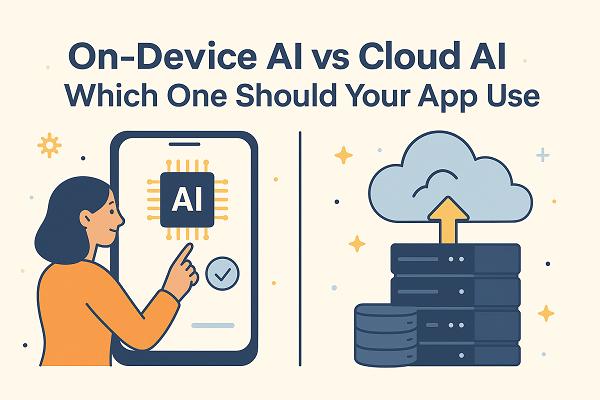
As the rain softened outside, I switched back and forth between versions, watching the interaction rhythm shift each time. Cloud AI offered depth — larger models, stronger reasoning, richer context. On-device AI offered immediacy — the feeling that the app understood the user without needing approval from somewhere far away.
The real question wasn’t about capability. It was about intention.
Some apps rely on deep analysis and can afford to wait. Others depend on timing so precise that even a brief delay feels like the app is breaking eye contact with the user.
The Thought That Stayed With Me After the Tests Ended
When I finally closed my laptop and stepped into the cool Portland night, the mist brushed gently against my face. The streets shimmered, quiet and reflective, as if the city had been listening to my tests just as closely as I had.
Choosing between on-device AI and cloud AI isn’t a battle between two technologies. It’s a decision about the relationship your app wants with its users. Whether it wants to move instantly with them, or think deeply from afar.
And once you feel that difference — not in theory, but in your hands — the choice becomes far more human than technical.

Post Your Ad Here
Comments