Inside the Mind of AI: How World Models Help Machines Predict the Future
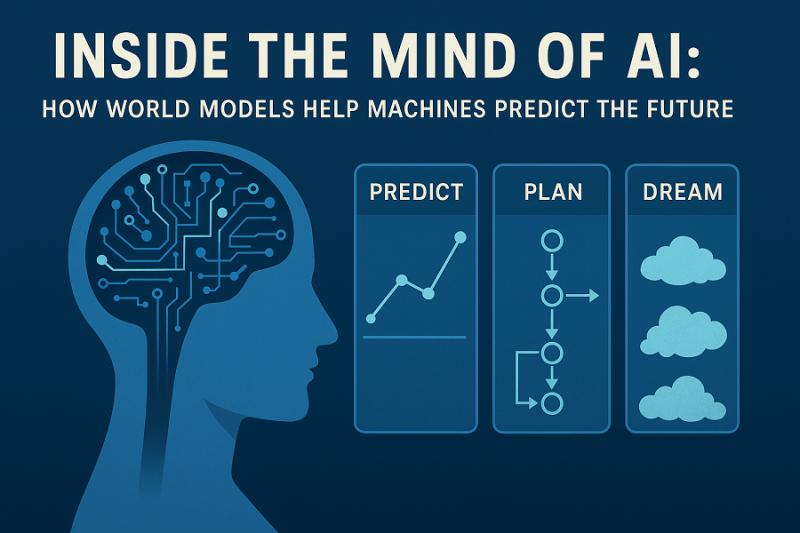
I still remember watching a small robot in a lab, pausing before it moved. Not frozen, but thinking.
Not the way we think-with hesitation or with fear-but by running an internal simulation. Inside its neural core, thousands of future worlds were being constructed: What if I turn left? What if that obstacle moves?
It was not reacting to the real world. It was making predictions about the real world.
That’s when I realized something fundamental — intelligence isn’t just about knowing what is happening. It’s about understanding what might happen next. This was the beating heart of the then-nascent concept now popularly known as world models in AI.
What Exactly Is a World Model?
You use one every time you plan your drive to work. You imagine the route, where red lights will catch you, how long before traffic moves.
That mental rehearsal- inner simulation of reality- is technically what a world model does for machines.
A world model, in the language of AI, is some internal representation learned by the machine about how the environment behaves. This lets it predict within itself how its actions would change the state of the environment or any part thereof without actually having to perform those actions in reality.
Smarter reinforcement learning. Safer robotics. More self-aware generative AI. It turns reaction into reasoning.
The concept gained traction after a 2018 study by David Ha and Jürgen Schmidhuber, where an AI agent learned to play the racing game CarRacing-v0. But it did not learn by playing the game over and over again. It learned dreams-by creating internal visual simulations of the track inside its “mind” and then planning within those imagined worlds.
This resulted in faster learning with fewer mistakes.
Or, in other words, the machine developed a rudimentary type of foresight.
How It Works: The Architecture of Imagination
At its core, every world model has three main components — think of them as perception; physics; and planning:
Perception Encoder: Translates sensory input (like images or text or sound) into compact, meaningful data — called latent states.
Dynamics Model: Predicts how these states change with time — this is the AI’s way of learning “how the world works.”
Planner (or policy network): Selects the next course of action based on those detections.
Internal simulation engine. That is what these two layers build together.
You give it an action, but it doesn’t execute the action immediately — now it can imagine possible outcomes, select among them, and choose the one most likely to produce maximum reward according to its own predictions.
No more guessing. Foreseeing.
Prediction Before Perception: Why This Matters
Conventional AI responds to inputs. World models respond to expectations.
That nuance changes everything.
The next wave of machines will not need to make every single possible mistake in the actual real world so that they can learn, because imagined experience can also teach them about an outcome as well as a cause.
They have abilities: modeling something never before seen by them; drawing inferences down a chain consequence set about what might happen next if this or that were true.
DeepMind’s MuZero was perhaps the most articulate demonstration yet, without ever being told the rules of chess or Go, it built its own internal model of the game’s logic. Then, it used that mental model to plan ahead — beating systems trained with far more data and resources.
In short, MuZero didn’t just play the game. It understood it.
When Machines Begin to Dream
The most poetic part of world models is their capacity to “dream.” Inside this dreamland,
Researchers do not refer to hallucinating or any sentient fantasies when they say an AI is ‘dreaming’. They refer to latent imagination training - the capability of creating self-generated experiences within its own learned world.
Advanced world-model architectures, DreamerV3 and PlaNet allow the AI agent to simulate thousands of future frames inside its head- without interacting with the environment.
It learns faster, cheaper, and safer.
This idea is already transforming reinforcement learning efficiency .
A model that would once have needed 100,000 interactions can now get almost the same results with just 20,000 because 80 percent of its 'training' takes place inside its own internal dream space.
In their way, machines have begun to imagine possible futures.
The Data on Imagination
World models deliver quantifiable returns. Across several studies:
MuZero (DeepMind,2020):41% more efficient in planning than systems without world models.
DreamerV3(2023): Learns continuous control tasks 2.5x times faster than model-free methods.
PlaNet (Google Research, 2019): Higher visual control task rewards. “PlaNet achieves a higher cumulative reward in the visual control tasks-that is on average 35% higher than that obtained by baseline methods.”
Hybrid World Models (2024): State prediction error reductions. “State-prediction errors of Hybrid World Models are over 60% lower(relative reduction in mean-squared error)than those ofthe RNN-based baselines.”
Not big philosophical claims. Hard numbers on performance.
Three virtues: Efficiency, stability and the ability to look ahead, which have always been needed in AI but seldom attainedallat once.
The Real-World Impact
To put some flesh on this bone:
In robotics, logistics and predictive maintenance it’s already becoming a strategic shift through the use of world models. But the change trickles down to regular tech, too-even app ecosystems.
For example in mobile app development Portland professionals are experimenting with predictive models a lot more lightweight and tightly integrated making better guesses about what the user wants to do.
Picture an application that does not simply wait for your tap but begins slightly modifying itself based on probable next actions-layout changes or recommendation adjustments or interaction retiming.
That’s not user analytics. That is instantaneous real-time prediction and micro world modeling.
So here are the implications:
Applications automatically reconfiguring themselves.
An assistant that can plan your next move before you articulate it.
Edge AI keeping training local so privacy is protected but still aware of context.
In short, intelligence arrives just-in-time prior to interaction.
Philosophical Edge: Do Androids Dream About the Real World?
You can’t really write about world models without at least elliptically addressing the poetic question: Do androids dream?
When a model simulates a world in latent space, what exactly is happening? It is possible futures being generated inside visual, auditory, semantic spaces…all understood from some environmental context. It does not ‘see’ as humans do but there is internal motion created by it; sequences and outcomes. Its dreaming may not be totally random-it could be purposeful rehearsals hence machine dreaming need not be mystical-it can simply amount to mathematical creativity.
And that’s a milestone.
Because fundamentally, imagination is just prediction stretched out over time.
The Reality Gap
No dream is perfect, though. That’s the challenge. World models face what researchers call the reality gap—the mismatch between imagined outcomes and real-world physics.
A robot trained entirely in simulation might perform flawlessly in virtual space, then trip on a slightly uneven floor in real life.
This gap can only be filled by hybrid systems-integration of learned latent models with explicit physical priors or symbolic reasoning.
That is also where current research interest lies: in the combination of predictive learning with grounded feedback from environments, as the gap reduces not only will machines dream more vividly but accurately too.
Where It’s Going Next
World models are quickly becoming the core infrastructure of what researchers have termed Agentic AI-systems capable of self-directed reasoning and planning.
These agents do not follow a set of instructions. These agents determine potential future states and select the best state autonomously.
That crop will not just process information, though, because they are running small internal decision-making simulations about everything from how traffic might flow to what someone could say next in a conversation.
They shall develop copilot speculative reasoning abilities through logistics bots and creative systems based on an internal engine capable of continuously running small simulations inside itself-in other words, they won’t wait for something with which to react-they’ll think ahead.
Conclusion: The Intelligence of Imagination
Whenever the “mind” of AI is discussed, it becomes a metaphor for cold logic and linear computation. However, real intelligence has always been something different: an ability to predict, simulate, and imagine.
World models endow machines with such abilities. They transform information into knowledge, rules into reasoning capabilities—and most important for the emergence of true artificial general intelligence (AGI), perception into prediction.
The more accurate their world becomes, the more we get to a kind of artificial thinking that does not only react to its current state but also remembers previous states or anticipates future ones.
And if that sounds like dreaming, maybe that’s exactly what it is.
Because whether you’re human or machine, all intelligent life starts with imagination.
FAQs
1. What is a world model in AI?
A world model is an internal simulation that allows AI to predict the outcome of its actions before taking them. In other words, it learns the dynamics of the environment to support intelligent planning.
2. How is it different from a normal machine learning model?
Traditional models learn patterns in data; world models learn rules about how environments change. They can predict and plan — not just classify.
3. Why are World Models so important for the future of AI?
They support reasoning ahead and drastically slash the cost of training. Now machines can think possibilities before taking any action thus making them safe as well as adaptive.
4. Which industries are currently using world models?
Robotics, self-driving cars, logistics, healthcare,-even mobile apps! Yes Portland’s budding AI scene is diving into them too.
5. Do world models mean AI can dream?
Yes, in the computational sense. That is a form of dreaming when models simulate some internal experiences to train themselves-it is an imagination loop learned by the model.
6. What’s the biggest challenge world models face? The reality gap. Making sure simulated predictions match real-world outcomes. Hybrid approaches using physics-informed learning are narrowing that gap.

Post Your Ad Here
Comments