Sequential Logic Circuits Aspects by Engineering Colleges in India Professors
If you want to explore your bright career by designing of logical circuitry devices, it is essential for you to know about sequential logic circuits and its types. Hence, with the help of this article, most of the experienced people working under engineering colleges in India have explained on Sequential Logic Circuits.
Sequential Logical Circuits Possess Inherent Memory
Sequential type of logic circuits comes with in-built or inherent memory, because of which they are able to consider the present and previous input state. In fact, these circuits have some sort of before as well as after effect associated with sequential logic circuits.
Output as Three Different States
Professors belonging to few of the reputed engineering colleges in India have said that the output state of any sequential logic circuit implies function of three different states named as past input, present input and past output. Sequential circuits always remember all of these aforementioned conditions and remain fixed into their present state until changes takes place in any one of the states of next clock signal. This function is solely based on Memory allocated to the sequential logical circuits.
Referred as Bistable or Two State Devices
Professors of good engineering colleges in India mostly refer sequential logic circuits as bistable or two state devices. The reason for this is that such circuits are available with output or set of outputs in any of the two different basic states i.e. logic level 0 or logic level 1. Moreover, the circuit of this type remains in latched condition until an individual applies any input triggering pulse or signal to cause changes in state of the bistable device.
Circuit Representation of Sequential Logic Circuits
The word Sequential mainly implies all things, which take place in a proper sequence i.e. one after the completion of another one. In these types of circuits, clock signal determines when any particular event takes place next. Simple type of logical circuits incorporate constructions with the help of standardized Bistable circuits referred as Latches, Flip Flops and Counters. Designing of circuits in this case involves simple connection of universal NOR and NAND gates in a specific combinational way to create the required logical circuit.
Sequential Logic Gates Classification
According to EE and EC experts of engineering colleges in India, flip-flops and bi-stable latches serve as fundamental building blocks of aforementioned type of circuit. In fact, construction of a Sequential Logic Circuit primarily objects to produce either any simple triggered type of flip-flops or complicated sequential circuit in the form of memory devices, storage registers, shift registers and counters.
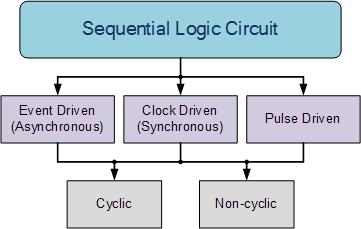
Based on broad classification, experts may choose to divide or classify sequential logic circuits into three different categories, as mentioned here.
· Even Driven circuits are asynchronous circuits, which mainly show change in their states once individuals opt to enable them.
· Clock Driven circuits i,e, synchronous circuits under the category of Sequential Logics. In this case, circuit undergoes for synchronization process for a specified clock signal.
· Pulse driven signals are combination of Event and Clock driven circuits, which response to various triggering pulses.
Excluding the presence of two different logical states as logic level 0 and logic level 1, individuals will be able to find a third element as TIME in the sequential logical circuits, which differentiates them from combination logical circuits. Sequential logic circuits return to their actual steady state once they reset, while such circuits available in combination with feedback paths and loops are of cyclic in nature.
Post Your Ad Here
Comments