Die-A Complete Tool to Produce Work in Press
Die refers to female part of any complete tool used mainly for producing of work in presses. In other words, die implies a complete tool comprises of mating members pair that helps in producing work of particular size in a press.
Categories or Classification of Dies
According to experts of Mechanical Engineering Department belonging to best engineering colleges in India, dies will be available in different categories based on the specific press operation and on operational methods.
Based on Type Used for Press Operations
On classifying dies based on type used to perform press operations, one will come across two different categories. These are
· Cutting Dies
Cutting dies used mainly for cutting of metals. These products use shearing or cutting action. Under this category, students studying in best engineering colleges in India can know about few common categories, such as perforating dies, blanking dies, notching, shaving, trimming and nibbling dies.
· Forming Dies
According to the name, forming dies mainly change their blank’s appearances without any requirement of stock removal process. These products are available as drawing, bending and squeezing dies.
Based on Operational Methods
According to Mech. Scholars of best engineering colleges in India, dies based on operational methods are classified as simple or single operation dies, progressive dies, combination dies, compound dies, multiple and transfer dies.
· Simple Dies
Single action or simple dies perform only one operation for a particular stroke made by press slide. In this case, operation may be any one among the listed operations available under forming or cutting dies.
· Compound Dies
Compound dies are responsible for performing more than one operation at a single station. Individuals should consider such dies as cutting tools, as they are only able to carry the cutting job. Compound dies give relatively high accurate results and are of economical ones in terms of production as compared to simple dies.
· Combination Dies
Combination dies also perform two or more than two different operations at a particular station. However, the difference of combination type with compound one lies in the fact that combination dies combine the cutting operation with drawing and bending operations. Hence, experts associated with best engineering colleges in India have called it as a combination die.
· Follow On or Progressive Dies
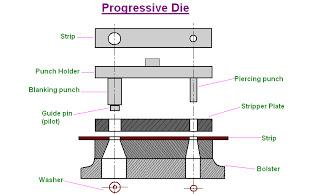
Follow on or progressive dies are available with a huge series of various operations. At every station, it performs an operation on work piece during a particular stroke of a press. Moreover, in between two different strokes, transfer of metallic strip piece takes place to next station. In other words, progressive dies allow for formation of finished work piece at every stroke of any press.
Moreover, you will find two different types of punches to perform different functions. Here, piercing punches cut holes present in different strokes and blanking punches blank out varying parts present in a metal, where piercing of holes take place at last station. Hence, once the first stroke completes and only a single hole is punched, each stroke associated with press will produce a complete washer.
· Transfer Dies
In case of transfer dies, industrial professionals feed already cut blanks mechanically from a particular station to another one.
· Gang or Multiple Dies
Gang or multiple dies produce about two different or more than two different types of work pieces at every stroke of a particular press. Multiple numbers of simple dies or gangs form together to produce various parts at every stroke of any press.
Post Your Ad Here
Comments