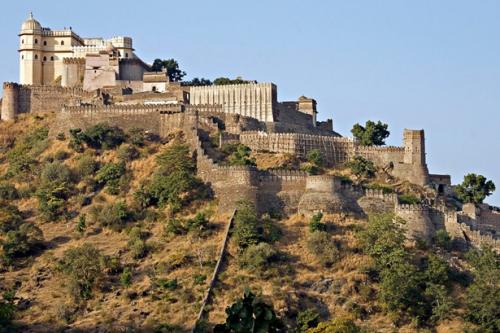
About 80 km from Udaipur
is a fort which can teleport one directly to the hey-days of the Rajput kings. The Kumbhalgarh fort has the distinction of being one of the six hill forts of
Rajasthan which were recently included in Unesco's World Heritage list. It is
also perhaps the only fort which nestes in a National Park besides boasting of
the second longest continuous wall after the Great Wall of China. And, if
heritage and wildlife are not enough, it has the added attraction of
playing host to a marathon along its wall every January.
When we think of Rajasthan, our vision ends with Jaipur and the desert and
colourful festivals. But Kumbhalgarh is much more than this. It is history,
heritage and biodiversity wrapped in one package. Built by the great Maharana
Kumbha in the 15th century, it rises 1,914 m above sea level and is the
principal fort after Chittorgarh fort. Its fortifications extend a length of 36
km which has reserved its position as the second longest wall in the world.
Because of its inimical topography, it remained inaccessible and
impregnable for years.
The huge complex of the fort has numerous palaces, temples and gardens, making it truly magnificent. Kumbhalgarh
occupies a large area of about 14 square km. It has played an
important part in the history of Mewar, particularly from the time of Maharana
Kumbha to that of Maharana Pratap. There are around 360 temples and shrines
within the complex. Out of these, 60 are Hindu and the remaining are Jain temples, each more magnificent than the other even as a ruin.
There are about 10 dams and 20 baoris (step wells) within or outside the
fort which make one marvel not only at its architectural genius but also at the
conservation aspect of its conception. Its palace complex is also awe-inspiring, especially Badal Mahal which was rebuilt by Rana Fateh Singh in the
early 20th century. The view from the windows of this palace offers an amazing
spectacle of clouds and the forest surrounding the fort and, if one is very
lucky, sometimes the spotted denizen of the jungle. Another very interesting
aspect of the fort relates to the tribal inhabitants who have been living there
from Rana Kumbha’s times.
There are many legends associated with the place. Its very inception has a tale
of the Mer Baba Yogi, who, it is believed, offered his head to please
Goddess Shakti so that the fort walls would stand. Then there is the tale of
three Mali women who showed the enemy
the way to the secret
entrance of the fort with flower petals, leading to its siege. It is believed
that, as punishment, they were bricked up alive inside the walls of the fort.
The fort is also associated with the legend of Panna Dhai who sacrificed her
own son to save Udai Singh, the heir apparent to Rana Vikramaditya in 1588.
Besides, the famous wars at Haldighati were fought to lay siege to the fort.
But most of all, the place is revered for being the birthplace of Maharana
Pratap who has acquired the stature of a demi-god in this part of India.
The fort is so well camouflaged ‘within the forest that, according to a legend,
when Akbar sent Shahbaz Khan to Kumbhalgarh in order to eliminate Rana Pratap,
it took him seven years just to locate the fort! The forest, which is spread in
an area of 578 sq km, abounds in wolves, bears, panthers, deer, antelope and
leopards. The best time to spot animals is from March to June when water is
scarce and the animals venture frequently to watering holes.
The list of feathered friends found here includes the golden oriole,
kingfishers, red spur owls, peacocks and parakeets. The
The forest, which is
spread in an area of 578 sq km, abounds in wolves, bears, panthers, deer,
antelope and leopards
sanctuary was elevated to a National Park in 2012 and,
like all national parks of India, remains closed during the monsoon i.e. July
to October. But going in the off-season months is no guarantee for a room in
any of the many hotels so it is safer to book online before going.
There are hotels to suit every budget. From the forest rest houses to budget
hotels such as Karni Palace and Kumbhal Castle to top-end luxury accommodation
such as Dera Kumbhalgarh, Tiger Valley and The Aodhi. Most of the hotels in the
vicinity arrange jeep safaris, But a more adventurous option is to do a hike in
the forest. Because it is on a ridge, the walk can become gruelling but it is
definitely worth the effort.
Comments