Create Awesome Music With These Advanced Sounding, Easy To Play Chords On Your Acoustic Guitar
Many guitar players, while advanced in soloing, really struggle with their rhythm guitar skills. This is a gross in-balance in ones playing and is due in part to a lack of chord knowledge and application, as well as time dedicated to this area of guitar playing.
Today I want to take you beyond the world of open and bar chords, and introduce you to a kind of chord that when applied will sound super advanced, but is easy to play. You’ll be able to change between major, minor, and dominant chord types effortlessly as well as use these chords in both a rhythm and solo context.
Sound too good to be true?
Well it’s not. Commonly known as “block chords” or 4, 3, 2, 1 voicing’s due to the strings of the guitar they fall on, these shapes will transform the way you see and use chords on your guitar from this day onward. You will feel great in knowing you can be just as creative with your chord playing on the guitar as you are with your soloing, addressing and eliminating this in-balance between solo and rhythm guitar that is common to so many.
We won’t be focusing on the theory behind these chords in todays article so much, as it will detract from what I want you to really learn. It’s the visualisation and application of block chords in your guitar playing to create awesome sounding music that will be our focus.
Don’t Do What I Did. Work On Your Chord Playing Now!
My early years of playing guitar was mostly about soloing. Of course I played chords, but it pretty much started and ended with open and bar chords. There were other chords I would play incidentally within a song, but if you asked me if I understood these chords and/or could use them in my playing, the answer would be no. So these chords were useless to me outside the songs I was playing them in.
Finally, while studying jazz guitar in the late nineties, I started to develop my chord playing, and thanks to this my guitar playing really started to take off. Block chords were among some of the chords I was learning to understand and use in my guitar playing at the time. They were a real game changer for me both in a rhythm and solo context.
Thankfully you don’t have to be like me and delay your chord development in your playing. Or should I be saying, don’t be like me and delay your chord development! Get onto it now starting with block chords.
The Key To Visualising Block Chords
It was around the time I was finally starting to work on my chords that I bought one of those chord encyclopaedias. You know, the big thick books with thousands of chords in them.
My intention was to go through it page by page getting as many of the chords down as I could. Let me tell you, this is NOT the way to learn chords on your guitar. Encyclopaedias are never meant for reading front to back, they are a reference book, and the chord encyclopaedias are no different.
The key to learning any chord on your guitar, so that you can understand it and use it with absolute freedom in your playing, is to see how it relates to the other chords you know on the fretboard. As your chord vocabulary and knowledge increases, there will be other key relationships you can tap into as well.
Let’s begin with our first block chord, a major 7th root position shape:
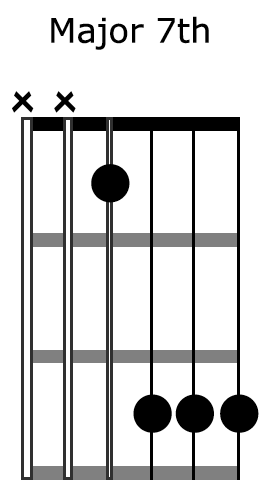
To convert the chord above into a dominant 7th shape, you need to change just one note, as there is only one note difference between a major 7th and dominant 7th chord.
Here is our dominant 7th block chord in root position:
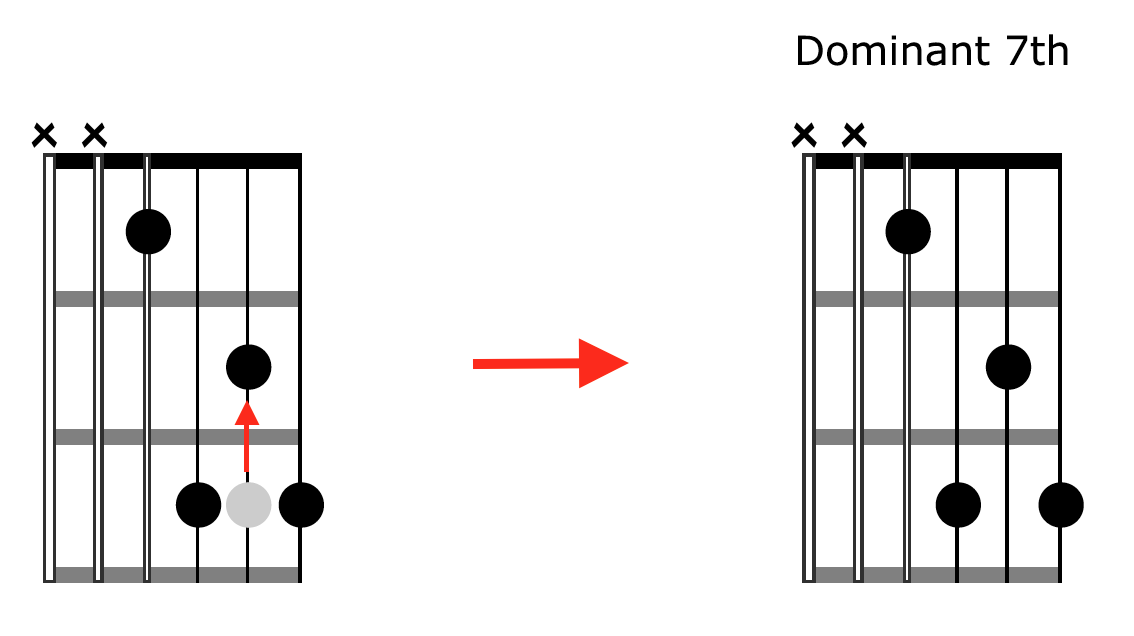
All we did was move the note on the second string of the major 7th chord down one fret.
Remember that our focus is all about the visualisation and application of block chords in todays article, not the theory behind them. No need to worry if you don’t understand the make up of a major 7th or dominant chord for now. It won’t stop you from creating great music with them.
From our dominant 7th block chord form we can create a minor 7th by again changing just one note. This time we are going to shift the note on the first string of the dominant 7th shape down one fret:
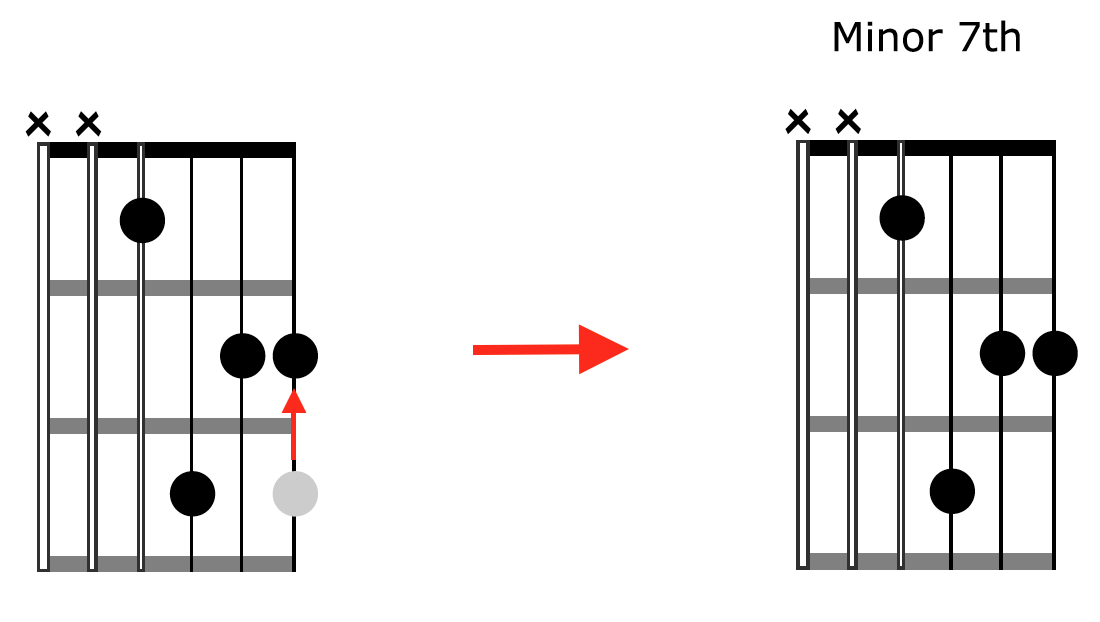
This is what I am referring to when I am talking about relating one chord shape to another. It will ensure you have your chord forms visualised on the fretboard so that you can easily find them when in the act of playing, where there is often little time to think.
How To Easily Quadruple Your Block Chords
We can easily increase our block chords and the amount of real-estate they occupy on the fretboard by playing inversions of our root position forms above.
What are inversions?
In a nutshell, it’s when a note, other than the root, is the lowest note in the chord. However, as mentioned previously, our focus remains with visualising and applying these chords, not so much the theory behind them.
Let’s take our major 7th root position block chord from earlier and add the inversions of this chord:
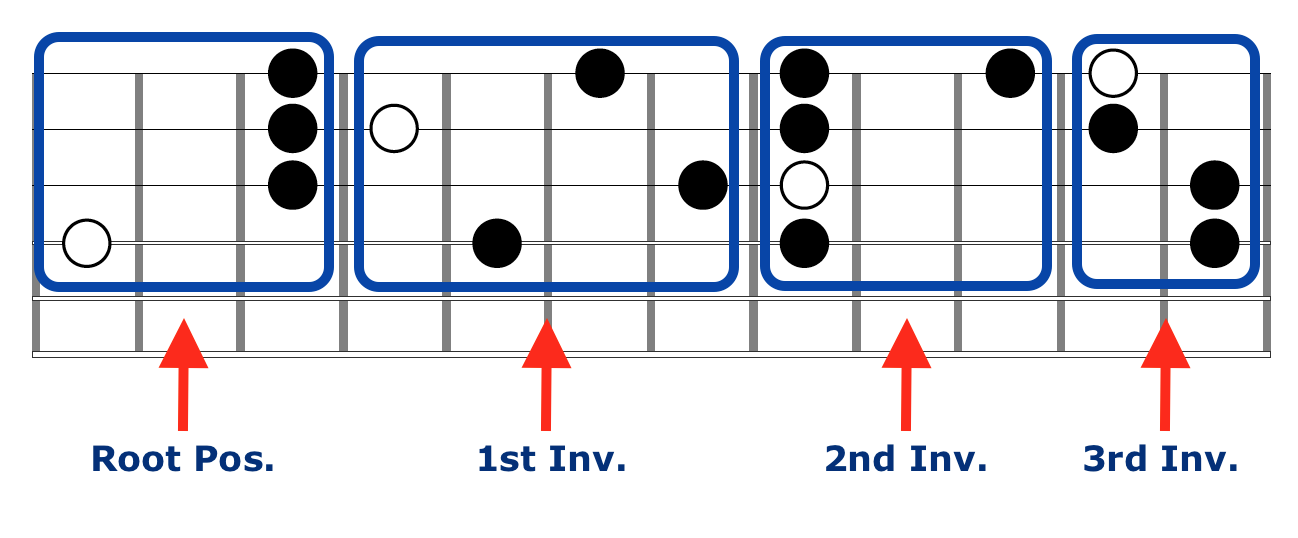
As you can see in the diagram above, our major 7th chord runs up the length of the fretboard. By the time you get to the 3rd version form, it’s time to go back to the root position again, only it would be an octave higher.
The highlighted note in the each shape above is the root note. If you can identify the root note in a chord, and how that chord relates to the root note, it will help greatly in being able to find the chord you are after.
As was the case with our root position block chords from earlier, we can derive our dominant and minor 7th chords from the shapes above by simply changing one note:
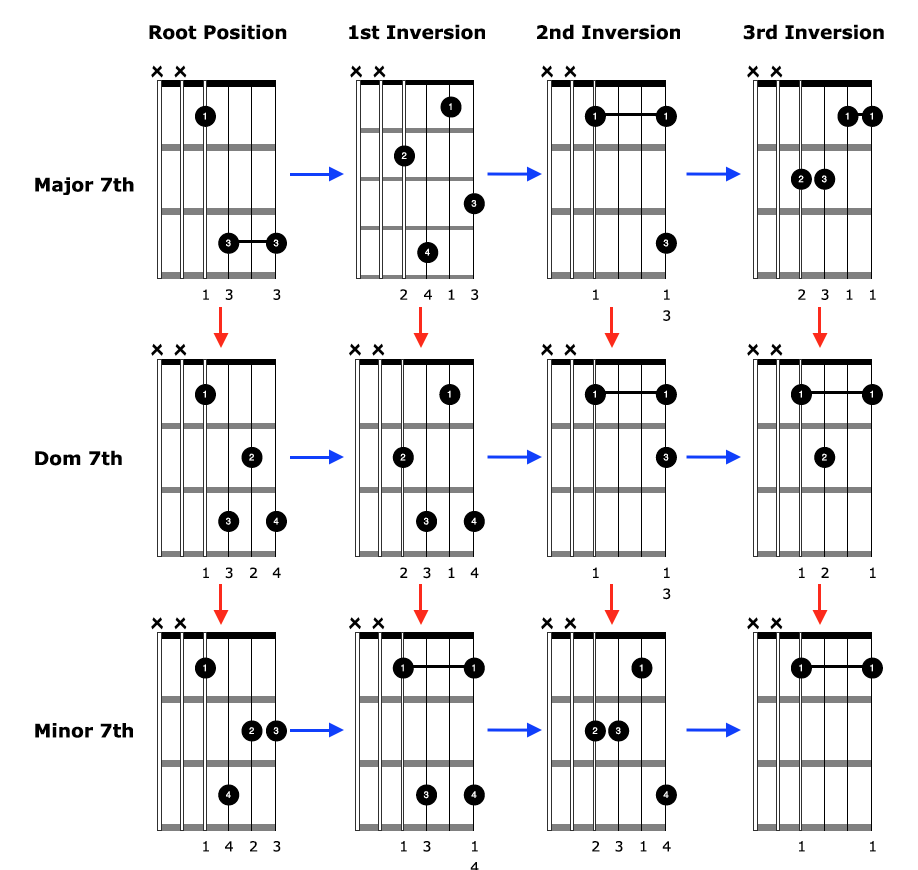
Above is a diagram showing you the major, dominant, and minor 7th block chord forms, plus inversions so you can use them all over the fretboard.
Approach the shapes above in the following two ways:
- By row (horizontally) so you are playing each of the four shapes of the one chord type (eg. Major 7th)
- By column (vertically) so you are playing one of each chord type in the same position on the fretboard. This illustrates the similarities between each shape
How To Use Block Chords To Create Great Sounding Music
Ok, so we have three of the most common chord types used in music, and four positions to play each of them up and down the fretboard.
Now what do we do?
Apply them musically is what we do! You could know thousands of chords on the guitar, but if you don’t how to use them in a musical context they are useless to you.
So let me give you an example of applying our block chord forms using what is known as a II V I progression. This progression pulls the II, V, and I chord out of a key, giving you a minor, dominant, and major chord respectively.
Here is a II V I progression in the key of G:

Below is an example of applying some of our block chord forms to this progression:
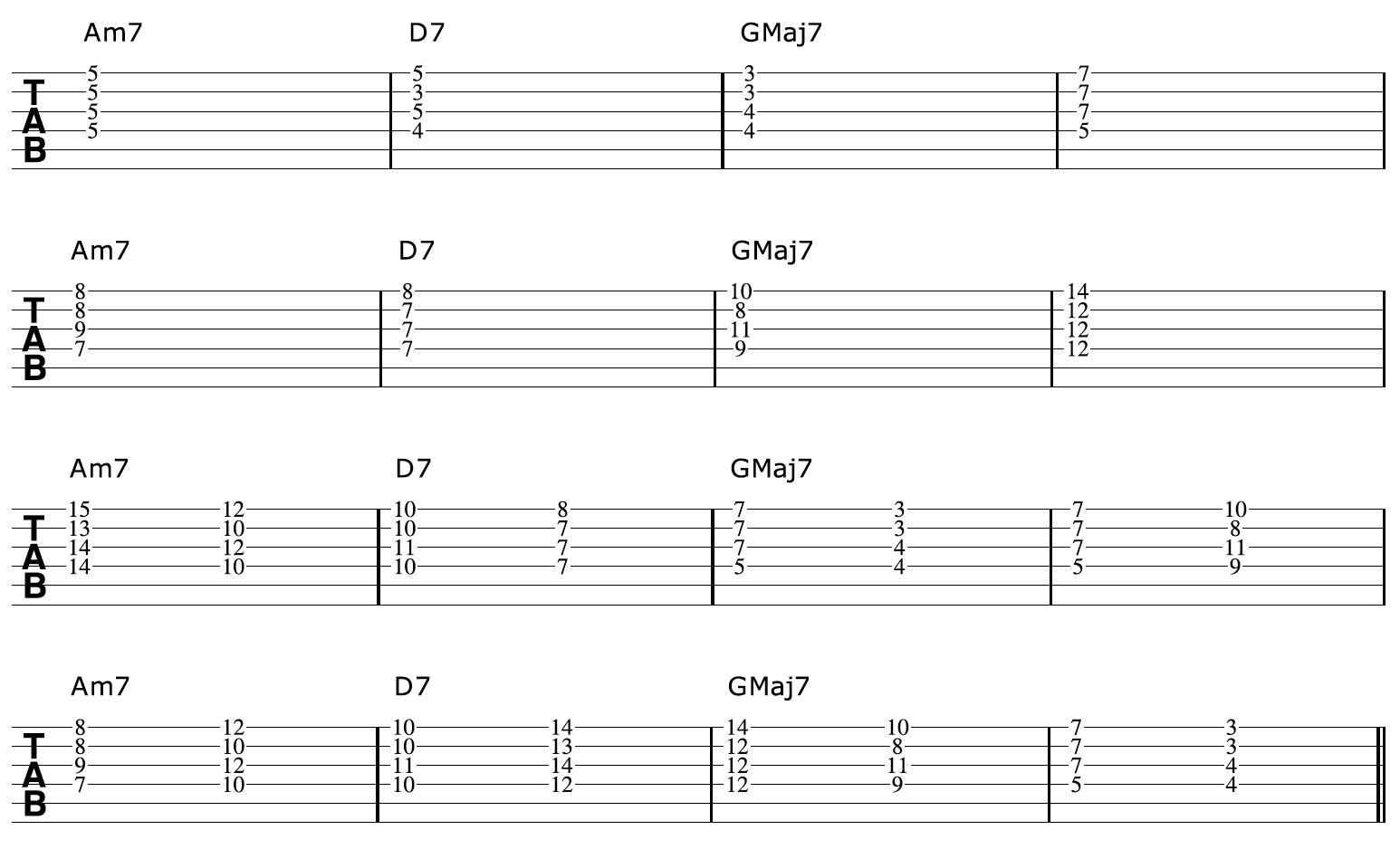
To continue highlighting how each block chord form relates to another, I have kept the shapes I am using within the same position on the fretboard for each rotation of the progression above.
You will notice I am moving between block chord forms for the last two repeats of the II V I progression, even though the chord itself has not changed.
For example on the Am7 and D7 chords I am playing two shapes, and on the G major 7th I am playing between four shapes. Moving through your block chord forms across a static chord like this, brings movement and interest to the progression. This is just a tiny preview of the possibilities block chords can bring to your acoustic guitar playing.
Learn how to play jazz chord shapes on your acoustic guitar. These chords are great for using in many styles, not just jazz.
About the author:
Simon Candy has taught and trained people to play guitar for over 20 years. Highly sought after in his hometown of Melbourne, Australia, Simon specialises in the acoustic guitar. In addition to running his own guitar school, Simon also offers the very best acoustic guitar lessons online
Post Your Ad Here
Comments