Become A More Superior, Creative, And Innovative Acoustic Guitarist By Studying Other Instruments
To only listen to guitar players, and to only learn from other guitar players, is detrimental to your development as a musician. You need to widen your focus so that it extends beyond the guitar world.
A great way to start doing this right now is to take something another instrument is playing and transcribe it to your acoustic guitar. This will open you up to playing your guitar in ways you never would have thought, not to mention increasing your creativity big time!
While we all play the same language, music, each instrument is unique in how it goes about sounding and arranging the notes it plays. Learning songs or parts thereof that other instruments play, on your acoustic guitar, will naturally develop your skills in ways that might never have happened otherwise.
There are basically two ways you can go about doing this. You can work from sheet music, or you can use you ear. Going with the latter will do wonders for your aural skills because your ear won’t be use to hearing and working out the sounds of another instrument.
This can be challenging at first, but I for one am always up for a challenge as I see it as an opportunity to improve my skills. You should always view any kind of a challenge in the same way.
What If You Can’t Work Music Out By Ear To Save Your Life
You can skip this section if you already know how to, and are comfortable with working music out using your ear. However if you haven’t, take it from me, learning this skill will be one of the best things you will ever do regarding your guitar playing and musicianship.
It is challenging at first no doubt, I certainly found this, but like anything it gets easier the more you do it. The achievement you feel and the run on effect it has to the rest of your playing is well worth it!
With the focus of this article being on arranging music other instruments play to expand and transform your guitar skills, I won’t go too deeply into the art of working music out by ear. However the following are some guidelines to get you started.
* Remember that it’s not necessary to have the skill of working music out by ear to reap the benefits of arranging music from other instruments. There are some resources that exist that you can work from that have done this for you (ie. transcribed music from another instrument to guitar)
5 things you need to do when working music out using your ear:
- Stop the recording immediately after the part of the song you are trying to work out. What you last heard sticks. This way you will have much more chance of getting it down.
- Take it one little piece at a time. This will likely be a single note or chord. Trying to hear and work out too much at once won’t work. Little by little you will work out the song using just your ear.
- You may feel silly, but singing/pitching the notes you are trying to work out by ear first, really helps you connect with that note and find it on the guitar.
- Working out what the bass guitar is doing in a song really helps in finding the chords. This is because the bass will most likely be playing the root note on the first beat of each chord.
- There are many programs and apps that now exist allowing you to manipulate songs so you can slow them down, change the key, and loop sections. You need to take advantage of these by using them to help you in working music out by ear.
The key is to just get in there and start developing your ear by using it to work out music. Down the track you will be so thankful you started doing this.
About Phrasing
Phrasing is an extremely important and critical part of any musicians playing despite the instrument. In a nutshell, phrasing will make or break your playing. Learning music from other instruments on your guitar will get you phrasing your notes in ways you probably would not have otherwise, and is one of the advantages of doing this.
All instruments will be unique in the way they phrase their notes. By “phrasing” I am referring to the way in which an instrument plays and arranges its notes.
In the context of this article, I am only referring to the general phrasing of a particular instrument. Each musician themselves will have unique ways in which they phrase their notes. This in itself will provide many cool nuances and subtleties to your own playing when you go about arranging music played by a particular musician.
Exactly Why And How Learning Music Another Instrument Is Playing Will Make You Better Guitar Player
There are so many areas of your guitar playing you will develop by working out music from another instrument, and is the reason why you want to do this.
Let’s for example consider a trumpet player or saxophonist for a moment. Can you work out the main difference in the way they play their notes compared to us guitar players?
Answer: They need to stop to breathe in order to continue playing.
A big reason why guitar players are notorious for over playing is that we don’t need to stop in order to take a breath between the phrases we play.
The notes you don’t play are as important as the notes you do. By transcribing music played by horn instruments, such as a trumpet or saxophone, you will learn to “breathe” between the phrases you play. Instead of wall to wall notes, you will have something that is much more expressive and musical.
How about a vocal line to a song? (yes, your voice is an instrument)
To bring more melody to the lines you play as a guitarist, oppose to playing back to back riffs and licks all the time, transcribing a vocal line from a song will do wonders for your playing! You will learn about the finesse, subtitles and nuances that a melodic vocal line has to offer. Don’t underestimate the benefits this will bring to your guitar playing.
How about something a piano is playing?
A piano is of course very different to a guitar in the way it plays and arranges notes. In fact, some things a piano plays just won’t be possible to play note for note on your guitar. This is the beauty. You will be forced into having to come up with unique and creative ways to emulate music played by a piano in a lot of cases.
Let’s take the following progression played by a piano as an example:

Transcribing this note for note isn’t going to really work out well for you on the guitar. Some of it may, but not all of it, so you need to get a little more creative in arranging something that will emulate what the piano is doing.
Here is one possibility:
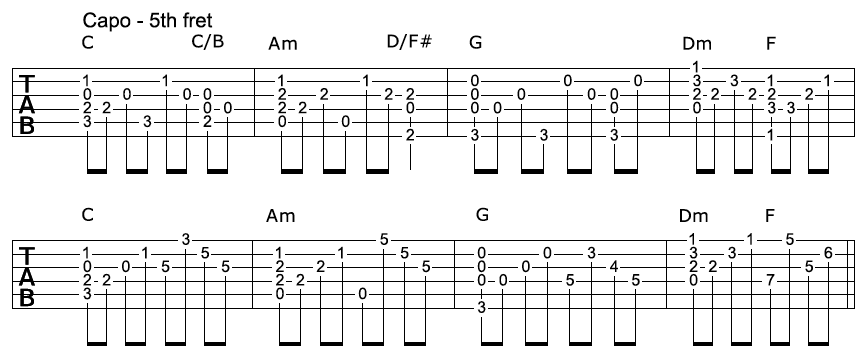
I decided to capo my guitar at the 5th fret when arranging the piano example for guitar. This is so I had more open chords to use than I would have had without it. Open chords generally allow for more embellishments and sustain in your playing via the open strings used. I am also fingerpicking throughout, mostly arpeggiating the chords with a few chord hits thrown in to emulate the piano part.
Notice I am not trying to play the piano excerpt note for note, but rather emulate the feel and flow of it instead. On the repeat of the progression, I have fretted my chords an octave higher to resemble what the piano is doing. This is an example of the little creative and innovative things you find yourself doing when arranging music played by other instruments.
Extend and broaden your horizons as a musician by looking beyond the guitar world. There are many things other instruments can teach you about your own playing to make you a much better guitarist and musician.
Discover these 3 advanced patterns for fingerpicking your acoustic guitar.
About the author: Simon Candy has played guitar for over 25 years. During this time Simon has studied many styles including rock, jazz, blues, and fingerstyle/acoustic. Running his own guitar school out of Melbourne, Australia, Simon also offers and helps people from all around the world with online instruction for acoustic guitar

Post Your Ad Here
Comments