Why San Diego Cleantech Apps Struggle With Real-Time Data?
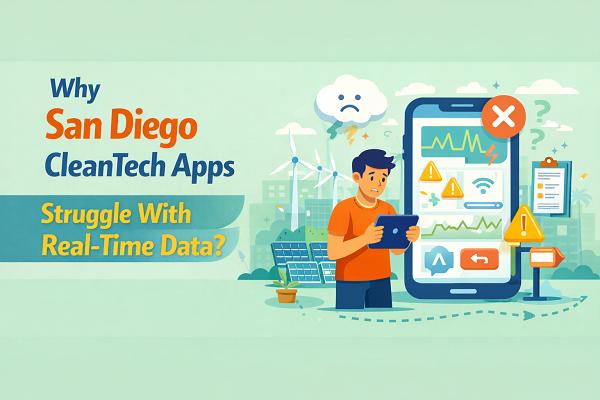
Daniel Reyes first noticed the problem during a routine field check.
The mobile app showed stable output from a cluster of solar installations outside the city. The graphs looked calm. The indicators were green. From the dashboard’s perspective, everything was normal.
On the ground, it wasn’t.
Actual production had dipped minutes earlier. Operators reacted late—not because alerts failed, but because the app showed a present that was already in the past.
By 2026, this gap defines one of the hardest problems facing San Diego’s CleanTech sector. Mobile apps promise real-time visibility, yet operators quietly stop trusting them when timing matters most.
For teams involved in mobile app development San Diego, the issue isn’t rendering speed or missing APIs. It’s a deeper mismatch between how real-time data behaves in energy systems and how mobile apps present it.
The Illusion of “Real-Time” in CleanTech Dashboards
Daniel oversees digital systems for a CleanTech platform aggregating data from:
-
Solar inverters
-
Battery storage systems
-
Grid interaction points
-
Field sensors operating under variable conditions
From an architectural standpoint, everything works:
-
Data streams arrive
-
Dashboards update
-
Alerts fire eventually
But operational trust is eroding.
Industry research into industrial IoT and energy monitoring shows that operators lose confidence when latency becomes unpredictable, even if average delays are low. A “live” feed that updates every few seconds—except when it doesn’t—is worse than a clearly delayed one.
CleanTech apps often confuse freshness with reliability.
Why Latency Variance Hurts More Than Latency Itself
Priyanka Shah, lead platform engineer, framed the issue during a post-incident review.
Average latency looked acceptable.
Variance did not.
Energy telemetry studies indicate that decision-making accuracy drops sharply when latency jitter exceeds operator expectations, even if mean delay stays within tolerances.
Why Latency Variance Breaks Trust
| Scenario | Operator Response |
|---|---|
| Consistent 5s delay | Adjusts expectations |
| Variable 1–15s delay | Hesitation, double-checking |
| Occasional stale data | Distrust of entire feed |
Mobile app development San Diego teams working with CleanTech platforms increasingly design for predictable delay, not minimal delay.
This is a subtle but crucial shift.
The Edge-to-Cloud Reality Most Apps Ignore
CleanTech systems are distributed by nature.
Sensors:
-
Operate in harsh environments
-
Lose connectivity intermittently
-
Buffer data unpredictably
-
Compete for bandwidth and power
Yet many apps assume:
-
Continuous connectivity
-
Cloud-first processing
-
Uniform sensor behavior
Energy infrastructure studies show that up to 30–40% of telemetry delays originate at the edge, not in the cloud. Mobile dashboards that don’t account for this present a misleading sense of precision.
This is where many CleanTech apps begin to fail—not technically, but communicatively.
Why Mobile Makes Real-Time Harder Than Control Rooms
Mobile apps introduce constraints that traditional monitoring systems don’t face:
-
Intermittent connectivity
-
Background execution limits
-
Battery optimization
-
OS scheduling delays
Operators in the field rely on phones under imperfect conditions:
-
Bright sunlight
-
Gloves
-
Movement between sites
-
Inconsistent networks
Mobile app development San Diego teams see a recurring pattern: mobile dashboards are expected to replace control rooms, but are built like web dashboards shrunk down.
That expectation gap creates risk.
The Most Common Failure Modes in CleanTech “Real-Time” Apps
Daniel reviewed incidents across multiple deployments. The causes weren’t dramatic failures. They were subtle misalignments.
Where CleanTech Real-Time Apps Break (2026 Observations)
| Failure Mode | Why It Happens |
|---|---|
| Stale “live” data | Edge buffering + silent delays |
| Misleading smooth graphs | Averaging hides volatility |
| Late alerts | Cloud-first thresholds |
| UI confidence without certainty | No indication of data freshness |
| Over-reliance on color/status | Masks uncertainty |
These issues don’t crash apps.
They erode trust quietly.
Once operators stop believing what they see, the app loses its purpose.
Why San Diego’s CleanTech Ecosystem Feels This Pain Earlier
San Diego’s CleanTech landscape amplifies real-time challenges:
-
Distributed solar and storage sites
-
Coastal and desert microclimates
-
Regulatory pressure for accuracy
-
Mobile-first field operations
Teams involved in mobile app development San Diego discover quickly that:
-
Near real-time is often operationally useless
-
Operators need confidence more than speed
-
Decisions depend on knowing what you don’t know
Daniel noticed that the most successful local teams didn’t promise “real-time.” They promised honest-time.
Redefining Real-Time as a Contract, Not a Feature
The turning point for Daniel’s team came when they stopped treating real-time as a UI problem.
They reframed it as a system contract:
-
What latency can we guarantee?
-
How do we communicate uncertainty?
-
When should data be withheld rather than shown?
Research in human-in-the-loop systems shows that explicit uncertainty indicators improve decision quality more than faster updates.
A distributed systems researcher involved in energy platforms summarized it succinctly:
“Operators don’t need perfect data. They need to know how wrong it might be.” — [FACT CHECK NEEDED]
What Changed When Teams Designed for Trust, Not Speed
Daniel’s team redesigned the mobile experience around transparency:
-
Visible data freshness indicators
-
Clear degradation states
-
Edge-side validation before display
-
Alerts based on confidence, not just thresholds
Operational Impact After Real-Time Redesign
| Metric | Before | After |
|---|---|---|
| Operator response confidence | Low | Improved |
| False alarm escalation | Frequent | Reduced |
| Field decision delays | Common | Less frequent |
| Trust in mobile dashboards | Eroding | Restored |
Importantly, the system wasn’t faster.
It was more honest.
This pattern mirrors outcomes reported by other mobile app development San Diego teams working in CleanTech.
Why Faster Dashboards Alone Make Things Worse
One temptation Daniel resisted was “making it faster.”
Faster pipelines increased:
-
Battery drain
-
Network costs
-
Data jitter
-
False confidence
Energy systems research suggests that over-optimizing for freshness without stability increases operational errors, especially in distributed environments.
Mobile apps that chase millisecond updates often sacrifice the very reliability operators need.
The Real Reason CleanTech Apps Struggle With Real-Time Data
They struggle because real-time isn’t about speed.
It’s about trust, predictability, and communication.
Apps fail when they:
-
Hide uncertainty
-
Smooth away volatility
-
Pretend delays don’t exist
-
Overpromise precision
Mobile app development San Diego teams that succeed treat real-time as a relationship with the user, not a streaming problem.
Key Takeaways for CleanTech Leaders in 2026
-
Real-time data must be predictable, not just fast
-
Latency variance erodes trust more than delay
-
Mobile constraints amplify real-time challenges
-
Honest data beats polished dashboards
-
Mobile app development San Diego teams succeed by designing for confidence, not illusion
In 2026, the most effective CleanTech apps aren’t the ones that update the fastest.
They’re the ones operators trust when timing actually matters.



Comments (19)
AI Automation Insigh...6
Helping businesses work smarter wit
Yes, Service businesses rely heavily on trust.
AI Automation Insigh...6
Helping businesses work smarter wit
most successful local teams
Alexross Bean6
Carpet Floor Installation
Many San Diego cleantech apps face real-time data challenges due to integration gaps, sensor latency, and infrastructure limitations.
TechGropseDallas6
TechGropse Dallas - Mobile App Dev
Great article with clear, in-depth insights on the topic.
Pankaj Mittal6
Digital Marketing - SEO, SEM, SMO (Free & Paid))
Great Article with proper in-depth information on the topic.
Alexross Bean6
Carpet Floor Installation
Very informative article . very good............
Sophie Lane7
Developer By Passion
A must‑read for Cleantech app developers aiming to build dashboards operators can actually rely on in the field.
Simon Harris10
On-Demand Clone App Development
Mobile app development San Diego teams working Great Article with proper in-depth information on the topic.
Amit Saxena7
Digital Marketing Executive
Very informative article.......
Mozan1238
Writer
On the ground, it wasn’t.
Sophie Lane7
Developer By Passion
Useful insights on Cleantech Apps!
Paty Diaz6
Content Writer
Nice Article with in-depth information.
Isha Singh6
Software Tester
Excellent Article..................
Axon Software6
Truck Fuel Management System
Mobile app development San Diego teams working with CleanTech platforms increasingly design for predictable delay, not minimal delay.
James0098
Content Writer
excellent................................................
Micheal Brown7
Telephone Answering Service UK
Good .....................
Panman Culi6
computer
Great Article like this ...................................
Mike Baster6
Blogger
Yes, It include proper charts and table for easy understanding. this is best
John Forster smith6
Blogger
Great Article with proper in-depth information on the topic.