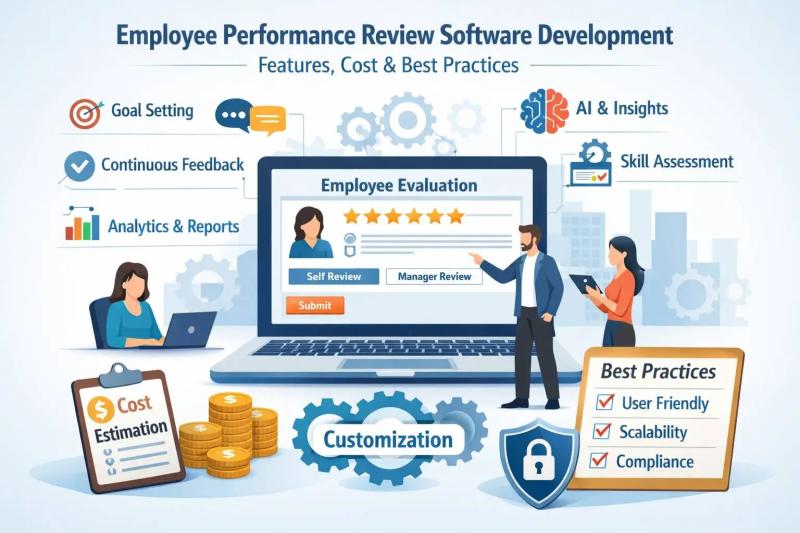
Employee performance management has evolved significantly from manual appraisals and annual reviews to continuous, data-driven evaluation systems. Organizations today need structured, transparent, and scalable tools to assess employee contributions, identify skill gaps, and align individual performance with business goals. This growing demand has led to the rapid adoption of Employee Performance Review Software Development as a core HR technology investment.
Modern performance review systems help HR teams and managers move beyond subjective evaluations by using measurable KPIs, automated workflows, and real-time feedback mechanisms. When designed correctly, such platforms not only improve productivity but also enhance employee engagement, retention, and overall organizational growth.
What Is Employee Performance Review Software Development and Why It Matters
Employee Performance Review Software Development refers to the process of designing, building, and deploying a digital platform that enables organizations to plan, conduct, track, and analyze employee performance reviews efficiently. These systems centralize performance data, standardize evaluation processes, and provide actionable insights for decision-makers.
From startups to large enterprises, companies use employee performance evaluation software development to reduce bias, ensure consistency across departments, and support strategic workforce planning. With remote and hybrid work models becoming common, performance review software has become essential for maintaining accountability and continuous communication.
Core Features of Employee Performance Review Software Development
Goal Setting and Performance Planning Modules
A robust performance review system begins with clear goal definition. This feature allows managers and employees to set individual, team, and organizational goals aligned with business objectives. Goals can be linked to KPIs, timelines, and measurable outcomes, ensuring transparency from the start of the review cycle.
Advanced platforms also support OKRs, cascading goals, and real-time progress tracking, helping employees stay focused and motivated throughout the evaluation period.
Continuous Feedback and Real-Time Performance Tracking
Traditional annual reviews often fail due to delayed feedback. Modern employee performance evaluation software development focuses on continuous feedback mechanisms, enabling managers and peers to share insights in real time.
This feature includes check-ins, feedback requests, peer recognition, and performance notes, allowing employees to improve continuously rather than waiting for formal review cycles.
Customizable Performance Review Templates and Workflows
Every organization has unique evaluation criteria. Customizable review templates allow HR teams to design appraisal forms based on job roles, departments, or competencies. Workflows can be configured to support self-assessments, manager reviews, peer evaluations, and multi-level approvals.
Automation ensures that reviews are completed on time, reminders are sent automatically, and the entire process remains structured and consistent.
Competency Mapping and Skill Assessment Tools
Competency-based evaluations help organizations assess not just what employees achieve, but how they achieve it. This feature enables HR teams to define core competencies, map them to roles, and evaluate employees against predefined standards.
Skill assessment tools integrated within employee performance review software development help identify training needs, leadership potential, and future-ready talent.
Analytics, Reporting, and Data-Driven Insights
Data analytics is one of the most valuable components of modern performance review systems. Dashboards provide insights into individual performance trends, team productivity, goal completion rates, and appraisal outcomes.
These insights support informed decisions related to promotions, compensation planning, succession planning, and workforce optimization.
Integration with HRMS, Payroll, and Learning Systems
To deliver maximum value, performance review software must integrate seamlessly with existing HR systems such as HRMS, payroll, attendance, and learning management platforms. Integration ensures a unified employee data ecosystem and eliminates manual data duplication.
This interconnected approach strengthens the overall HR technology stack and improves operational efficiency.
Benefits of Investing in Employee Performance Evaluation Software Development
Improved Transparency and Fairness in Evaluations
Standardized evaluation criteria and documented feedback reduce bias and subjectivity. Employees gain clarity on expectations, evaluation metrics, and performance outcomes, fostering trust in the appraisal process.
Enhanced Employee Engagement and Retention
Regular feedback, recognition, and goal alignment help employees feel valued and supported. Engaged employees are more likely to stay with the organization and contribute meaningfully to its success.
Better Talent Development and Workforce Planning
By identifying strengths, weaknesses, and potential early, organizations can design targeted training programs and career development plans. Employee performance evaluation software development plays a critical role in building future leaders and reducing skill gaps.
Time and Cost Efficiency for HR Teams
Automation significantly reduces administrative workload. HR teams can focus on strategic initiatives rather than manual tracking, paperwork, and follow-ups.
Cost Breakdown of Employee Performance Review Software Development
Factors Influencing Development Cost
The cost of Employee Performance Review Software Development depends on several factors, including feature complexity, customization level, user capacity, integration requirements, and deployment model.
Basic systems with standard features and limited customization are more cost-effective, while enterprise-grade solutions with advanced analytics, AI-driven insights, and deep integrations require higher investment.
Typical Cost Ranges
A basic performance review system may cost between $15,000 and $30,000. Mid-level solutions with customization, reporting, and integrations can range from $30,000 to $70,000. Advanced platforms with AI, predictive analytics, and enterprise scalability can exceed $100,000 depending on requirements.
Ongoing costs such as maintenance, upgrades, cloud hosting, and support should also be considered during planning.
Cost Optimization Strategies
Organizations can control costs by prioritizing essential features, opting for modular development, and planning phased enhancements. Choosing the right development partner and scalable architecture also reduces long-term expenses.
Best Practices for Employee Performance Review Software Development
Align Software Features with Business Objectives
Before development begins, organizations should clearly define performance management goals. The software must support business strategy, company culture, and workforce structure rather than adopting generic evaluation models.
Focus on User Experience and Accessibility
A complex or unintuitive interface can lead to low adoption. User-friendly design, clear navigation, and mobile accessibility are critical for ensuring consistent usage across all employee levels.
Ensure Data Security and Compliance
Performance review systems handle sensitive employee data. Implementing strong data encryption, access controls, and compliance with regulations such as GDPR is essential for protecting employee information.
Enable Customization and Scalability
As organizations grow, performance management needs evolve. Employee performance evaluation software development should support scalability, role-based customization, and easy feature expansion without major rework.
Incorporate Continuous Improvement Through Feedback
Post-deployment feedback from users should be used to refine workflows, add features, and improve usability. Performance management software should evolve alongside organizational needs.
Future Trends in Employee Performance Review Software Development
Emerging trends include AI-driven performance insights, predictive analytics for talent management, sentiment analysis from feedback, and deeper integration with learning platforms. Continuous performance management models are replacing traditional annual reviews, emphasizing agility and ongoing development.
Organizations that invest early in advanced employee performance review software gain a competitive advantage in talent management and organizational agility.
Conclusion
Employee Performance Review Software Development has become a strategic necessity for organizations seeking to build high-performing, engaged, and future-ready teams. By combining structured evaluations, continuous feedback, data-driven insights, and seamless integrations, modern performance review systems transform how organizations manage talent. With the right features, cost planning, and best practices, employee performance evaluation software development delivers long-term value by aligning individual growth with organizational success.
What is the primary purpose of employee performance review software?
The primary purpose is to provide a structured, transparent, and data-driven system for evaluating employee performance, setting goals, and supporting continuous development.
How long does employee performance evaluation software development take?
Development timelines typically range from 8 to 16 weeks, depending on feature complexity, customization requirements, and integration needs.
Can performance review software be customized for different roles and departments?
Yes, modern systems allow role-based templates, workflows, and evaluation criteria to meet diverse organizational requirements.
Is employee performance review software suitable for small businesses?
Yes, scalable solutions can be tailored for small businesses, offering essential features without unnecessary complexity or high costs.
How does performance review software improve employee engagement?
By enabling regular feedback, clear goal alignment, and recognition, performance review software helps employees feel valued, supported, and motivated.

Comments