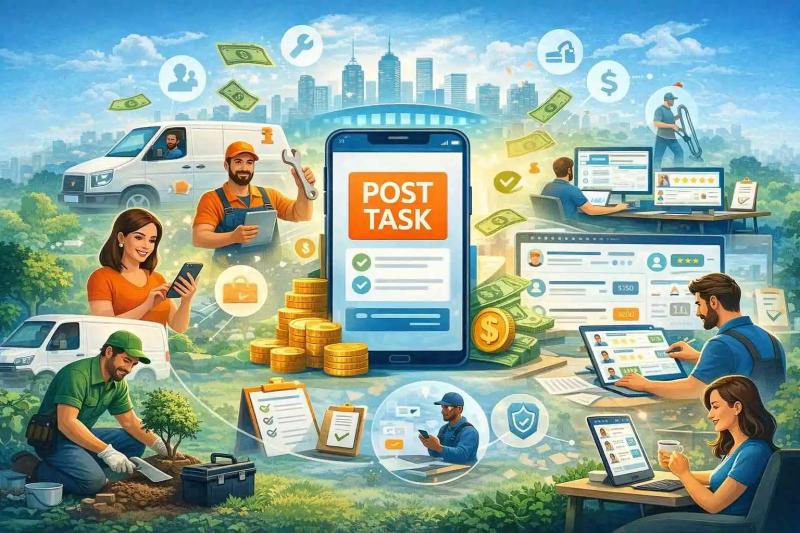
The global gig economy has shifted from a side-income model to a core employment ecosystem. On-demand task marketplaces connect individuals who need services with skilled taskers who want flexible work. Platforms inspired by Airtasker thrive because they remove friction from everyday service discovery—users can post a task, review offers, and hire within minutes.
From furniture assembly and home cleaning to digital marketing and content writing, demand spans both physical and digital services. For entrepreneurs, this model presents a scalable opportunity driven by commission-based revenue, low inventory dependency, and repeat usage. However, profitability depends on executing the right business strategy, platform architecture, and go-to-market plan.
Building a successful Airtasker Clone requires more than replicating features—it demands thoughtful market alignment and long-term scalability planning.
Defining a Profitable Business Model Before Development
Before investing in development, clarity on how the platform will generate revenue is essential. Airtasker-like platforms typically rely on multi-channel monetization strategies rather than a single income stream.
Common revenue models include commission fees on completed tasks, premium task visibility for posters, subscription plans for taskers, service fees for secure payments, and featured listings for businesses. A sustainable approach often combines commissions with optional paid upgrades to avoid user resistance.
Geographic focus also impacts profitability. Launching in a single city or niche market helps validate demand and unit economics before expanding. A hyperlocal rollout reduces marketing spend while allowing tighter control over service quality.
Aligning the business model early ensures the Airtasker Clone script is customized for revenue optimization rather than retrofitted later.
Market Research and Niche Validation for Competitive Advantage
Generic marketplaces face high competition. Niche-focused platforms often gain traction faster by serving a specific audience with tailored workflows. Examples include platforms dedicated to home services, enterprise task outsourcing, or creative freelancers.
Market research should assess demand density, average task value, user acquisition costs, and existing competitors. Interviews with both service seekers and providers reveal pain points that can differentiate the platform, such as delayed payments, trust issues, or lack of task transparency.
Localization is another powerful lever. Pricing structures, task categories, and onboarding flows should reflect regional behavior. Successful Airtasker like app development adapts the platform experience to the target market rather than copying a global model unchanged.
Core Platform Architecture and Technical Foundations
A scalable architecture is the backbone of long-term profitability. Task marketplaces require real-time interactions, secure payments, and high availability. Choosing a modular backend allows features to evolve without disrupting the system.
Core components include user management, task posting and bidding, in-app messaging, payment escrow, review systems, and admin dashboards. Cloud-based infrastructure ensures elasticity during peak demand periods.
Security must be embedded at every level, including data encryption, fraud detection, and identity verification. Trust directly impacts transaction volume, making platform reliability a revenue driver rather than a technical afterthought.
A production-ready Airtasker Clone script should support API integrations, third-party services, and future mobile or web expansions.
Essential Features That Drive User Adoption and Retention
User experience determines whether a marketplace grows organically or struggles with churn. Both task posters and service providers need intuitive workflows that reduce effort and build confidence.
For task posters, features such as quick task creation, budget transparency, verified profiles, and secure payments reduce hesitation. For taskers, easy onboarding, skill tagging, location-based discovery, and fast payouts encourage long-term engagement.
Reputation systems are critical. Ratings, reviews, and dispute resolution mechanisms maintain service quality and trust. Notification systems keep users informed without overwhelming them, balancing engagement with usability.
Successful Airtasker like app development focuses on reducing time-to-value—the faster users complete their first successful task, the higher the retention rate.
Monetization Optimization Through Platform Design
Monetization should feel like a value exchange rather than a barrier. Commission structures must be transparent, while premium features should offer measurable benefits such as increased visibility or faster hiring.
Dynamic pricing models can adjust service fees based on task value or demand. Subscription tiers for professional taskers provide predictable revenue while rewarding high performers with lower commissions or exclusive leads.
Data analytics play a crucial role in optimization. Tracking task completion rates, average order values, and user lifetime value helps refine pricing strategies. Over time, data-driven adjustments significantly improve profitability without increasing user acquisition costs.
Marketing Strategy for Scaling Supply and Demand Together
Marketplace growth requires balancing both sides of the platform. Acquiring task posters without enough taskers—or vice versa—creates friction and damages trust.
Early-stage marketing often focuses on supply acquisition, ensuring service availability before aggressive demand campaigns. Referral programs, local partnerships, and performance-based incentives help bootstrap the ecosystem.
Content marketing and search visibility position the platform as a trusted solution for everyday services. Over time, brand authority reduces dependency on paid advertising, improving margins.
A well-executed go-to-market plan ensures the Airtasker Clone scales sustainably rather than burning capital on unbalanced growth.
Operational Management and Quality Control at Scale
As the platform grows, operational efficiency becomes as important as technology. Automated moderation, AI-driven fraud detection, and standardized dispute workflows reduce manual overhead.
Quality assurance processes ensure consistent service delivery. This may include tasker verification, skill assessments, or performance monitoring. High-quality outcomes drive repeat usage, which is the foundation of marketplace profitability.
Customer support should evolve from reactive issue handling to proactive engagement, using data signals to prevent problems before they escalate.
Legal, Compliance, and Risk Considerations
Gig platforms operate within evolving regulatory frameworks. Worker classification, tax reporting, and data protection laws vary by region and must be addressed early.
Clear terms of service, insurance options, and payment compliance protect both users and the platform. Neglecting legal foundations can result in fines or operational shutdowns, undermining profitability.
Building compliance into the Airtasker Clone script reduces long-term risk and increases investor confidence.
Future-Proofing the Platform With Innovation
Long-term success depends on continuous improvement. AI-powered task matching, dynamic pricing, and predictive demand forecasting enhance efficiency as the platform scales.
Expanding into adjacent services, corporate task management, or subscription-based enterprise offerings opens new revenue streams. International expansion becomes easier when the platform is designed with localization and modular upgrades in mind.
Innovation ensures the platform remains competitive even as new marketplaces enter the ecosystem.
Conclusion
Building a profitable Airtasker-like platform is a strategic journey that extends far beyond development. From validating the business model and niche to designing scalable architecture and optimizing monetization, every decision impacts long-term success. A well-planned Airtasker Clone combines user-centric design, robust technology, and data-driven growth strategies. With the right execution, entrepreneurs can transform a simple marketplace idea into a sustainable, revenue-generating platform that thrives in the evolving gig economy.
Frequently Asked Questions
What is an Airtasker Clone and how does it differ from custom development?
An Airtasker Clone is a ready-made marketplace framework that replicates core task marketplace functionality. It accelerates launch timelines compared to building from scratch while still allowing customization for branding, features, and monetization.
Is an Airtasker Clone script suitable for niche marketplaces?
Yes, an Airtasker Clone script can be customized for niche use cases such as home services, digital freelancers, or enterprise task outsourcing by modifying workflows, categories, and pricing models.
How long does Airtasker like app development usually take?
Development timelines vary based on customization and integrations, but a robust platform typically takes several months from planning to launch, including testing and compliance checks.
How can profitability be improved after launch?
Profitability improves through optimized commission structures, premium subscriptions, data-driven pricing adjustments, and reducing operational costs through automation and analytics.
Can the platform scale to multiple cities or countries?
Yes, with proper architecture and localization support, an Airtasker-like platform can scale across regions, currencies, and languages without major redevelopment.


Comments