The Impact of Pune's Tech Ecosystem on Coworking Space Growth in 2026
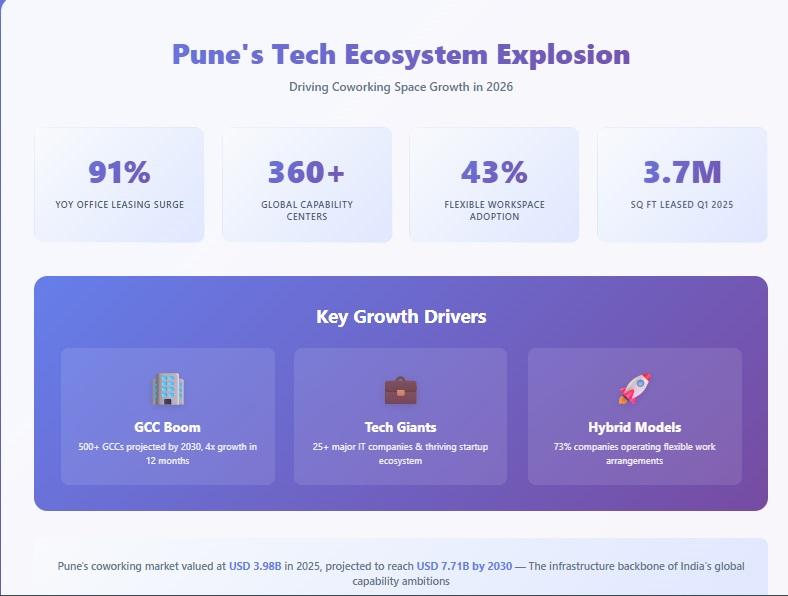
Something extraordinary is happening in Pune. While the rest of India celebrates steady growth, this city just posted a jaw-dropping 91% year-over-year surge in office leasing during Q1 2025. The driver? A perfect storm of Global Capability Centers, tech innovation, and a coworking revolution in Pune that's reshaping how global enterprises think about workspace strategy.
With 3.7 million square feet of office space leased in Q1 2025 alone—nearly double the previous year—Pune has catapulted into India's top three commercial real estate markets. But here's what makes this growth fascinating: it's not traditional office space leading the charge. It's flexible workspaces, and they're rewriting the rules.
The GCC Explosion: Pune's New Identity
Pune is no longer just "the Oxford of the East" or manufacturing hub—it's evolved into India's fastest-growing Global Capability Center destination. The numbers tell an undeniable story: GCCs accounted for 1.1 million square feet of leasing in Q1 2025, up from just 0.3 million square feet a year earlier. That's a four-fold increase in twelve months.
Currently hosting over 360 GCCs and projected to reach 500+ by 2030, Pune has become the strategic alternative to Bengaluru's congestion and Hyderabad's soaring costs. Major players like HSBC, Credit Suisse, ZF, Bosch, Siemens, and TCS have established substantial operations here, focusing on engineering R&D, digital transformation, automotive technology, BFSI analytics, and advanced manufacturing.
What changed? Geography, talent, and economics. Pune offers 20-30% lower operational costs compared to Bengaluru while maintaining comparable talent quality. The city produces thousands of engineering graduates annually from institutions like COEP, VIT Pune, and Symbiosis, creating a talent pipeline that global enterprises can't ignore. Add proximity to Mumbai—India's financial capital—and you've got a location that checks every box for GCC expansion.
Tech Giants, Startups, and the Workspace Demand Surge
Pune's tech ecosystem isn't just about GCCs. The city houses 25+ major IT companies including Tech Mahindra, Infosys, Wipro, Persistent Systems, and Zensar Technologies. These established players employ tens of thousands of professionals across software development, cloud computing, AI/ML, cybersecurity, and product engineering.
But the real energy comes from Pune's thriving startup scene. From AI-powered platforms to biotech innovations and Industry 4.0 solutions, Pune's startups are tackling global challenges with cutting-edge technology. These young companies—along with expanding GCCs and multinational corporations—are driving unprecedented demand for flexible workspace solutions.
The data is striking: flexible office spaces in Pune now account for 43% of total leasing activity, translating to 1.6 million square feet in Q1 2025 alone. That's the highest flexible workspace adoption rate among India's Tier-1 cities, surpassing even Bengaluru's 40% share.
Why Coworking Spaces Are Winning in Pune's Tech Ecosystem
Several converging factors explain why coworking spaces dominate Pune's commercial real estate landscape:
Hybrid work permanence: With 73% of companies globally operating hybrid models, enterprises need distributed workspace solutions. GCCs and tech companies require satellite offices that support occasional collaboration without forcing daily commutes to centralized headquarters.
Cost optimization without compromise: India's coworking market, valued at USD 3.98 billion in 2025 and projected to reach USD 7.71 billion by 2030 (14.14% CAGR), reflects enterprise recognition that flexible spaces deliver cost efficiency. Companies eliminate CAPEX burdens and 3-5 year lease commitments while accessing Grade-A infrastructure in prime locations like Hinjewadi, Magarpatta, Kharadi, and Viman Nagar.
Speed to market: When a GCC needs to scale from 50 to 200 employees in six months, traditional office procurement timelines—12-18 months for build-outs—become deal-breakers. Modern coworking spaces in Pune can onboard teams in weeks, not quarters, with enterprise-grade infrastructure already in place.
Multi-city talent strategies: As GCCs adopt multi-location strategies to access talent without bottlenecks, Pune's coworking hubs provide the flexibility to establish professional presences across Hinjewadi's IT corridor, Kharadi's BFSI belt, and Magarpatta's startup ecosystem simultaneously.
The Infrastructure That Fuels Growth
What separates Pune's coworking boom from café culture or basic shared offices? Purpose-built, technology-enabled infrastructure designed for enterprise clients:
High-speed dedicated internet with 99.9% uptime SLAs, critical for GCC operations running global platforms
Advanced security systems including biometric access, CCTV surveillance, and cyber-secure networks that meet multinational compliance standards
Scalable meeting infrastructure with AV equipment, video conferencing capabilities, and private discussion rooms
24/7 access models supporting round-the-clock GCC operations across time zones
Ergonomic design and wellness facilities addressing the productivity paradox—while remote workers show 31% engagement rates, they also face higher burnout risks
Major operators have invested heavily in Pune's market. The 23% share that coworking spaces captured of India's office leasing in 2025 reflects institutional confidence in the model's sustainability.
The 2026 Outlook: Acceleration, Not Slowdown
Every indicator points toward continued momentum. Pune witnessed a 97% surge in net absorption during 2025, the highest growth rate among India's top seven cities. With average office rentals rising 6% year-over-year to ₹90 per square foot and vacancy rates tightening, demand continues outpacing supply.
The tech ecosystem shows no signs of cooling. India is projected to host over 1,800 GCCs by end of 2025, with Pune capturing an increasing share. The startup ecosystem remains vibrant, enterprise adoption of hybrid models continues climbing, and flexible workspace operators are expanding aggressively into neighborhoods like Yerwada, Viman Nagar, and Chakan.
For professionals and companies navigating Pune's 2026 workspace landscape, the message is clear: coworking isn't alternative workspace anymore—it's primary workspace. As GCCs drive innovation, startups scale rapidly, and established tech giants optimize real estate portfolios, Pune's coworking ecosystem has become the infrastructure backbone of the city's tech transformation.
The Oxford of the East is now writing a new chapter—one where flexibility, innovation, and strategic workspace converge to power India's global capability ambitions.
Post Your Ad Here
Comments