Why Remote Teams Are Choosing Coworking Spaces in Bangalore Over Cafes in 2026
The laptop-wielding professional sipping an overpriced latte at a crowded café—once the poster image of remote work freedom—is quietly becoming a relic of 2024. As we move through 2026, India's flexible workspace sector, now valued at a staggering $25 billion and growing at over 25-30% annually, tells a different story. Remote teams in Bangalore aren't just abandoning cafés; they're running toward purpose-built coworking spaces in Bangalore at an unprecedented rate.
Here's what's driving this seismic shift—and why your team should pay attention.
The Café Dream vs. The Remote Work Reality
Working from cafés seemed romantic in theory. The ambient buzz, the artisanal coffee, the Instagram-worthy aesthetics. But as remote work matured from pandemic necessity to permanent strategy, the cracks in the café-as-office model became impossible to ignore.
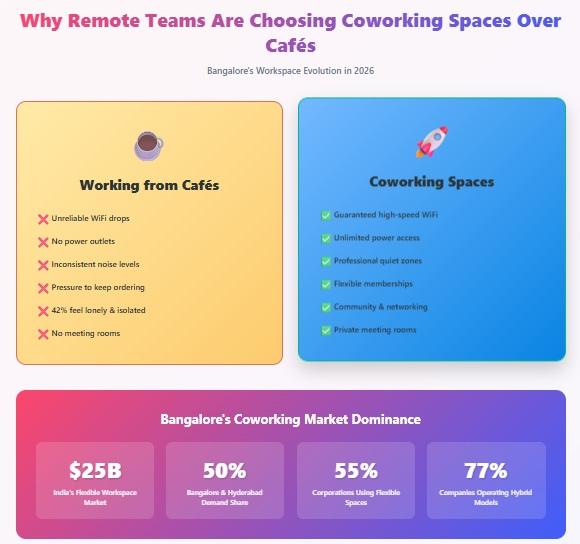
According to recent workforce studies, 42% of remote workers cite loneliness as their biggest struggle, followed immediately by collaboration and communication difficulties. Cafés, designed for quick coffee runs and casual meetups, simply weren't built to solve these problems. The reality? Unreliable WiFi that drops during client calls. No power outlets when your battery hits 10%. Noise levels that swing wildly between library-quiet and construction-loud. And the unspoken pressure to order another drink every hour just to justify your table squat.
By 2026, remote professionals have learned what truly matters: structure, consistency, and infrastructure that actually supports deep work—not just the appearance of it.
Bangalore's Coworking Revolution: The Numbers Don't Lie
Bangalore hasn't just embraced coworking; it's leading India's $25 billion flexible workspace boom. The data is striking:
Market dominance: Bangalore and Hyderabad together command at least 50% of India's total coworking demand share. From coworking spaces in Koramangala's startup energy to coworking spaces in Whitefield's enterprise-grade hubs, the Silicon Valley of India is setting the blueprint for 2026.
Enterprise adoption: Here's the kicker—55% of corporations now use flexible workspaces in Bangalore, and this isn't just about hot desks anymore. Companies are leasing entire coworking floors instead of signing long-term traditional office rentals. India's flexible workspace market is projected to account for nearly 20% of commercial real estate by 2030, up from under 5% a decade ago.
The hybrid workforce reality: With 77% of companies operating hybrid models globally, the demand for satellite offices and coworking spaces has exploded. Remote teams need spaces that facilitate occasional in-person collaboration without forcing daily commutes to a central headquarters.
What Coworking Spaces Get Right (That Cafés Don't)
The modern coworking space in Bangalore isn't your freelancer's 2019 hot desk. It's evolved into what industry experts call "Coworking 2.0"—holistic, tech-driven environments that solve actual remote work pain points:
Professional infrastructure: High-speed internet isn't a gamble; it's guaranteed. Meeting rooms equipped with latest AV tech. Biometric security. 24/7 access for round-the-clock teams. Private phone booths for confidential calls. These aren't luxuries—they're baseline requirements that cafés simply cannot provide.
Ergonomic design for sustainability: Remote workers in 2025 report the "remote work paradox"—highest engagement rates (31%) but also higher stress, loneliness, and burnout compared to other work arrangements. Coworking spaces combat this with ergonomic furniture, wellness rooms, mental health initiatives, and fitness centers. Try finding that in your neighborhood Starbucks.
Community that drives business: Perhaps most compelling is what you can't measure in square footage: networking opportunities. VCs and angel investors frequent startup-centric hubs. Collaboration happens organically when you're surrounded by designers, developers, marketers, and fellow innovators. Events, workshops, and upskilling programs are built into membership—transforming your workspace into a growth platform.
Cost-effective flexibility: Monthly coworking memberships starting at ₹6,000-₹12,000 for hot desks in prime locations like Koramangala eliminate the CAPEX burden of traditional offices while maintaining operational control. Compare that to café bills that add up with zero professional amenities to show for it.
The 2026 Workforce Speaks: Time Over Money
Here's what really matters to today's professionals: Recent surveys consistently show workers would accept lower pay in exchange for greater flexibility, structure, and balance. But flexibility doesn't mean chaos. It means having a professional environment when you need one, without being chained to a 3-year lease or fighting for a table at a noisy café.
Stanford economist Professor Nick Bloom, who's studied remote work for two decades, cuts through the productivity debate: "Firms should care about profitability, not productivity." Fully remote teams have "an enormous upside"—no office space costs and access to talent anywhere. Coworking spaces deliver this equation better than cafés ever could.
The Bottom Line
As Bangalore's coworking spaces continue their trajectory toward claiming 20% of India's commercial real estate through flexible workspaces by 2030, the message is clear: Remote teams have outgrown cafés. They need spaces purpose-built for how work actually happens in 2026—collaborative yet focused, flexible yet structured, independent yet connected.
The café will always have its place for quick meetings and creative brainstorming over coffee. But for remote teams serious about productivity, culture, and growth? The future is already here, and it's located in Bangalore's thriving coworking ecosystem.
Post Your Ad Here
Comments