The Ultimate Guide to Choosing the Right Stainless Steel Work Table for Your Commercial Kitchen
The backbone of any efficient commercial kitchen isn't just a talented chef—it's the equipment they rely on. Among the most critical pieces is the humble work table. It’s a prep station, a temporary storage area, a landing zone, and often, the most-used surface in the entire kitchen. Choosing the right stainless steel work table is an investment in productivity, safety, and longevity. This guide will walk you through the key considerations to ensure you select the perfect table for your needs.
1. Grade and Quality of Stainless Steel: The Foundation of Durability
Not all stainless steel is created equal. The most common grades in commercial settings are 304 and 430. Grade 304 (often referred to as 18/8 or "food-grade") contains nickel and chromium, making it highly resistant to rust, corrosion, and acidic foods like citrus, vinegar, and tomatoes. It is the undisputed gold standard for food preparation surfaces.
Grade 430 is a chromium-only steel. While less expensive and still rust-resistant, it is more susceptible to corrosion from salts and acids over time. For a table that will see heavy daily use, insist on Grade 304.
Beyond the grade, consider the gauge (thickness). Thickness is measured in gauges (lower number = thicker steel) or millimeters. A thicker steel (e.g., 16-gauge or 1.2mm) is more durable, less likely to dent, and provides a more stable, vibration-free surface than a thinner (e.g., 22-gauge or 0.8mm) one. Reputable manufacturers, like Keasid, often specify the thickness of different components. For instance, a table might feature a heavier-gauge top (0.6mm) for the work surface and a slightly thinner, yet still robust, gauge (0.8mm) for the legs and frame, creating an optimal balance of sturdiness and value.
2. Design and Functional Features: Tailoring to Your Workflow
The best table is one that actively improves your kitchen's workflow. Consider these design elements:
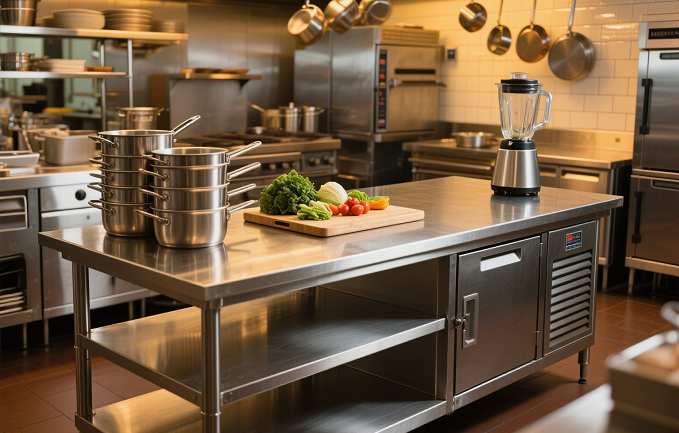
Legs and Frame: Look for solid, square legs (e.g., 38mm x 38mm) which offer superior stability compared to round tubes. They are easier to clean and less likely to wobble under heavy loads.
Adjustable Feet: Essential for ensuring your table sits perfectly level on any kitchen floor, preventing rocking and protecting the floor from scratches.
The Top: A splashback is a simple addition that prevents liquids and debris from falling behind the table, making cleanup easier. Edges should be smoothly rolled or hemmed for safety and easy cleaning.
Storage Options: This is where customization is key. Do you need undershelves for storing sheet pans and large pots? Drawers for keeping utensils organized and within reach? Or a fully enclosed storage cabinet, like those offered by Keasid, which are ideal for protecting cutlery, dry goods, or cleaning supplies from dust and splashes? Their cabinets often feature easy-sliding doors and internal shelves, maximizing utility without sacrificing floor space.
3. Load Capacity and intended Use: Matching Strength to Demand
A work table must be built to carry your weight. A small prep station might only need to hold 150kg, but a central table supporting mixers, meat grinders, and heavy pots needs a much higher capacity. Always check the manufacturer's stated load capacity. Heavy-duty units are engineered with reinforced legs and double-walled tops to handle demands of 500kg or more, ensuring they won't buckle or bend during intense service.
4. Hygiene and Ease of Cleaning: Non-Negotiable in Food Safety
Stainless steel is chosen primarily for its hygienic properties. A smooth, non-porous surface prevents bacteria from harboring and is easy to sanitize. The finish matters: a brushed or Scotch-Brite finish is common as it hides scratches and fingerprints better than a mirror polish. All welds should be ground smooth, and the design should have minimal crevices where dirt can accumulate. Features like upturned edges on undershelves demonstrate a brand's commitment to meeting the highest international hygiene standards.
5. Size and Configuration: Fitting Your Space
Measure your kitchen space meticulously. Consider not just the table's footprint, but also the clearance needed around it for staff to move comfortably. Think about height—standard is around 36 inches, but ensure it’s comfortable for your primary users. Modular tables that can be placed together or on casters for mobility offer incredible flexibility for dynamic kitchen environments.
Conclusion: An Investment in Efficiency
Choosing a stainless steel work table is a strategic decision. By prioritizing high-quality 304-grade steel, considering the functional features that match your workflow, and verifying its structural strength, you select more than just a table. You invest in a tool that enhances organization, upholds food safety, and withstands the relentless pace of a commercial kitchen for years to come. Brands that provide clear specifications—like the material thickness, load rating, and construction details—such as Keasid, empower you to make an informed choice, ensuring your kitchen’s backbone is as strong as it needs to be.

Post Your Ad Here
Comments