The Rise of Generative AI in Everyday Life (2025 Update)
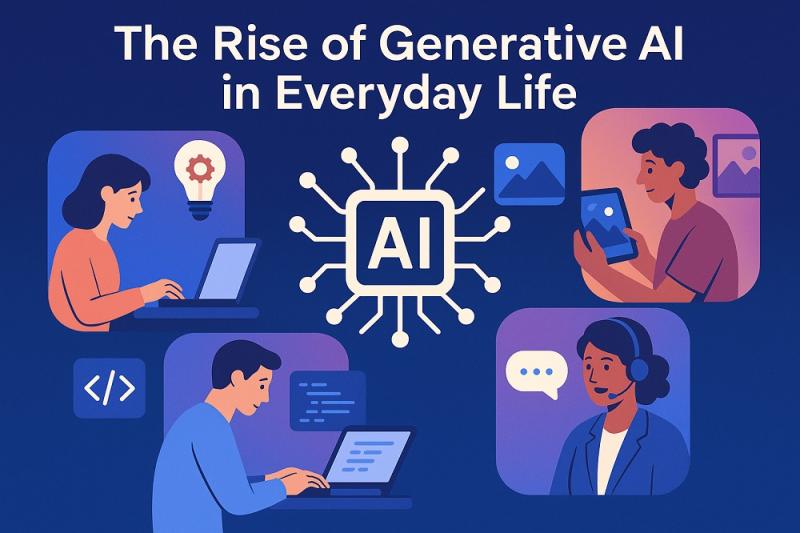
In just a few short years, Generative Artificial Intelligence (AI) has evolved from a futuristic concept into a real-world technology that is transforming everyday life. From assisting creatives to helping developers code smarter, generative AI is not only reshaping industries—it’s reshaping how we live, work, and interact.
As of 2025, the adoption of generative AI has surged across sectors, from healthcare and education to design, entertainment, marketing, and customer service. This article explores the rise of generative AI, real-world use cases, ethical concerns, and what the future may hold.
What is Generative AI?
Generative AI refers to algorithms—especially those built on deep learning models like GPT (Generative Pre-trained Transformer), DALL·E, and Stable Diffusion—that can create new content such as text, images, music, and even code. These models are “trained” on massive datasets and can produce human-like results based on prompts.
Unlike traditional AI that classifies or predicts based on input data, generative AI goes a step further—it generates entirely new data that mimics human creativity.
Why the Boom in 2025?
Several key factors have contributed to the explosion of generative AI in 2025:
-
Improved Computing Power: The widespread adoption of powerful GPUs and cloud-based AI platforms has made training and deploying generative models faster and more affordable.
-
User-Friendly Interfaces: Platforms like ChatGPT, Midjourney, Adobe Firefly, and GitHub Copilot have made it easier for non-technical users to leverage generative AI tools.
-
API & Plugin Ecosystems: From Figma to Notion to Microsoft Word, countless SaaS platforms have integrated generative AI via APIs, offering seamless content creation within popular apps.
-
Open-Source Contributions: Open-source models like Mistral, LLaMA, and Mixtral have democratized access to powerful generative technologies for developers worldwide.
Real-Life Applications of Generative AI
1. Content Creation
Writers, marketers, and creators are using tools like ChatGPT, Jasper, and Writesonic to generate blog posts, product descriptions, ad copy, and email campaigns within minutes.
2. Design & Visual Art
Artists and designers leverage tools like Midjourney, DALL·E, and Adobe Firefly to create concept art, logos, posters, and even fashion designs—streamlining ideation and reducing production time.
3. Music and Audio Production
AI tools such as Suno, AIVA, and Soundraw allow musicians to compose original scores, generate backing tracks, and even replicate specific genres or moods.
4. Education & Learning
Personalized AI tutors are helping students learn at their own pace. Tools like Khanmigo (by Khan Academy), Quizlet’s AI tutor, and Google’s LearnLM model offer interactive and adaptive learning experiences.
5. Programming & Development
GitHub Copilot and CodeWhisperer generate code, suggest functions, and even write documentation, accelerating software development workflows.
6. Customer Service Automation
Businesses are replacing outdated chatbots with smarter AI agents that handle complex queries with conversational fluency, leading to improved customer satisfaction.
7. Healthcare Assistance
Generative AI is being used for medical imaging, drug discovery, mental health chatbots, and even generating personalized diet and fitness plans.
Ethical Considerations and Risks
Despite its transformative potential, generative AI raises several ethical and practical concerns:
-
Misinformation and Deepfakes: AI-generated text, images, or videos can spread false narratives and impersonate public figures.
-
Bias and Representation: Models trained on biased data may reproduce stereotypes, affecting outputs in sensitive fields like hiring or healthcare.
-
Plagiarism and IP Theft: Artists and writers argue that generative AI may replicate original work without consent, leading to copyright concerns.
-
Job Displacement: Roles in content writing, customer support, and even design are being reshaped, raising questions about job security.
Governments and organizations are increasingly calling for AI regulation. In March 2024, the European Union passed the AI Act, the first legislation of its kind, categorizing AI use cases by risk levels and mandating transparency for generative AI models.
Case Study: AI in Journalism
One of the most impactful use cases of generative AI is in journalism. Media outlets now use AI to draft breaking news, generate summaries, and even suggest headlines. For example, Associated Press has been using AI-generated earnings reports since 2014, and in 2025, they’ve scaled it to cover hundreds of real-time updates every day.
AI helps journalists focus on investigative and human-interest stories by automating repetitive reporting tasks. However, it also raises concerns about accuracy and the diminishing role of human editors in validating news.
Generative AI & Personal Productivity
Many individuals now rely on generative AI to enhance personal productivity. Whether it’s writing a resume, creating a meal plan, drafting legal letters, or designing a wedding invitation, generative AI acts like a “copilot for life.”
Some popular personal productivity tools in 2025 include:
-
ChatGPT-4o: Real-time, multi-modal assistant integrated with voice, vision, and text
-
Notion AI: Smart meeting notes, task tracking, and writing help
-
Canva Magic Studio: Design suggestions, automated presentations, and AI-generated visuals
-
Rewind AI: Contextual memory assistant that records and summarizes screen activity
Future Outlook: What’s Next for Generative AI?
1. Agentic AI
The next wave involves Agentic AI—autonomous systems that not only generate but also act on their own. Imagine an AI assistant that not only books your flights but reschedules your meetings and negotiates upgrades.
2. Multimodal Fusion
Future models are expected to fully merge vision, audio, and text into a unified understanding system. Google Gemini, OpenAI’s GPT-5 (expected soon), and Anthropic’s Claude 3.5 are working towards this goal.
3. Local & Private AI
With privacy being a top concern, on-device AI (running locally without cloud dependency) is gaining traction. Apple’s latest iPhones now ship with Apple Intelligence, combining device-based AI with private cloud execution.
4. AI in the Physical World
Generative AI is moving beyond screens into robots, vehicles, and IoT devices. For instance, AI-generated instructions are used in home robotics for cleaning, cooking, or companionship.
Conclusion
Generative AI is not just a trend—it’s a technological revolution that is already reshaping our personal and professional lives in 2025. While it brings immense opportunities for creativity, efficiency, and problem-solving, it also demands careful thought about ethics, regulation, and human oversight.
Whether you’re a marketer, student, developer, artist, or entrepreneur, the future will likely involve you collaborating with AI tools in some form. Embracing this transformation—while staying informed and cautious—is key to thriving in the AI-powered era.
Post Your Ad Here
Comments (1)
AcademIQ.io6
All-in-One School Empowerment
Generative AI is no longer just futuristic — it’s part of our daily routines in 2025.
And with platforms like Academiq.io, it’s making learning, teaching, and even student wellness smarter, faster, and stress-free.