The best shoulder exercises and why they’re essential to your workout
This is why you shouldn't overlook working
your shoulders
You know you're supposed to
work your back and chest... maybe you even put a heavy emphasis on building
your biceps and triceps, but are you neglecting your shoulders?
If you
are, it's time to make a change. The shoulder joint is the most flexible joint
in the entire body — which is pretty amazing, actually, except that with its
propensity for flexibility comes an increased instability and risk for injury.
And
injury is pretty common — especially given that the shoulder is used, well, all
the time. Want to grab something off a shelf? You're using your shoulder. Want
to push yourself up out of bed? You're using your shoulder. Want to turn the
steering wheel while driving? You're using your shoulder.
More: Workouts for Women
See? It's pretty important to Workout for Women, which is
precisely why you need to make a point of working it when you work out. The
good news is compound exercises — including push-ups, planks and assisted
pull-ups — already help get the many (many!) muscles of your shoulders warmed
up. So, if you're already engaged in a full-body routine, you probably haven't
completely neglected your shoulders.
That doesn't mean you
can rest on your laurels. By specifically targeting your shoulders with the
following exercises, you can increase strength and stability in your shoulder
joint, helping reduce the likelihood of injury.
1.
Dumbbell shoulder press
This
compound, multijoint exercise engages all three deltoid muscle heads, as well
as the back, chest, triceps and other stabilizing muscles, which is precisely
why it should be performed first.
Stand, kneel or sit on a bench with a dumbbell in each
hand. Raise the dumbbells to shoulder height with elbows bent, palms facing
away from you. Press the dumbbells straight up over your head, stopping just
before your elbows fully extend. Reverse the movement and return to start.
2.
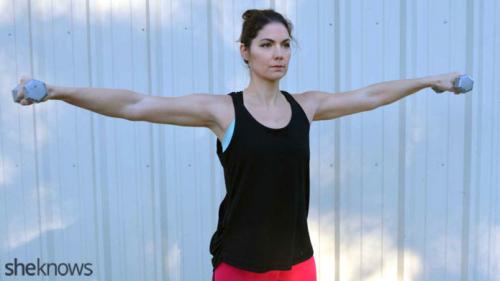
Lateral dumbbell raise
Isolate the middle, or lateral, deltoid with a lateral
dumbbell raise. Stand or kneel, holding a dumbbell in each hand, your arms at
your sides, palms facing toward your body. Keeping a slight bend in your
elbows, engage your shoulders and raise your arms straight up and out to your
sides, stopping when they're extended out laterally at shoulder height. Reverse
the movement and return to start.
3.
Front dumbbell raise
Isolate the anterior, or front, deltoid with a front raise.
Stand or kneel, holding a dumbbell in each hand with your arms at your sides —
but this time, rotate your arms slightly forward, so your hands are in front of
your thighs, your palms facing your body. Keeping a slight bend in your elbows,
engage your shoulders and raise your arms straight up in front of your body,
stopping when they're extended forward at shoulder height. Reverse the movement
and return to start.
4.
Reverse fly
Isolate the posterior, or rear, delts with a reverse fly.
Hold a dumbbell in each hand, your feet hip-distance apart, your knees slightly
bent. Press your hips back and tip forward from the hips, lowering your chest
toward the floor while keeping your back straight. Allow your arms to hang from
your shoulders, but keep your muscles engaged, your elbows slightly bent and
your palms facing one another.
6.
Resistance band scapular squeeze
To improve posture and help train you to keep your
shoulders back, a simple scapular squeeze can help. Hold a resistance band in
both hands, your elbows bent, upper arms affixed to your sides and palms facing
one another. In a single movement, squeeze your shoulder blades together and
rotate your arms out laterally to your sides, pulling against the resistance of
the band. When you've rotated as far as you can, hold for a second and then
return to startPost Your Ad Here
Comments