DBCO Reaction – Principles
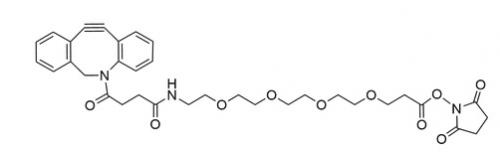

Diarylcyclooctynes
Diarylcyclooctynes happen to be thermally constant compounds that are characterized by their incredibly narrow and explicit reactivity towards the azide group. The ligation reaction happens to be very high-speed and brings about a quantitative production of stable triazoles.
The strain-helped Click reaction is a rival of the professed Staudinger ligation. Each of the reactions is chemoselective and has no need of copper and thus none of them cause damage to biomolecules. Nevertheless, the Staudinger ligation has a rate that is approximately 100 times lesser that what the DBCO cycloaddition has, which is why the Staudinger ligation is hardly of any use in the study of dynamic biological systems. Just in cases not depending on the rate of ligation, each of the reactions is able to be used equally effectively.
DBCO Conjugation Chemistry
DBCO conjugation chemistry happens to be founded on reaction of a dibenzylcyclooctyne/DBCO/ADIBO linker with an lnker of the azide group to produce a constant triazole. The rate of this “click reaction“ is exceptionally speedy at room temperature, has no need of a cytotoxic Cu(I) catalyst & produces constant triazoles. This exclusive covalent bond is formed when DBCO, integrated into one variety of biomolecule, reacts with a linker of the azide group, integrated into another biomolecule.
DBCO and azide is dissimilar to numerous conjugation reagents in that they are continuingly stable when joined to biomolecules. A feature of DBCO – azide conjugation chemistry is its complimentary nature, because of which they react among themselves only.
Features & Benefits
• Stable – produces a triazole
• Biocompatible – have no need for a catalyst
• Explicit – the only thing that azide reacts with is DBCO, even if -SH, -NH2, -COOH or added protein functionalities are present
• Bio-orthogonal
• Each and every reaction is performed in aqueous buffered media leading to high conjugation effectiveness.
This three step method is better than preceding methods since it does not lead to the formation of homo-polymers and enables more controllable production of the conjugate wanted. DBCO & azide linkers come in different lengths and could be picked to react with a thiol, amine, / carboxyl group of biomolecules. Getting this started requires a couple of reagents, namely, DBCO & azide.
Such crosslinkers happen to be the most competent & quantitative linkers existing and helps in production of first-rate conjugates that are easily reproducible and performs better in examinations.
List Of Chemical Modification Reagents Containing DBCO
DBCO-Acid
Dibenzylcyclooctyne-Acid
DBCO-lc-Acid
Dibenzylcyclooctyne-C6-Acid
DBCO-Amine
Dibenzylcyclooctyne-Amine
DBCO-NHS ester
Dibenzylcyclooctyne-NHS ester
DBCO-lc-NHS ester
Dibenzylcyclooctyne-C6-NHS ester
DBCO-Sulfo-NHS ester
Sulfo-Dibenzylcyclooctyne-NHS ester Sodium salt
DBCO-PEG4-NHS ester
Dibenzylcyclooctyne-PEG4-NHS ester
Dibenzylcyclooctyne-S-S-NHS ester
DBCO-S-S-NHS ester
DBCO-Maleimide
Dibenzylcyclooctyne-Maleimide
DBCO-PEG4-Maleimide
Dibenzylcyclooctyne-PEG4-Maleimide
About the Author
Find more from Click Chemistry Tools! Expand the boundary of your discovery research with our click chemistry toolbox. Read more.
Advertise on APSense
This advertising space is available.
Post Your Ad Here
Post Your Ad Here
Comments