Couscous nutrition
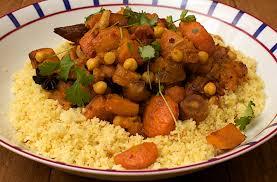
What is couscous?
Couscous, a staple of North African and national dish in several countries (Tunisia, Libya, Algeria, Morocco), has its roots among the Berbers. The oldest traces of manufacture (sort of couscous) were found in Kabylia. Strictly speaking, the couscous is the seed obtained by agglomeration of semolina, fine, medium or large. Couscous is often accompanied by a vegetable broth called "marka". It can also serve it with sour milk called "bin".
What is the etymology of the word "couscous"?
According to Salem Chaker Advanced etymology by [Algerian university, doctor of letters, Berber language specialist, Professor of Berber universities at the National Institute of Oriental Languages and Civilizations - INALCO - de Paris], the word comes from the Berber couscous whose basic form is "k'seksu" which means both semolina durum and popular dish in which it is the basic ingredient. The name "couscous" was given to the preparation once traditionally made in a clay dish.
Some think it comes from an onomatopoeia referring to the rattle of breath and semolina grains when the rolls on hand. Others believe it could be derived from Classical Arabic "kaskasah" which means "grind, grind," from the Arabic "kiskis" designating the steamer used for its cooking or sound issued by steam during cooking .. It could also come from an Arabic word meaning beaked bird that gives its young.
Most of Algeria, Morocco and Libya is call this dish also طعام or "ta`aam", that is to say, food. In eastern Algerian country is called the "barbucha" derived from the Berber "aberbuc" meaning large grains.
What is the origin of couscous?

Historians are divided about the exact origin of Couscous and the date of its appearance in the Maghreb: some argue that it would be from China, other East Africa (Sudan via the Egypt); Sudan was cooked the pilpil and "couscous" millet or sorghum in woven baskets subjected to steam in the same way that today is cooked semolina wheat or barley in the strainer of the couscous .
But the most common and the most plausible theory is that the appearance of couscous in North Africa where archaeological excavations have revealed the presence of cooking utensils dating from the ninth century that resemble very strongly to the cooking main tool couscous which is the couscous. A researcher dates its origins between -238 and -149 BC. BC, while another states that it appeared that between the XI and XIII century, between the end of the Zirid Dynasty to the beginning of the Almohad Dynasty.
The expansion of couscous was effected from the eleventh through the commercial development of this region, particularly the development of wheat, brought by the Arab-Muslim conquests. Under the Roman Empire, wheat is mainly grown in North African colonies, the Near East and Sicily. These areas serve as foster attics.
Thus couscous was introduced and spread in sub-Saharan Africa, Andalusia and the Mediterranean in general. Couscous spread from the Maghreb to Egypt, sub-Saharan Africa and the Middle East. This dish was introduced in the Iberian peninsula in the thirteenth century when it became popular among the Moors. A period of Muslim rule, between 829 and 1063, may be the source of the introduction of couscous in Sicily. Portugal has introduced the commodity in the sixteenth century in its Brazilian colony, where he remains an important dish for breakfast today.
The French have discovered under Charles X at the time of the conquest of Algeria. The couscous was ranked in 2006 as the second most favorite French dishes.
The expansion of couscous has continued and has seen a major boost during the twentieth century thanks to the successive waves of immigration from North Africa to many European countries, particularly in France where the dish has become over very popular years.
The fantastic beliefs about couscous
It is said that to make someone fall in love with a spell, simply roll the couscous to the "Moon Water" or the hand of a recently buried corpse. These are the witches, dark, haunting cemeteries to engage in practices as macabre ...
The virtues attributed to the couscous
He brings God's blessing on all who consume.
He wears, like bread, baraka (luck).
Superstitious women ensure the loyalty of their husbands to the next year if they serve their couscous in which they have concealed the tenderest pieces of the tail of the sheep.
Place couscous in the community
The image that we retain couscous is that of a woman (mother or grandmother) who, "sitting on the floor on a sheepskin, folded right leg and extended left leg, back against the wall with all the handy utensil ", rolls with the golden grain repetitive.
Couscous has in the Maghreb countries a cultural dimension which can be described as identity. Just like pasta or rice are staple foods for the Italians or the Chinese, couscous represents for the people of the Maghreb a staple and an identity pillar. Couscous has long been the "national dish" of North Africa. For all, it is part of daily and religious life and accompanies all the great events of life. Its preparation and tasting are always a celebration.
To discover a tale Berber couscous around the theme here.
Couscous is a symbolic fine in the Algerian tradition and Maghreb: festivity, wedding, circumcision, offerings, death ... It creates a meeting, reunion. It is also a link that strengthens friendship and further strengthens family alliances. It means, moreover, links and reconciliations. It means sharing and solidarity. Couscous is the flat sharing, so the hospitality and generosity. It refers to the founding principle of every community, solidarity.
On many occasions, couscous is present in the life of the community:
- Couscous celebrations, wedding, baptism or circumcision: these dishes are the product of a long social-cultural process that has its origins in the past; on these occasions, couscous and tradition are strongly intertwined.
- Couscous cities, mountains, desert. Couscous of the rich and the poor. Couscous Maghreb, immigration and beyond. Couscous adapts to specific means and living conditions of each family and each community, which explains its permanence and its ability to evolve. The spirit of sociability and conviviality that characterizes excellence by sharing dish.
Couscous also means authenticity. Thus, couscous remain forever inscribed in our memories, in our songs, our palace.
Advertise on APSense
This advertising space is available.
Post Your Ad Here
Post Your Ad Here
Comments