Compare Spectrum vs WOW Business Internet Florida: High-Speed Plans & ISP Comparison
Florida weather can flip from sunny to sideways rain before you finish an iced latte. When the lights flicker, broadband is the first to feel it—and a ten-minute outage during lunch can wipe out a day’s sales. Cafés refund whole queues, retailers watch card readers time-out, and field data shows two hours of downtime can cost a small shop thousands in lost revenue and one-star reviews.
For years, Spectrum Business filled most of that gap, stringing hybrid fiber-coax across Orlando, Tampa, and the Panhandle. Now challenger WOW! Business is trenching brand-new fiber straight to the curb, lighting pockets of Seminole, Orange, and Pinellas counties with equal-upload, multi-gigabit speeds. Competition is finally on the menu.
In the pages ahead we’ll compare these providers the way you run your P&L: speed, price, reliability, coverage, support, and the extras that make life easier. You’ll see where each wins, where each falls short, and—most important—what that means for your bottom line in the Sunshine State.
Pull up your address, grab last month’s bill, and let’s find the connection that keeps your business humming even when the clouds roll in.
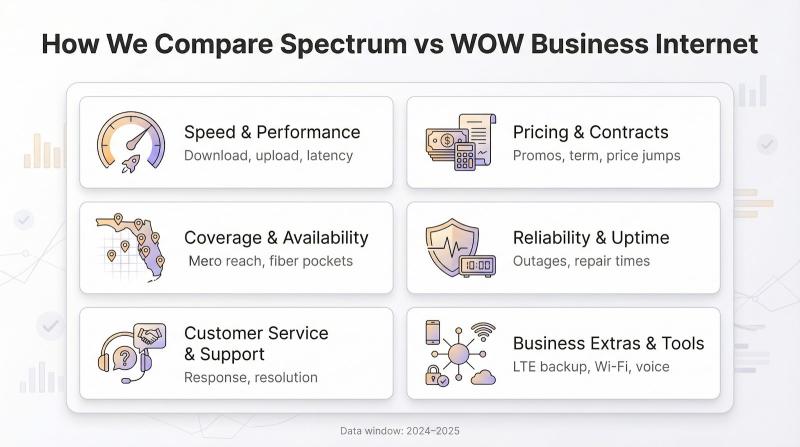
How we put Spectrum and WOW! under the microscope
To choose a winner you need clear rules, so we built a six-point scorecard that matches the worries Florida owners raise every day.
First came raw horsepower. We logged the advertised tiers and verified real-world results from independent speed tests. Next came dollars and fine print: promo prices, contract clauses, and the second-year jump many plans hide.
Coverage mattered just as much. We plotted both networks against the latest FCC service maps, then zeroed in on hurricane-prone counties where uptime can make or break a quarter. Reliability received its own lens through third-party outage studies and storm reports.
For example, the WOW! Business service-status portal posts live outage maps with time-stamped restoration ETAs—transparency that helps us see whether a blip was a neighborhood hiccup or a county-wide event.
We paired those logs with Spectrum’s public maintenance bulletins to calculate each provider’s real mean-time-to-repair and spot patterns third-party trackers sometimes miss.
We rounded out the analysis with customer-service benchmarks and add-on tools such as LTE failover or mesh Wi-Fi that turn a plain circuit into a business solution.
Every data point sits inside the 2024–2025 window, so you’re judging today’s reality, not last decade’s marketing slide.
Spectrum and WOW! at a glance: two very different playbooks
Picture Spectrum as the long-established franchise. It inherited Bright House’s coax grid, stretched fresh fiber backbones, and now covers most of Florida’s metro ZIP codes. Walk into a strip mall in Tampa, Daytona, or the Panhandle and chances are a Spectrum node already feeds the building. Plans start at 500 Mbps down and scale to 1 Gbps or 2 Gbps, but uploads stay modest because the last mile still rides copper. The payoff? No contracts and a deep bench of field techs on speed-dial.
WOW! feels more like the hungry expansion team. Instead of retrofitting old cables, it pours concrete, drops conduit, and blows new fiber straight to the storefront. The footprint is smaller: pockets of Pinellas, Seminole, Orange, and a sliver of Panama City. Inside those zones you get symmetrical 300 Mbps up to 5 Gbps. A one-year contract locks the promo price for 24 months, and the install crew often finishes the drop before the paint over utility markouts dries.
So the first decision is simple. If WOW! can’t reach your address, Spectrum becomes the default choice. If both providers are available, you’re weighing broader reach against pure speed. In the next sections we’ll score each category so you know exactly where one outmuscles the other.
Spectrum vs WOW! in one glance
Before we dive into speed tests and fine print, here is the quick comparison every owner asks for. Scan the rows, circle the column that fits your priorities, and you will know which sales rep to call first.
All figures reflect 2025 promotional offers and public specifications.
Keep that snapshot handy; we will unpack each line in the next sections.
Speed and network performance
Spectrum cable muscle: fast downloads, modest uploads
Spectrum delivers plenty of horsepower where owners feel it first: downloads. The entry business tier clocks 500 Mbps, and you can move to a full gig with ease. On a good day Speedtest results even top the sticker, thanks to Charter’s fiber backbone feeding each neighborhood node.
Uploads still squeeze through coax. Twenty to fifty Mbps works for point-of-sale syncs and light Teams calls, but creative shops moving 4 K footage or medical offices uploading imaging files will watch the progress bar inch along. Spectrum knows this pinch point and has begun mid-split upgrades that double or triple upstream room while it readies a full DOCSIS 4.0 lift. Once the statewide upgrade arrives, uploads climb into the hundreds and even gig range. Today, though, we rate what you can order, not the press release.
Latency sits in the low twenties for most Florida hops, quick enough for video chat and cloud apps, though fiber rivals dip into single digits. In short, Spectrum hands you a highway built for download-heavy workflows and steady performance. If your business sends far more data out than it pulls in, keep reading because the next provider flips that ratio.
WOW! fiber advantage: uploads that fly
WOW! flips the script. WOW!’s fiber internet for business plans top out at 10 Gbps symmetrical, leaving plenty of headroom for render farms, nightly cloud backups, and tomorrow’s AI workloads.
Because the line into your building is pure glass, download and upload speeds match stride for stride: 300, 600, 1,000, even 5,000 Mbps in both directions. That symmetry feels almost magical the first time you drag a gig-size file to the cloud and watch it leave as fast as it arrived.
Latency drops as well. Most Florida hops land in single-digit milliseconds, so video calls sound crisp and remote-desktop sessions feel local. Congestion, the bane of many cable nodes at 5 p.m., barely registers on a freshly lit fiber splitter with generous headroom.
Consistency stays high because the drop is buried. Afternoon squalls knock branches into power lines, not underground conduit. As long as electricity reaches the optical network terminal, your data keeps moving.
On raw performance WOW! wins the footrace, especially for upload-heavy workflows. Spectrum still owns the download crown in broader speed-test averages, but when you need two-way muscle for render farms, nightly backups, or telehealth video, you will notice the fiber difference.
Pricing and contract dynamics
Sticker price grabs attention, but total cost over three years decides whether you buy new laptops or shelve the upgrade.
Spectrum keeps things simple. Pay about $65 each month for 500 Mbps or a little over $100 for 1 Gbps, and leave whenever you like. The first 12 bills stay flat; invoice 13 often climbs by roughly $35. Because you are month-to-month, retention agents will extend fresh promos if you hint at switching. That flexibility is valuable when rent rises or you open a second location.
WOW! takes the opposite approach. Sign a one-year agreement, and the company locks your promo for 24 months: $45 for 300 Mbps symmetrical, $55 for 600 Mbps, and around $95 for the gig tier. No jump in year two keeps budget meetings calm. Break the contract early, though, and you pay the remaining balance or a capped fee.
Equipment fees differ. Spectrum includes the modem but charges extra for managed Wi-Fi gear. WOW! supplies the fiber gateway free for three months, then adds a modest rental unless you bring your own router.
Run the math: over 24 months WOW! often lands a few hundred dollars cheaper for pure internet. Add phone or mobile lines, and Spectrum’s bundle credits close the gap. Request written quotes from both, drop them into a spreadsheet, and compare 36-month totals, including expected price hikes and any early-termination exposure.
If flexibility matters more than every last dollar, Spectrum’s no-strings model wins. If cost certainty helps you sleep, WOW!’s two-year lock may feel safer. In either case, negotiate; both providers know the other is one call away.
Coverage and availability
Your dream provider is worthless if the truck never reaches your curb, so let’s map the turf.
Spectrum covers nearly every area you would expect from a major cable company. From Clearwater Beach, downtown Orlando, and the military bases in the Panhandle, its coax lines run along most commercial corridors. If your ZIP code sits outside the South Florida Comcast zone, odds are a Spectrum pedestal already feeds your strip center. That reach scales as well. A franchise with offices in Tampa, Lakeland, and Ocala can run one master agreement and keep billing tidy.
WOW! takes a sniper approach rather than a broad sweep. Its Florida network follows a thin line along Pinellas County’s west coast, hops east into Seminole and Orange suburbs, and ends in Panama City. New construction in Hernando County widens the band, but large portions of the state, such as Jacksonville, Gainesville, and the Treasure Coast, remain blank. In short, you either sit inside a fiber-lit pocket or you do not.
Overlap exists, and that is where deals can shine. Businesses in Altamonte Springs, Largo, or parts of St. Petersburg can play providers against each other and watch promo credits grow. Everywhere else, the available streetscape already chooses for you.
Start with each provider’s address checker. If WOW! cannot service your suite, keep reading for Spectrum details. If both pass your door, you have gained bargaining power.
Reliability and uptime
Florida weather challenges every provider. Afternoon lightning can scorch pole-mounted lines, and tropical storms push tree limbs through cable like hot knives through butter. The question is not whether outages occur, but how often and how long they last.
Spectrum’s grid is mostly aerial, so wind and debris take their shots. The company counters with scale: hundreds of local technicians, pre-staged generators, and a wireless LTE fail-over box that switches on automatically when the main line drops. That box keeps card readers and key laptops online for about eight hours, long enough to finish a dinner rush or close out the books.
WOW! plays defense differently. Its new fiber is buried along most routes, safe from flying branches and less prone to lightning strikes. Users report few hiccups outside of commercial power cuts. When power does fail, the optical terminal in your suite needs backup batteries you supply; plan for that and the fiber usually rides out the storm.
Consistency shows in the numbers. Opensignal’s 2024 national reliability study ranked Spectrum first among major ISPs, noting the lowest share of disrupted sessions over the year. WOW! was too small for that list, but early Florida fiber customers praise its solid uptime in forums and local user groups.
Which path feels safer? Spectrum leads with proven recovery muscle and an automatic cellular backup. WOW! answers with fewer incidents to begin with. If your operation cannot tolerate even a brief blip, add a secondary circuit. If you must choose one line, weigh Spectrum’s fallback tools against WOW!’s storm-resistant trench and select the level of risk that fits your business.
Customer service and support
When the internet blinks at 8 a.m. on payroll day, the hold music you hear next shapes your mood for the week. Here is how each provider treats you once the sale is signed.
Spectrum runs a service like a Fortune 500 help desk. Business support is staffed around the clock and based entirely in the United States. Techs roll out fast because there are many of them; most metro areas host local crews plus a spare van or two borrowed from residential ops. That depth shows in the numbers. J.D. Power’s 2025 study crowned Spectrum the top small-business ISP for overall satisfaction, scoring high on performance, cost, and problem resolution.
WOW! aims for a boutique feel. The Florida fiber build is still young, so you often reach the same handful of reps who remember your last ticket. Install windows are flexible, and field techs sometimes share personal cell numbers for follow-up. The trade-off is capacity. A county-wide outage can swamp the call queue, and advanced replacement gear may need to ship from out of state.
Which style works better depends on your temperament. If you want a large safety net and predictable processes, Spectrum’s scale feels reassuring. If you prefer knowing the support agent by name and can handle a little hustle during rare large-scale events, WOW!’s personal touch may suit you. Test both hotlines before signing: time the pickup and decide whose tone you trust when deadlines loom.
Business extras that sweeten the pipe
The Internet alone rarely covers modern needs. You also need phones that never drop, Wi-Fi that blankets the showroom, and security that blocks malware before it reaches a laptop. Here is how the two contenders bundle those extras.
Spectrum leans into a unified model. Add a cloud voice line for about $20, tack on mobile plans that ride Verizon’s towers, and choose its managed router if you want Wi-Fi 6 and automatic threat blocking. Put everything on one invoice, and Spectrum often extends the price guarantee or throws in a free LTE backup modem, a lifesaver when lightning knocks out the main link.
WOW! keeps the bundle lighter but polished. Every new fiber install includes a Wi-Fi 6E gateway at no extra charge, or you can upgrade to mesh eero units that cover corner offices and patio seating in reliable signal. Need a static IP? Often included. The company also partners with YouTube TV for lobby or sports-bar screens, skipping clunky coax boxes.
Both providers offer VoIP, static addressing, and guest networks; the difference is nuance. Spectrum’s scale brings nationwide roaming hotspots and enterprise tools such as SD-WAN. WOW! relies on high-end hardware baked into the base price and the speed of fiber to keep overhead low.
List your must-haves (phone, mobile, TV, security) and tally the add-on costs. One provider usually stands out once the extras hit the spreadsheet.
Future-proofing: where each network goes next
Technology never sits still. Spectrum and WOW! both have ambitious roadmaps, but they move in different directions.
Spectrum’s play is a large DOCSIS 4.0 overhaul. Field trials are underway, and commercial launches are set to reach Florida metros by late 2025. Once the switch flips, the same coax that tops out at 50 Mbps uploads today can jump to gig-class upstream with multi-gig downstream. The upgrade rides existing lines, so no trench crews or landlord approvals are needed, just a modem swap and you are back in business with fiber-like speeds.
WOW! is investing in fiber build-out rather than tuning copper. The company has budgeted millions to pass 400,000 more Florida addresses by 2027, carving new routes north of Tampa and deeper into Central Florida suburbs. Because the build rests on XGS-PON gear already capable of 10 Gbps symmetrical, raising speed tiers later is mostly a software change.
Conclusion
What does that mean for your timeline? If you need fast uploads today and sit inside a WOW! pocket, act now. If you operate statewide or want the certainty of defined launch dates, Spectrum’s coming upgrade levels the field without a move. Either way, by the end of this decade most Florida businesses will treat multi-gig service as standard, so plan your cloud projects with that in mind.
Post Your Ad Here
Comments