Invisible AI in 2026: How AI Runs Modern Businesses
Introduction
Most organizations believe their AI journey is still in its early stages of adoption. They assume that true adoption will occur once their business has implemented visible chatbots, predictive dashboards, or copilots. That approach of assumption is already outdated. The reality is that 2025 was the year of Invisible AI—the silent, embedded intelligence that makes decisions, runs operations, and optimizes outcomes without making any announcement.
Invisible AI operates in the background, beneath familiar systems and tools, quietly transforming how modern enterprises function. And whether leadership realizes it or not, AI in business is already a part of their daily ecosystem. Gartner predicts 40% of enterprise apps will feature task-specific AI agents by 2026, up from less than 5% in 2025.
What is “Invisible AI”?
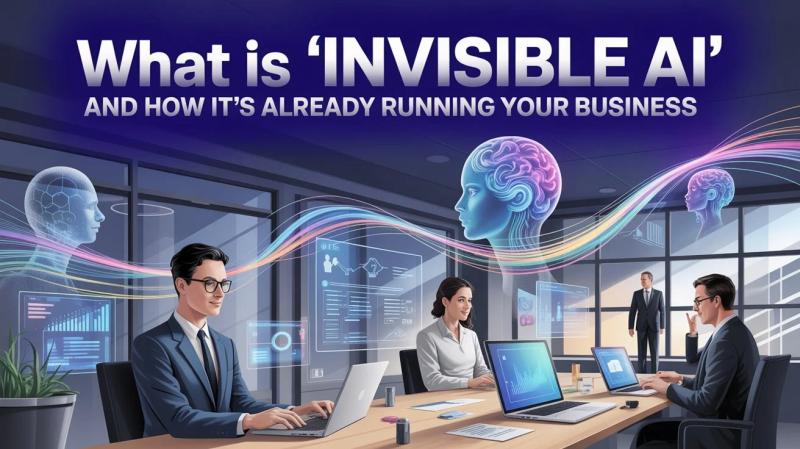
Invisible AI is artificial intelligence integrated into enterprise systems and business processes to the point that end users no longer recognize it as AI. It's the intelligence that:
- Scores are automatically ranked, so no one has to do it manually.
- Finance departments flag irregularities in advance.
- Makes recommendations on the supply chain without executive instructions.
- Personalizes customer experiences without requiring the marketing teams to coordinate.
This is not an interface. It is not a chatbot. It is enterprise AI behaving like digital intuition: it is independent of humans, constantly learning, and making real-time decisions.
Invisible AI is not launched as an independent project, unlike conventional AI projects. It is orchestrated as a layer in business automation to streamline workflows without requiring visible triggers or prompts.
Why 2025 Was the Year of Invisible AI
Several structural changes have overlapped, making Invisible AI the dominant force shaping enterprise operations in 2025:
1. Intelligence is Now Native to SaaS
Contemporary platforms, such as CRM or supply chain ERPs, integrate AI tools for business operations. You are not deploying AI that way, but every time you are looking to the next-best actions suggested by a system or automating approvals, you are using AI.
2. Enterprises Finally Have Data Worth Learning From
Earlier, the organizations gathered information in the hope that it would eventually be used to bring about transformation. That day has arrived. Labeled, clean data enables Invisible AI to make wise decisions for businesses.
3. Cloud + Edge = Real-Time Inference
AI is not dependent on human-initiated processes. Prices, routing, and personalization decisions are implemented in a few milliseconds before employees even know.
4. Business Leaders Are Prioritizing Outcomes, Not Technology
The narrative has shifted. Stakeholders don't ask "Where is AI?" They question, "What can we do to optimize processes as quickly as we can? They have KPIs aligned with AI automation services, autonomous systems, and quantifiable value deliveries.
2025 is the moment when AI stops being a visible innovation and becomes invisible infrastructure.
Invisible AI is Already Running Critical Business Operations
The impact of AI is becoming increasingly substantial, yet executives underestimate it. They envision that AI is yet to have a strategic kickoff. The reality is that they are already engulfed in the AI automation, and it is pervasive even in mission-critical situations:
Sales & CRM
The most important opportunities are those identified by predictive scoring. The AI can identify deal risks, recommend engagement strategies, and identify action priorities without lifting a finger for sales managers.
Finance
Anomaly detection, revenue prediction, and fraud detection are performed by invisible algorithms. CFOs are shifting toward automated insights rather than models that require analyst services.
Customer Experience
AI-based processes direct queries, personalize communications, and initiate intelligent interventions. Customers get the impression that they are supported, even when a human isn't directly communicating with them.
Supply Chain
Routing, procurement, and vendor scoring are no longer fixed working processes. AI predicts demand, optimizes order volumes, and automatically takes corrective measures, an extreme form of business automation.
Security & Compliance
Invisible AI alarms raise threats and enable policy controls more rapidly than human teams can analyze logs or address breaches.
This is the operational reality of how Invisible AI is transforming business operations, not taking the place of teams, but enhancing their decisions and minimizing the time in which they can be implemented. Explore how process automation enables SMEs to compete effectively in a changing business market.
Invisible AI Use Cases Across Enterprise Functions
Business Function | Invisible AI Use Case | Business Impact |
Sales & CRM | Predictive lead scoring, deal risk analysis | Higher win rates, reduced sales cycle time |
Marketing | Behavioral segmentation, real-time personalization | Improved conversion and campaign ROI |
Customer Support | Intent-based ticket routing, sentiment analysis | Faster resolution, improved CSAT |
Finance | Anomaly detection, revenue forecasting | Reduced fraud risk, improved forecasting accuracy |
Operations | Demand forecasting, workflow optimization | Lower operational costs, improved efficiency |
Supply Chain | Autonomous routing, vendor performance scoring | Reduced delays, resilient logistics |
HR & Talent | Attrition prediction, workforce planning | Reduced churn, optimized hiring |
IT & Security | Threat detection, access risk scoring | Faster response, improved compliance |
Cloud & DevOps | Cost anomaly detection, auto-scaling | Optimized infrastructure spend |
The Enterprise Stack is Quietly Evolving Into an AI Operating System
Technology had been historically a toolset. The model is being mutated by AI today. Models take their own initiative, rather than humans, who organize businesses into self-regulating spaces.
This change transforms old workflows into AI workflow automation ecosystems:
- Service flows are initiated automatically by customer intent.
- Abnormalities in finances initiate remedial compliance measures.
- The late deliveries trigger re-routings without permission.
We are also moving into the era of enterprise AI, which is becoming an invisible command-and-control layer. Companies that comprehend this change will not implement AI; they will control it.
The Competitive Divide is No Longer About AI Adoption
In 2025, enterprise competitiveness has been divided into two camps:
Winners
- Think of AI as an implementation layer, not a visible technology.
- Control operational bottlenecks with autonomous AI systems.
- Manage information such as a strategic asset.
- Invest in proprietary signal loops feeding the next generation of cognitive models.
Losers
- Still "planning AI pilots."
- Think of AI as software, not infrastructure.
- Algorithms should be trusted only after they begin to show measurable metrics.
The winners will not discuss the AI, but they will benefit from it.
Invisible AI is Reshaping Profitability
All leadership teams are focused on a single outcome: efficiency. AI attack invisibility inefficient source:
- Creating less decision debt through manual decisions
- Improving consumer sensitivity
- Eradicating budgetary drag
- Compressing cycle time
This is how AI saves operational costs for businesses without introducing disruptive changes in the organization. It is not necessary for companies to implement new systems; they should make the ones they have work.
It is the strategic quality of AI business optimization, not to add technology but to be able to extract value through invisible intelligence that is already flowing through the business spine.
How to Capitalize on Invisible AI in 2026?
The following is the enterprise playbook to operationalize the value:
1. Map Your Current Invisible AI Footprint
Know the current locations of the embedded AI. You will be surprised to learn the number of systems that are making decisions on their own.
2. Identify High-Friction Decisions
These are the ideal candidates for the AI process automation and advanced process automation services.
3. Develop Agentic Artificial Intelligence
The following area of breakthrough is the development of agentic AI in business, where autonomous agents are used to perform business tasks without human control. Futuristic enterprises will:
- Apply agent models to reusable processes.
- Implement AI-based workflows of cross-department actions.
- Hire AI developers to add autonomy to legacy ecosystems.
It is through this that businesses can be able to use agentic AI systems to develop lasting and automated operating intelligence.
4. Invest in Machine Learning Foundations
Collaborate with machine learning development service providers that create models that are trained on proprietary signals, and not generic data.
5. Engineer Trust and Governance
Monitoring, observability, model explainability, and compliance form the new AI accountability core.
Organizations that implement these steps will enjoy compounding efficiency—the most defensible moat of the next decade.
Learn more about the cost considerations for AI development and enterprise implementation in “How Much Does AI Development Really Cost? A Comprehensive Breakdown.”
Conclusion
By 2025, the most powerful AI systems will be entitled not to those that make the news, but the ones that make the decisions, optimization of work, and scaling of operations run smoothly. Invisible AI has become the force behind the scenes, running the new businesses, transforming information into action and complexity into a competitive edge. Companies that acknowledge this change are no longer debating whether to adopt AI; they are already trying to control, maximize, and grow the intelligence already in place in their business.
Standalone tools and pilot projects will not be the next step in the enterprise transformation; the core of the transformation will be highly integrated, self-directed systems that learn and act continuously. Here, it is a strategic investment in AI development services that will be essential, not in bringing AI, but in designing, modularizing, and managing the work of the invisible intelligence regarding the core processes of business. Companies that proceed this way will not only reduce operational drag but also increase the speed at which decisions can be made and future-proof their digital foundation.
In the next few years, AI will no longer be something that you roll out, but rather something that you actually design into the structure of your business. And what the enterprises have mastered today, Invisible AI will dictate tomorrow's market leadership.
Post Your Ad Here
Comments