How Business Leaders Can Plan a Successful Cloud Migration
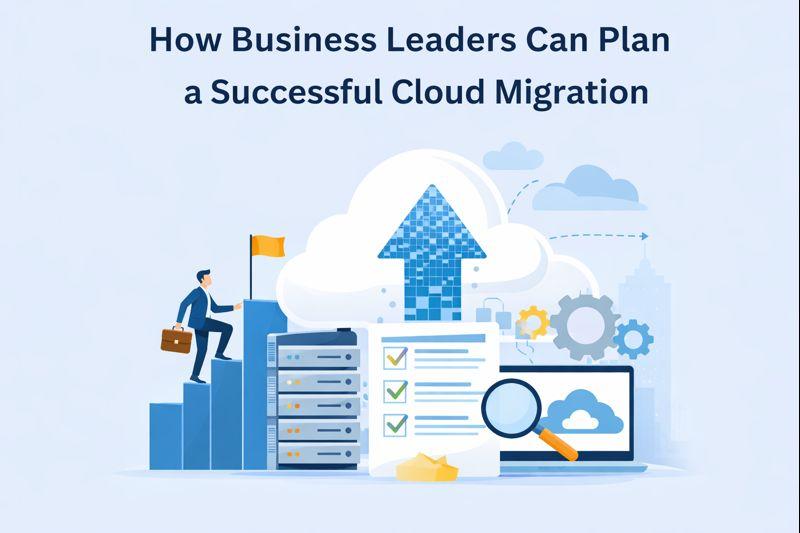
Cloud migration is no longer a low-key technical experiment for many businesses. Growth, resilience, and the capacity to adapt in an increasingly digital world are all directly impacted by this business decision.
However, shifting to the cloud without a clear plan frequently results in misunderstandings, overspending, and stalled development. Business executives must adopt a pragmatic strategy that strikes a balance between people, technology, and long-term corporate objectives.
That is the main focus of this roadmap.
Start with Business Intent, Not Technology
It's crucial to address a straightforward question before talking about platforms, tools, or architectures: What do we want the cloud to change for our business?
Faster product launches are desired by certain organizations. Others desire uninterrupted scalability or predictable infrastructure costs. Cloud decisions become simpler and more intentional when these results are well-defined.
Leadership, IT, and operations are all in sync from the start when a cloud migration is motivated by business intent.
Understand Your Current Environment Honestly
Every organization has a combination of legacy systems and contemporary applications. Ignoring this fact may lead to difficulties later in the migration process.
Leaders can determine which workloads are ready for the cloud, which need to be modernized, and which are no longer valuable by conducting a thorough assessment. Additionally, it draws attention to dependencies that are frequently undetectable until something goes wrong.
At this point, clarity is more important than speed. The transition gets easier the more you know where you're coming from.
Choose Migration Approaches That Fit the Workload
Rebuilding everything from the ground up is not necessary. While some apps can advance swiftly with little modification, others require a more thorough redesign to fully utilize cloud-native features.
Successful companies steer clear of imposing a single migration technique on every system. Rather, they use various strategies according to expected return, risk tolerance, and business criticality.
This adaptability keeps the migration focused on useful results and avoids needless complexity.
Bring in Experience Where It Matters
Migrating to the cloud is rarely merely a technical task. It entails team-wide planning, coordination, testing, and decision-making. Experienced cloud migration services can be very beneficial in this situation.
The appropriate expertise enhances internal teams rather than replaces them, assisting in avoiding typical pitfalls and speeding up development with tried-and-true frameworks and tools. This lowers uncertainty and boosts execution confidence for leaders.
Build Security and Governance into the Foundation
Security should never be an afterthought. Data protection, access controls, and compliance requirements must be taken into consideration from the outset when workloads shift to the cloud.
As environments expand, organizations can preserve visibility and control with the support of clear governance policies. Growth is accelerated rather than slowed when security and governance are incorporated into the original design.
Move in Phases, Not All at Once
Attempting to migrate everything in one go often creates unnecessary risk. A phased approach allows teams to learn, adjust, and improve with each step.
Starting with lower-risk workloads builds confidence. Gradually moving critical systems ensures business continuity while giving leadership time to evaluate results and refine strategies.
This measured approach keeps momentum without overwhelming teams.
Focus on Ongoing Operations After Migration
Reaching the cloud is not the finish line. Day-to-day performance, cost control, and reliability matter just as much after migration. This is where cloud management services become essential.
Effective management ensures systems stay optimized, secure, and available, allowing internal teams to focus on innovation rather than routine maintenance. Long-term success depends on how well the cloud environment is managed, not just how quickly it is deployed.
Review, Optimize, and Evolve Continuously
Cloud adoption is an ongoing journey. Business needs change, technology evolves, and opportunities emerge. Regular reviews help leaders measure progress against original goals and identify areas for improvement.
Optimization over time turns cloud migration from a one-time project into a strategic advantage that supports long-term growth.
Conclusion
A successful cloud migration is built on clarity, patience, and alignment between business and technology. When leaders approach migration with a clear roadmap, realistic expectations, and the right mix of expertise and management, the cloud becomes more than infrastructure — it becomes a platform for sustained innovation and resilience.

Comments