Event-Driven Database Design for Continuous Migration
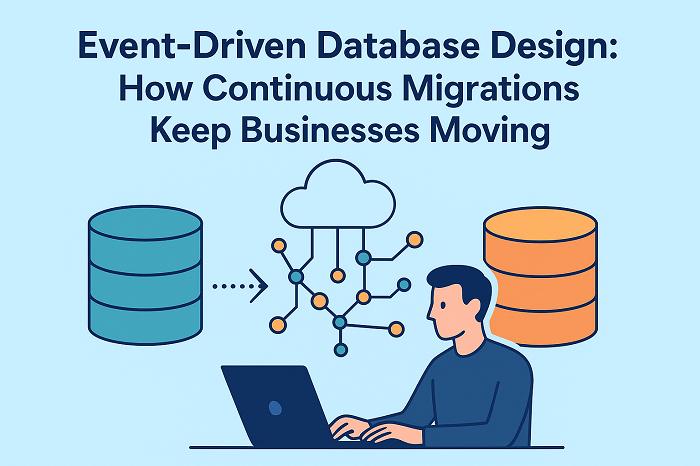
Every enterprise eventually faces the challenge of migrating databases — whether from on-premises systems to the cloud, across database engines, or into hybrid environments. Traditionally, these migrations came with risk, downtime, and anxious IT teams watching the clock. But that is changing. Today, with event-driven and self-healing architectures, organizations can migrate continuously — without ever stopping the business.
Why Traditional Migrations Fall Short
Picture a global e-commerce platform with millions of active users. At midnight, the IT team hits “go” to move a legacy SQL database to a cloud-native platform — and everything freezes. Orders stall, carts are abandoned, and revenue slips away.
This happens because traditional “lift-and-shift” methods rely on bulk data transfer — taking systems offline, copying data, and bringing them back online with uncertain results. The problem lies in treating migration as a one-time event instead of an ongoing process that evolves with the system itself.
Enter Event-Driven Database Design
The new approach views every data change — every insert, update, or delete — as an event. Instead of moving terabytes all at once, an event-driven model streams these changes in real time. Both old and new databases stay live and synchronized until the final switch-over.
Core components of this architecture include:
-
Change Data Capture (CDC) tools that record and publish updates.
-
Event-streaming platforms like Kafka or Kinesis that move those updates securely.
-
Target systems that apply these updates automatically and continuously.
This makes migration smooth, reversible, and nearly invisible to end users — business goes on uninterrupted.
How Event-Driven Designs Remove Migration Pain
Minimal downtime is the most immediate win. Both systems run side by side until the new one proves stable.
Built-in validation ensures issues appear early rather than at the end of a long migration cycle.
Future-readiness becomes a natural advantage — those same pipelines can power analytics, replication, and audit capabilities long after migration ends.
In short, migration becomes not a crisis but a feature of modern system design.
Building Self-Healing Pipelines
A self-healing pipeline is not science fiction — it is simply a design that anticipates failure and recovers automatically. Here is what that looks like in practice:
-
Stage before commit: Events are tested in a staging area before reaching production. Invalid records are isolated and flagged without stopping the flow. Many organizations rely on external data migration & management services to handle exception tracking, validation, and automated retries.
-
Version control for schemas: Treat schemas as code — track, checkpoint, and roll back safely.
-
Idempotent events: Ensure repeated events do not cause duplicate records or corrupt data.
-
Retry and dead-letter queues: Automate retries for temporary failures while sending problematic events for review.
-
Gradual cut-over: Shift traffic slowly, monitor closely, and roll back instantly if needed.
These principles allow migrations to stay live and adaptive — even under changing business demands.
Database Design Enables the Migration Strategy
Behind every smooth migration lies a thoughtful database design. Poorly structured databases make event-driven systems harder to maintain.
-
Normalized schemas reduce duplication and simplify event mapping.
-
Strong referential integrity keeps relationships between data consistent.
-
Consistent naming and metadata reduce human error during synchronization.
-
Sharding or partitioning allows parallel migrations and targeted rollbacks.
Well-designed databases not only simplify migrations but also make data more trustworthy, usable, and scalable.
Why You Need Expert Oversight
Even the best-designed pipelines need continuous supervision. That is where managed IT services add real value. These services offer 24/7 monitoring, automation for schema deployments, compliance checks, and real-time performance tuning of CDC and streaming layers.
With expert oversight, organizations move beyond “just completing migrations” — they evolve toward a culture of resilience, scalability, and uninterrupted growth.
Conclusion: Embrace Change Without Fear
Database migrations used to mean downtime, disruption, and high stakes. Not anymore. Event-driven database design and self-healing pipelines have made it possible to evolve continuously without halting operations.
Your database no longer has to be static storage — it can become a living system that grows with your business. In this future, companies do not fear change — they design for it.
Post Your Ad Here
Comments