How Diamond Resale Prices Are Calculated: The Complete Guide
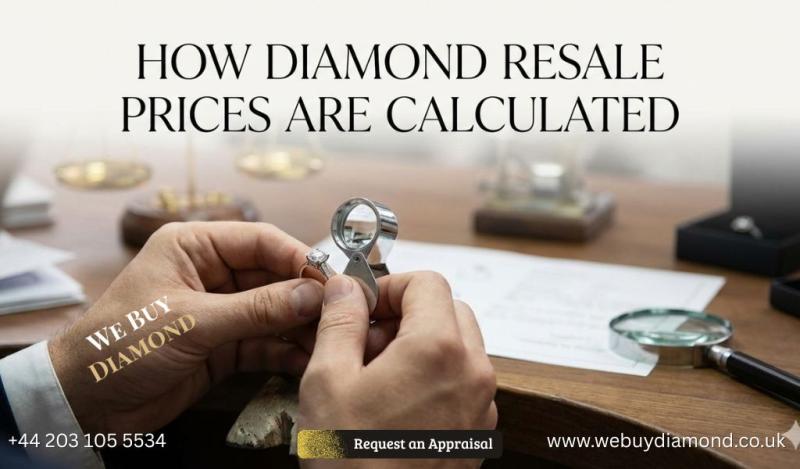
Calculating diamond resale prices is a scientific process based on the 4Cs
(Carat, Cut, Clarity, Colour), verified preferably by GIA certification.
Crucially, resale value is based on the current wholesale market price,
striping out the original retail markups, VAT, and overheads. Understanding
that you are selling the intrinsic value of the stone, rather than its original
retail cost, is key to a successful transaction in the London market.
Introduction
For many, deciding to sell a
cherished piece of diamond jewellery is a significant emotional decision.
Often, the second biggest emotion encountered is surprise upon receiving the
initial offer. A common question echoes among sellers: "Why is the offer
so different from what I originally paid?" Understanding how diamond resale prices are calculated
is crucial to managing expectations and ensuring you receive a fair deal when
selling your assets.
The secondary market for diamonds
operates differently than the retail sector. It is driven by intrinsic value
and global market conditions rather than retail markups. If you are looking to sell a diamond ring in
London, navigating this process requires understanding the specific
factors professional buyers use to determine value. This guide breaks down the
calculation process used by experts in hubs like Hatton Garden, ensuring
you are well-informed before you request an appraisal.
The
Core Components of Diamond Valuation
Professional diamond buyers do not
guess prices; they calculate them based on a rigid set of criteria. Here is the
step-by-step process of how your diamond's resale value is determined.
1.
The Foundation: The 4Cs
The universal language of diamond
quality is the "4Cs." Every valuation starts here.
- Carat Weight:
The physical weight of the diamond. Larger diamonds are rarer, so the
price per carat increases exponentially as the weight goes up.
- Cut:
This is perhaps the most critical factor for sparkle. A diamond with an
'Excellent' or 'Ideal' cut grade reflects light better and commands a
higher premium than a poorly cut stone that looks dull.
- Clarity:
The absence of internal inclusions or external blemishes. Grades range
from Flawless (FL) to Included (I3). The cleaner the stone, the higher the
value.
- Colour:
For white diamonds, this measures the absence of colour, ranging from D
(colourless and most valuable) to Z (light yellow).
2.
The "Passport": Laboratory Certification
A diamond's resale value is
significantly impacted by its paperwork. A certificate from a reputable
independent laboratory, most notably the GIA (Gemological Institute of
America), is the gold standard.
A GIA certificate provides
indisputable proof of the 4Cs. Without this "passport," the buyer
must grade the stone themselves, often taking a conservative approach to
mitigate risk, which can result in a lower offer. If you have a GIA
certificate, mention it immediately when you get a free quote.
3.
The Reality Check: Retail vs. Resale Market Value
This is the most critical concept
for sellers to grasp. When you bought the diamond at retail, the price
included:
- The jeweller's significant profit margin.
- VAT (20% in the UK).
- Business overheads (rent in a prime location,
marketing, staff).
When you sell, these costs are
stripped away. You are selling into the secondary market. Professional
buyers in London's Hatton Garden are calculating the intrinsic
wholesale value of the stone—essentially, what it would cost them to
replace that exact diamond on the global wholesale market today.
4.
Market Trends and Demand
Like any commodity, diamond prices
fluctuate based on global supply and demand.
- Shape Trends:
While Round Brilliant cuts hold value best due to constant demand, shapes
like Princess or Marquise fluctuate in popularity, affecting their resale
price.
- Economic Factors:
Global economic strength can influence the demand for luxury goods,
impacting wholesale diamond prices.
5.
The Setting Value
Don't forget the metal. If you are
selling a diamond ring or necklace, the gold or platinum setting has a scrap
metal value which is added to the final offer.
Why
Hatton Garden is the Hub for Accurate Pricing
If you are looking for the best diamond
valuation in London, Hatton Garden is the epicenter. The high concentration
of expert dealers creates a competitive environment. Buyers here have deep
expertise, direct access to international markets, and the capital to make
immediate offers on high-value items. Visiting a specialist here is often far
more fruitful than visiting a general high-street pawnbroker.
Conclusion
Selling diamond jewellery is an
excellent way to unlock capital for new endeavours, holidays, or investments.
By understanding how professional buyers calculate value, you can approach the
sale with confidence. Do not settle for guesswork. Ensure you deal with reputable Hatton Garden specialists
who offer transparent pricing based on the true market value of your gemstone.
Ready to discover the true value of
your diamond?
Don't let your assets gather dust.
Take advantage of the current market. Get a free quote from our expert
London buyers today. Request an appraisal
online, or Visit Our Store Today
in the heart of Hatton Garden for an immediate, no-obligation free valuation.
FAQs
Q: Why is the resale offer so much
lower than my insurance appraisal?
A: An insurance appraisal represents
the retail replacement cost—the highest possible price to replace the
item brand new in a jewellery store, including full retail markups and VAT. The
resale offer is the wholesale market value—what a dealer is willing to
pay for the pre-owned item. These two figures are fundamentally different.
Q: Does having a GIA certificate
increase my diamond's resale value?
A: Yes, significantly. A GIA
certificate is trusted globally and removes uncertainty about the diamond's
quality (the 4Cs). This allows buyers to offer a tighter, more competitive
price without factoring in a "risk discount."
Q: Where is the best place to sell a
diamond ring in London?
A: Hatton Garden is widely
considered the best location. It is London's historic jewellery quarter,
housing numerous specialist diamond buyers who compete for goods, ensuring you
receive an accurate valuation based on real-time market data.
Q: What if my diamond doesn't have a
certificate? Can I still get a free valuation?
A: Yes, absolutely. Expert buyers
have on-site gemologists who can grade the stone. However, for significant
stones, they may recommend sending it to GIA for certification to maximise its
resale value before finalising the sale.
Q: Is the price of the setting
included when I sell my diamond ring?
A: Yes. The offer will comprise the
wholesale value of the central diamond(s), plus the scrap metal value of the
gold or platinum setting, based on the current daily precious metal spot
prices.

Post Your Ad Here
Comments