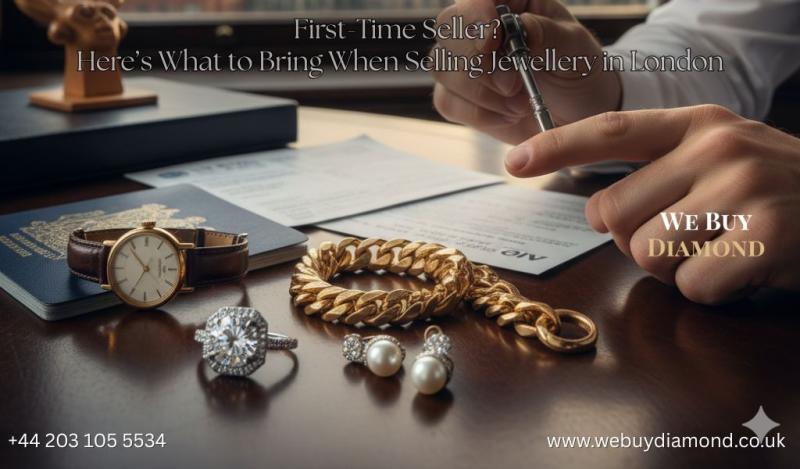
First-Time Seller? Here is What to Bring When Selling Jewellery in London
Introduction
If you are considering selling a
treasured piece of jewellery—perhaps an inherited diamond ring, an old watch,
or unused gold—the process can feel overwhelming. Where do you start? What is
it worth? And crucially, what documents do you need to ensure a secure, legal,
and profitable sale?
For sellers in London, the
historical Hatton Garden district is the ultimate destination for
securing the best price. To make your first visit efficient and successful,
being prepared is key. This guide outlines exactly what to bring when selling jewellery in London to guarantee a smooth and highly
rewarding experience.
Category
1: Mandatory Legal Requirements
Reputable jewellery buyers,
particularly those operating in established centres like Hatton Garden, must
adhere to strict Anti-Money Laundering (AML) regulations set by the UK
government. This diligence protects both the buyer and the seller and is
non-negotiable for a professional transaction.
·
1. Photographic ID: You must bring a current, valid form of photographic
identification. This is required to prove you are the legal owner making the
sale.
o Examples: Valid Passport, Full UK Driving Licence, or National ID
Card.
·
2. Proof of Address: You will also need documentation to confirm your current
residential address, typically issued within the last three months.
o Examples: Utility Bill (not a mobile phone bill), Bank Statement,
or Council Tax Bill.
Crucial Note: Reputable buyers will keep a record of these documents for
their legal compliance files (typically for five years). Never sell to a dealer
who does not ask for ID, as this signals a disregard for legal standards.
Category
2: Documents to Maximise Your Price
While the legal documents ensure
the transaction is secure, these items are vital for
establishing the value of your jewellery, often
leading to a significantly higher final offer:
·
1. Gemmological Certificates: If your item features a significant stone, especially a
diamond, the GIA (Gemological Institute of America) or IGI
(International Gemological Institute) certificate is the single most important
document. This independent report details the 4 Cs (Carat, Cut, Colour,
Clarity), saving the buyer time and cost on re-certification, which translates
directly into a higher price for you.
·
2. Original Receipts or
Invoices: The original proof of purchase or
sales invoice establishes the provenance (history of ownership) and can act as
unofficial proof of authenticity, particularly for branded or antique pieces.
·
3. Previous Appraisals or
Valuations: While an insurance valuation often
exceeds the resale market value, providing an older appraisal gives the buyer
essential information about the item's specifications, age, and condition at
the time the appraisal was conducted.
·
4. Original Box and Packaging: For high-end luxury items (e.g., Cartier, Tiffany & Co.,
Rolex), the original box, outer packaging, and papers (such as service history
for a watch) significantly enhance the resale value, as collectors desire a
complete set.
Category
3: The Jewellery Itself
Prepare your jewellery for its free
valuation by following these simple steps:
·
1. Clean and Detangle: While professional buyers will assess the metal purity and
stone quality regardless of condition, presenting a clean, detangled piece
(especially chains) makes the initial inspection faster and more pleasant.
·
2. Check for Hallmarks: Look for small stamps on the inside of rings, on the clasp of
necklaces, or the back of earrings. These UK hallmarks indicate
the metal and purity (e.g., '750' for 18ct gold, '925' for sterling silver) and
provide instant confirmation of content.
Summary
For a first-time seller
seeking to sell jewellery in London, preparation is the key to maximising your cash offer. You must
bring Photo ID and Proof of Address for legal compliance. To
maximise your valuation, gather any GIA/IGI certificates, original
receipts, and boxes. By visiting a professional buyer in Hatton Garden, you ensure a transparent, secure, and
competitive transaction based on a free valuation.
Conclusion
Selling your jewellery should be a rewarding experience, not a stressful one. By
compiling the necessary legal and value-adding documents before you leave home,
you empower yourself to secure the best possible price. Don’t delay—take
advantage of the competitive offers available in Hatton Garden, London,
today.
Ready to convert your unwanted
jewellery into instant cash?
Get a free quote for your items in minutes. Request an appraisal from our expert team or Visit Our Store Today
in the heart of Hatton Garden for an immediate, free valuation with no obligation.
FAQs
Q: Do I need a GIA certificate to
sell my diamond ring?
A: No, you can sell a diamond ring
without a certificate, but the buyer will need to have it professionally
appraised in-house. Having a GIA certificate provides immediate, trusted
third-party verification, which nearly always results in a higher and faster
offer.
Q: What if I can't find my old
receipt?
A: Don't worry. While helpful, the
receipt is not mandatory. The most important factor is the item's intrinsic
value (metal and stones), which will be determined by a professional jewellery
appraisal during your visit.
Q: Is it safe to sell jewellery in
Hatton Garden?
A: Yes. Hatton Garden is the
historical centre of the UK jewellery trade. Reputable dealers follow strict
legal protocols, require ID, and provide secure, traceable payment (usually
instant bank transfer), making it the safest place to sell jewellery in London.
Q: Do you offer a free valuation?
A: Yes, all professional buyers in
Hatton Garden, including our store, offer a complimentary, no-obligation free
valuation of your jewellery items based on current market prices.
Post Your Ad Here
Comments