CI Testing Practices That Improve Developer Feedback Loops
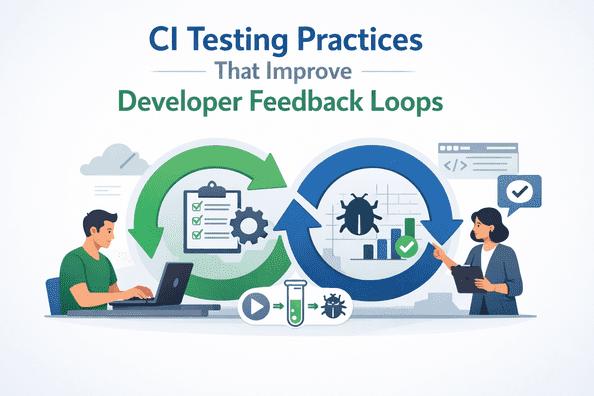
Fast and reliable feedback is the foundation of effective continuous integration. When developers receive timely signals about the impact of their changes, they can fix issues early and maintain delivery velocity. CI testing plays a central role in enabling this feedback loop by validating code changes automatically and consistently.
However, not all CI testing practices contribute equally to developer productivity. Poorly designed pipelines can slow builds, generate noisy failures, and erode trust in test results. Improving feedback loops requires deliberate testing strategies that balance speed, reliability, and relevance.
Why Developer Feedback Loops Matter
Developer feedback loops describe the time and effort required to understand whether a change is safe. Short feedback loops allow teams to identify defects immediately, while long or unreliable loops lead to delayed fixes and context switching.
CI testing acts as the first automated checkpoint after code is pushed. When implemented effectively, it provides developers with clear, actionable signals that guide decision-making without slowing down development.
Prioritize Fast-Running Tests in CI
One of the most effective ways to improve feedback is to keep CI testing fast. Long-running pipelines delay validation and discourage frequent commits.
Teams should prioritize lightweight tests such as unit tests and focused integration checks in CI pipelines. Heavier system or end-to-end tests can run asynchronously or on scheduled pipelines. This layered approach ensures developers receive rapid feedback while maintaining overall test coverage.
Make Test Failures Actionable
A failing test is only useful if developers can quickly understand why it failed. Ambiguous errors, flaky tests, or insufficient logs undermine the value of CI testing.
Clear assertions, meaningful error messages, and structured logs make failures easier to diagnose. Well-designed CI testing environments also preserve artifacts such as logs and reports, allowing developers to investigate issues without rerunning builds locally.
Reduce Noise from Flaky Tests
Flaky tests are a major obstacle to effective feedback loops. When tests fail intermittently, developers lose confidence in CI results and may ignore failures altogether.
Stabilizing tests through proper synchronization, environment isolation, and reliable test data improves signal quality. CI testing should surface real regressions, not environmental noise. Addressing flakiness is often one of the highest-impact improvements teams can make.
Align Tests with Real Development Risks
Not all failures are equally important. CI testing should focus on validating areas of the codebase that change frequently or carry higher risk.
By aligning test coverage with critical paths and recent changes, teams improve the relevance of feedback. Tests that rarely catch defects but frequently fail due to maintenance issues should be reconsidered or moved out of the main CI pipeline.
Use Incremental and Change-Based Testing
Running the entire test suite on every commit is often unnecessary and inefficient. Incremental CI testing strategies run only the tests impacted by recent changes, reducing execution time while preserving confidence.
Change-based testing improves feedback loops by delivering faster results without sacrificing quality. This approach is especially effective in large codebases with extensive test suites.
Integrate CI Testing with Pull Request Workflows
Feedback is most valuable when it arrives before code is merged. Integrating CI testing directly into pull request workflows ensures that developers see results in context.
Clear pass or fail signals, combined with test summaries and coverage indicators, help reviewers make informed decisions quickly. This tight integration reinforces CI testing as a core part of the development process rather than a post-merge safety net.
Combine Automation with Real-World Scenarios
While traditional tests validate expected behavior, incorporating real-world usage patterns can further improve feedback relevance. Some teams capture actual API interactions and replay them as automated tests to detect unexpected regressions.
Tools like Keploy support this approach by generating tests from real traffic, helping teams validate behavior that reflects production usage while keeping CI testing automated and fast.
Monitor and Continuously Improve Feedback Quality
Feedback loops should evolve as systems grow. Teams should regularly review CI testing performance, failure patterns, and execution time to identify improvement opportunities.
Metrics such as mean time to failure detection, test execution time, and failure resolution time provide insight into feedback effectiveness. Continuous refinement ensures CI testing remains an enabler of developer productivity rather than a bottleneck.
Final Thoughts
Effective CI testing is not about running more tests, but about delivering faster, clearer, and more reliable feedback. By prioritizing speed, stability, and relevance, teams can transform CI pipelines into powerful feedback mechanisms.
When CI testing is designed with developers in mind, it shortens feedback loops, reduces friction, and helps teams deliver high-quality software with confidence.

Comments (1)
Jack Willson6
Nice article on this topic and everyone should read it.