From Orchard to Factory - The Process of Drying Apricots
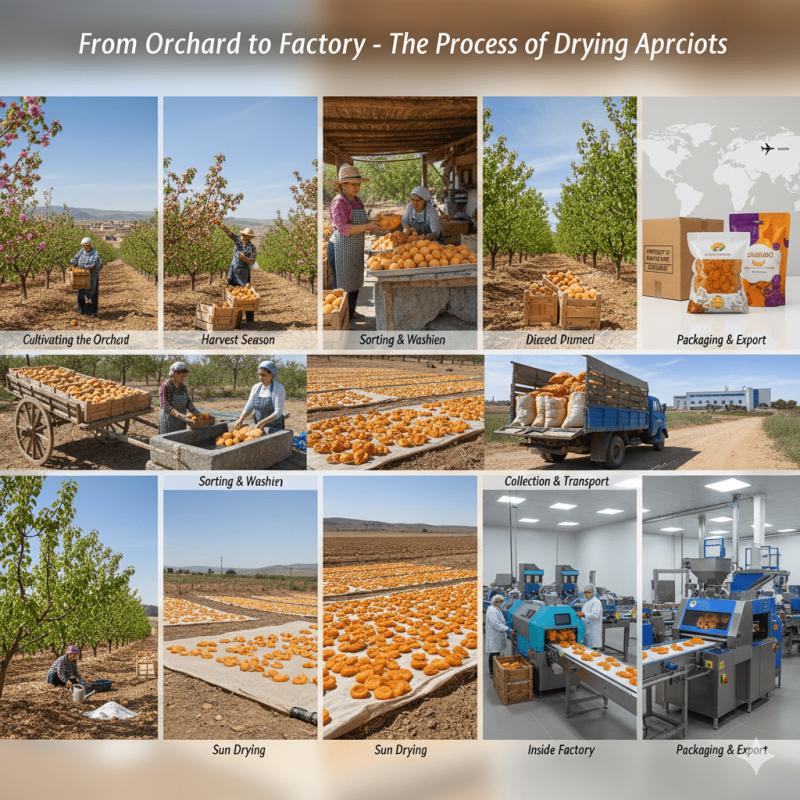
Cultivating the Orchard - The Beginning of Everything
The life cycle of dried apricots begins many years before the actual production of the crops. Apricot trees will grow best in an area with cold temperatures during winter and hot summer months. This type of environment is ideal in countries like Turkey, which is known as the world’s leading producer of apricot production. Examples of regions in Turkey include Malatya.
During orchard cultivation, farmers focus on:
Soil preparation & Fertilization
Tree pruning for controlled growth and airflow
Pollination assistance & flower protection
Seasonal pest & disease control
Water-efficient irrigating methods
This ensures that the resulting apricots from the orchard are of good flavor and quality, an ingredient prerequisite in Dried Apricots Production.
Harvest Season – Hand Harvested at Maturity
Harvest begins in late June or early July, when the apricots are in perfect ripeness. However, the period is of great importance, as unripe apricots will not be sweet, while dried apricots that are.overripe will be soft.
The farmers pick the produce by hand in order to avoid damaging it. The produce is carefully packed into boxes. The produce is then taken to the next processing stage. The issue of damaging the produce during this stage is important, as it will affect the produce after it has been processed.
Sorting, Washing, and Preparation of Drying
Once collected, apricots are transported from orchards to drying areas. Before the drying process begins, the fruit undergoes:
Sorting – Removing damaged or defective fruit
Washing - Cleaning in order to remove dust and natural residues.
Pitting and halving – Pitting the apricots followed by dividing them into halves in order to dry evenly.
This stage provides a base for establishing uniform Dried Apricots Production, which is dependent on standardization of size and quality during the drying process.
Stage 4: Sun Drying - Tradition meets Nature
Sun drying is considered one of the oldest preservation methods. Even now, sun drying is considered the hallmark of dried apricot production from premier sources. The prepared apricot halves are spread on cleaned drying trays or natural mats in the sunlight. The warm air from the sun gradually evaporates the moisture from the apricot.
Sun drying is an eco-friendly, economical, and efficient method. Sun drying also enhances the natural sugar contents of the fruits by giving them a rich natural flavor. The process is regulated by labor observing the temperatures, moisture levels, and sanitation of the food.
Sulphuring is done before drying, as demanded by customers, in order to create the famous bright orange color of sulphured apricots. For customers looking for chemical-free produce, unsulphured apricots can be dried naturally, giving an amber color.
Step 5: Harvesting or Collection, Transported to Factory
As soon as the moisture level reaches a level of 18-22%, dried apricot production can continue. The dried apricots are then packed in bulks and distributed to Dried Apricots Factory facilities. Factories act as the final processing hub, where dried apricots contribute to the production of a highly valuable, export-ready commercial produce. The dried apricots received by the facilities will still be cleaned.
Step 6: Inside the Factory – Advanced Processing and Food Safety
The Dried Apricots Factory is where tradition meets modern technology. The objective of this phase will be to refine, grade, calibrate, and pack the produce as per international standards. The processing plant of a professional level comprises of the following:
Optical Sorters & Laser Scanners
Manual inspection conveyors
Metal detectors & X-ray machines
The effect of moisture on buildings
Moisture
Automated Packaging Equipment
The factory stage entails the following steps:
A. Rehydration and Softening
Dried apricots can be rehydrated slightly in order to provide a more appetizing texture.
B. Grading and Calibration
Apricots are categorized by size, moisture level, cleanliness, and visual appearance. Uniform grading ensures consistency for buyers.
C. Sorting and Defect Removal
Sorting refers
Through the use of optical systems and human labor, foreign materials, defects, and broken pieces are eliminated in order to meet export standards.
D. Food Safety Assurance
Each Dried Apricots Factory has to comply with BRC, HACCP, ISO 22000, FDA standards. This ensures the safety of products, traceability, and hygienic practices by the dried apricots factories.
Step 7: Packaging for Export and Distribution
The processing is followed by the packing of the produce into bulks, PE bags, vacuum packages, or retail cartons. The packing of the produce protects it from moisture, oxidations, or physical injuries occasioned by transportation.
The dried apricots can be exported by both sea, land, and air transport. The dried apricots can be exported mainly to Europe, the USA, Asia, as well as the countries of the Middle East. The dried apricots can be consumed by retailers, wholesalers, bakeries, food service companies, or snacking enterprises.
Why This Journey Matters
The ‘orchard to factory’ process is the key to ensuring quality. Every step of this chain, from cultivation, harvesting, drying, grading, processing in the factories, to packaging, directly impacts:
FlavorColor
Texture
Food safety
Shelf life
Knowing how Dried Apricots Production works will help importers, retailers, and others understand the skills that go into every item of dried produce they consume. Conclusion The history of dried apricots can be traced from the sunny apricot orchards right through to their processing in modern manufacturing plants. The whole process, from cultivation right through to processing, encompasses tradition as well as modern manufacturing. Dried apricots can continue thriving among the most cherished dried fruits of the world owing to their processing through natural drying, sophisticated processing plants, and human labor. The relationship between the garden of fresh produce and the Dried Apricots Factory ensures production of the fruit that can be consumed practically all around the world.
Post Your Ad Here
Comments