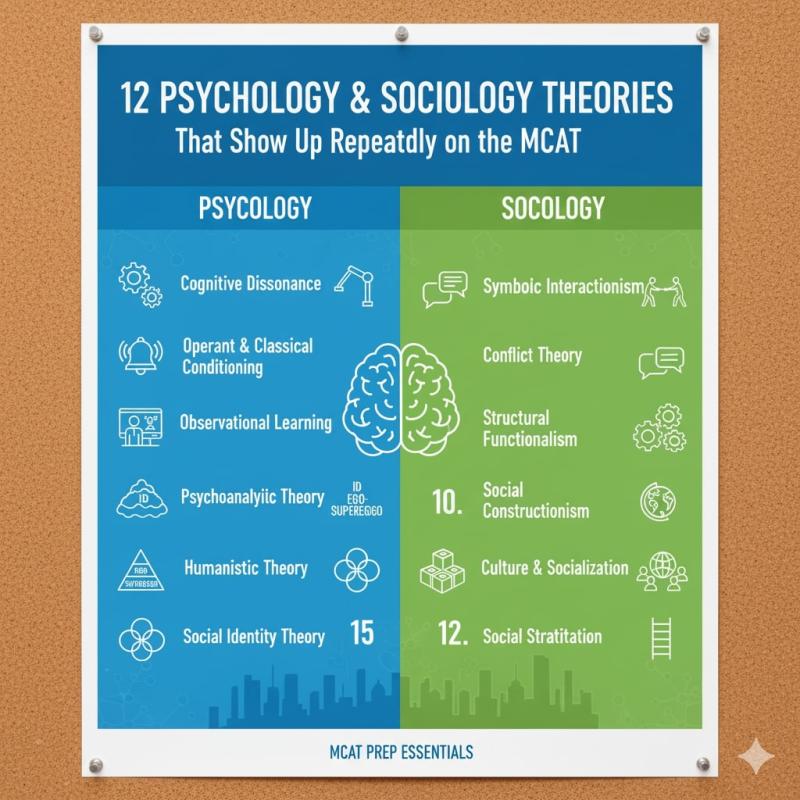
The psychology and sociology sections of the MCAT often challenge students not because they’re complex, but because they require conceptual clarity and real-world application. These subjects evaluate your ability to connect psychological theories with biological and social principles.
With expert MCAT Tutoring and MCAT classes online, students can decode these theories, understand their nuances, and recognize patterns that appear repeatedly in the test. Below are 12 theories that every MCAT aspirant must master.
1. Classical Conditioning – Pavlov’s Groundbreaking Experiment
Ivan Pavlov’s discovery of classical conditioning revealed how behaviors could be learned through associations. In this theory, a neutral stimulus becomes linked to an unconditioned stimulus to produce a conditioned response.
On the MCAT, expect to encounter questions that explore the formation of habits, phobias, or emotional responses through conditioning. Recognizing terms like unconditioned stimulus, conditioned response, and extinction can help you answer these quickly and accurately.
2. Operant Conditioning – B.F. Skinner’s Behavioral Mastery
Operant conditioning centers around reinforcement and punishment to shape behavior. Positive reinforcement adds pleasant consequences, while negative reinforcement removes discomfort.
MCAT questions might describe case studies involving student motivation, workplace productivity, or parenting techniques. Understanding Skinner boxes and reinforcement schedules is essential to mastering these questions.
3. Cognitive Dissonance Theory – Leon Festinger
Cognitive dissonance explains the discomfort we feel when our beliefs and behaviors conflict. To relieve that tension, people either change their attitudes or justify their actions.
For example, a person who values health but smokes might rationalize it by saying, “I only smoke occasionally.” On the MCAT, this concept shows up in questions testing attitude change and decision-making processes.
4. Social Learning Theory – Bandura’s Observational Learning
Albert Bandura’s Bobo doll experiment demonstrated how people learn through observation and imitation. In the MCAT, you’ll often find passages where individuals model behaviors based on observing others, emphasizing vicarious reinforcement.
Students in MCAT classes online often use group simulations to visualize this theory in real time, deepening their grasp of learning psychology.
5. Attribution Theory – Heider’s Perspective
Attribution theory helps explain how people infer causes for behavior—whether internal (dispositional) or external (situational). On the MCAT, attribution-based questions often test your understanding of fundamental attribution error or self-serving bias.
6. Functionalism – Emile Durkheim’s Social Balance
Durkheim’s perspective of society as a system of interdependent parts is central to functionalism. It focuses on how institutions contribute to social stability. MCAT passages may include examples from education, family, or religion, testing your ability to connect these to larger societal structures.
7. Conflict Theory – Karl Marx’s Power Struggles
Conflict theory interprets society through the lens of inequality, class struggle, and power dynamics. On the MCAT, you might see examples of healthcare disparities or resource allocation analyzed through Marx’s framework.
8. Symbolic Interactionism – George Herbert Mead’s Meaning-Making
This theory emphasizes how people assign meanings to symbols, actions, and interactions. Understanding micro-level communication—like gestures, tone, and social cues—is vital for tackling passage-based questions that focus on individual behavior in social settings.
9. Labeling Theory – The Power of Perception
Labeling theory examines how individuals become defined (and often limited) by the labels society assigns them. It’s especially relevant to deviance and self-fulfilling prophecy questions on the MCAT.
10. Social Constructionism – Reality Through Shared Meaning
Social constructionism suggests that our understanding of reality is shaped by shared beliefs, language, and norms. For example, race, gender, and morality are not inherent but socially constructed concepts. Recognizing these patterns helps you interpret sociology passages more effectively.
11. Maslow’s Hierarchy of Needs – Human Motivation Explained
Maslow’s pyramid ranks human needs from physiological basics to self-actualization. On the MCAT, this theory often appears in passages dealing with motivation, healthcare priorities, or patient psychology.
12. The Thomas Theorem – “If Men Define Situations as Real...”
This principle states that perceptions can shape reality. On the MCAT, expect questions where subjective interpretations lead to real social consequences, like stereotypes or expectations influencing behavior.
Boost Your MCAT Prep with Expert Help
Students who combine these insights with personalized MCAT Tutoring consistently outperform peers. Tutors tailor sessions to reinforce weak areas, helping you apply theories across question types.
Meanwhile, MCAT classes online offer flexibility, structured curriculums, and expert feedback, ideal for students balancing busy schedules.
FAQs About MCAT Psychology & Sociology Preparation
1. Which psychology theories appear most often on the MCAT?
Classical and operant conditioning, cognitive dissonance, and social learning are frequent test topics.
2. Are sociology theories equally weighted?
Yes, the MCAT emphasizes both sociology and psychology, often integrating them into combined passage questions.
3. How can MCAT Tutoring help improve my psychology/sociology score?
Tutoring offers tailored strategies, mock tests, and detailed concept breakdowns for efficient learning.
4. Are MCAT classes online as effective as in-person ones?
Absolutely. Many online classes use adaptive platforms, live sessions, and interactive simulations to enhance comprehension.
5. How do I remember all these theories efficiently?
Use spaced repetition, flashcards, and application-based practice questions.
6. What’s the best way to practice theory-based MCAT questions?
Combine official AAMC question banks with guided reviews through MCAT Tutoring programs.
Conclusion
Mastering these 12 theories will sharpen your conceptual understanding and test strategy. Pairing that knowledge with high-quality MCAT classes online and personalized MCAT Tutoring ensures you not only memorize theories but understand how to apply them effectively on test day.