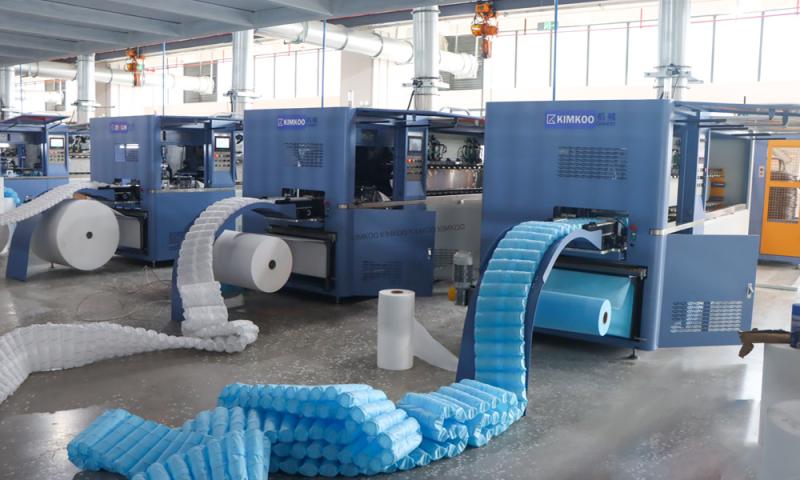
Step 1 — High-Speed Spring Coiling and Pocketing
The first stage in automated pocket spring mattress production is spring forming and pocketing. Modern CNC systems integrate wire feeding, dual-stage heat treatment, high-speed coiling, fabric feeding, ultrasonic welding, and spring separation into a continuous process. A high-performance pocket spring coiling machine can reach production speeds of up to 180 springs per minute in normal operation (with peak capabilities up to 200 springs/min), while maintaining precise coil geometry and consistent tempering.

Key production advantages at this stage include digital servo control for repeatable coil formation, infrared or optical counters for accurate output tracking, rapid cooling systems to protect nonwoven pockets from thermal distortion, and low-waste ultrasonic bonding to ensure clean, robust pocket seams.
Dual-Wire & Zoned Production
Optional dual-wire configurations allow manufacturers to create zoned spring patterns by alternating wire diameters or switching spools quickly without mechanical changeovers. This enables ergonomic layouts—firmer zones under hips and softer zones under shoulders—straight from the coiling stage.
Step 2 — Multi-Line Spring Assembly
After individual springs are pocketed, they are organized into rows and bonded into a complete spring unit. A dedicated pocket spring assembly machine (including triple-line models) accepts multiple feed channels and supports complex zoning by combining different spring types in parallel or nested arrangements.

Automatic assembly machines integrate ultrasonic cutting/welding with servo-controlled glue application (single-sided, double-sided, or glue-free modes). Servo glue control reduces adhesive consumption while ensuring uniform bond strength. Integrated fabric cutting and height-adaptable frames speed format changes and reduce manual intervention.
Quality & Efficiency Controls
- Ultrasonic sealing and precision cutting for clean edges and strong seams.
- Servo-driven glue spraying to minimize waste and maintain bond uniformity.
- Real-time sensors for spring counting, jam detection, and automatic error reporting.
Step 3 — From Spring Core to Finished Mattress
Once spring units are assembled, they proceed to mattress finishing lines where foams, comfort layers, quilting, and ticking are added. Automation keeps alignment consistent and maintains dimensional tolerances so each finished mattress matches its design specifications for firmness, durability, and comfort.
Combined, high-speed coiling and multi-line assembly create a continuous production flow that reduces cycle times, lowers labor costs, and improves yields—allowing manufacturers to scale without sacrificing product quality.
The Role of Automation in Modern Mattress Production
Automation delivers repeatable quality through precise servo control, PLC-coordinated workflows, and touchscreen interfaces that simplify setup and changeovers. Integration of industrial components—robust servo drives, reliable pneumatic systems, and industrial PLCs—ensures stable operation during long production runs and minimizes maintenance interruptions.
For manufacturers pursuing large-scale, consistent output, an automated pocket spring machine line is the cornerstone technology that transforms raw wire and fabric into high-performance pocket spring mattress cores.
Conclusion — Efficiency, Consistency, and Zoning Flexibility
Automatic pocket spring production systems combine fast, digital coiling with flexible, multi-line assembly to deliver mattresses that meet modern comfort standards and production targets. From reduced material waste to precise zoning capabilities, these integrated lines allow manufacturers to respond quickly to market demands while maintaining cost efficiency and product reliability.
Comments