AI Agents for Insurance Industry Explained: Role, Benefits, and Real-World Impact
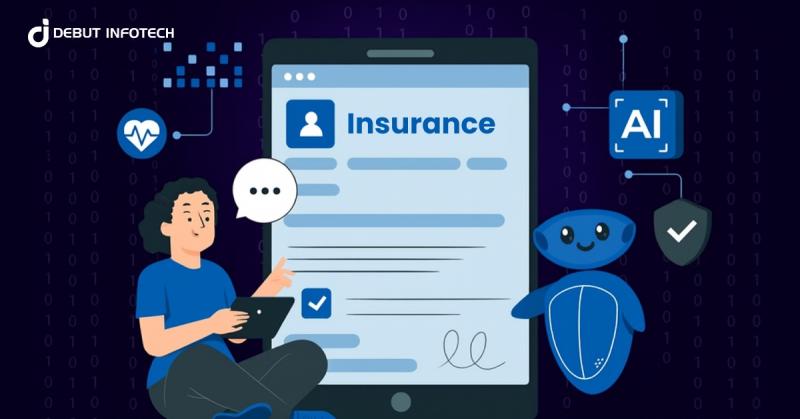
Think about the last time you filed an insurance claim. Chances are, it wasn’t exactly quick or stress-free. For years, the insurance industry has been bogged down by paperwork, long waiting times, and back-and-forth communication. But that’s finally changing.
AI agents are becoming the next driving force of insurance innovation. These systems are not only expected to automate the routine tasks but also to think, evolve and become better every time it interacts with a person. The effect is visible, be it increasing claim payments faster, improving accuracy in underwriting, or providing customers with more personalized experiences, AI agents are transforming the way insurers do business in an area that is long overdue an overhaul.
The results speak for themselves. When Compensa Poland, part of the Vienna Insurance Group, rolled out an AI-powered self-service claims system, they saw a 73% jump in claims process cost efficiency. That’s not just a win for the company, it means customers are getting quicker, smoother experiences, too.
Insurance is no longer just about managing risk. With AI agents for the insurance industry, it’s about creating trust, efficiency, and service that feels truly human.
What Are AI Agents in Insurance?
When one talks of “AI in insurance”, most tend to envision chatbots, the type that respond to simple questions like, “How do I reset my password?” or “What’s the status of my claim?” However, AI agents do more than that.
Think of them as autonomous digital coworkers. In contrast to conventional chatbots, which are rule-directed and restricted to pre-written responses, AI agents rely on conversational AI, sophisticated reasoning and AI agent architectures to comprehend context, make choices and act.
For example:
A chatbot may respond to a question asked by a policyholder regarding coverage.
However, an AI agent can take the customer through the whole claims procedure, including gathering documents, matching the information with the policy guidelines, and even showing the status of the claim in real time.
Since they use scalable AI tools and frameworks, insurers can deploy AI agents in various workflows, such as underwriting, compliance, or fraud detection, without needing to rewrite systems. That is, they are not just “smarter chatbots.” They are proactive, independent assistants, which can help insurers optimize operations and provide improved customer experience across all touchpoints.
Why the Insurance Industry Needs AI Agents Now
The insurance sector is at a crossroad. Insurers are under greater pressure than ever before due to escalating volumes of claims, growing risk of fraud and excessive compliance requirements. Simultaneously, the customers require 24/7 services and quicker claims resolutions. It is a hard ratio to maintain with conventional processes alone.
AI agents are transforming the game. They do not have to adhere to some strict script, but instead can learn, evolve and make smarter decisions as needed, which is the best part about them. Activities like processing claims, identifying potential fraudulent activities or verification of policies can be done with specificity and speed. The real win? Human teams have the opportunity to move out of the routine work and concentrate on the cases that require critical thinking, empathy and personal touch.
An AI agents platform, as an example, can process thousands of claims in real time and mark out anomalies that could signify fraud, which is virtually unachievable on the same scale manually. This not only minimizes the operational expenses but also accelerates the decision-making process. Likewise, by implementing AI agents directory that enables the integration of special tools, insurers can tailor workflows to underwriting, customer support, and compliance monitoring without having to reinvent the wheel.
Ultimately, AI agents are not about eliminating individuals in the insurance procedure, but providing them with more powerful tools. By replacing repetitive work and providing immediate feedback, AI agents liberate teams so that they can concentrate on what is most important: to provide faster service, better communication, and more reliable results. This balance assists insurers in ensuring that they meet the expectations of customers and remain ready to face the increasing industry challenges.
Key Benefits of AI Agents in Insurance
With AI agents, insurers are transforming the manner of conducting business, ensuring they offer services that are quicker, intelligent, and easier to clients. Rather than customers waiting weeks to receive updates, or becoming lost in tedious paperwork, insurers are now able to provide streamlined, near real-time experiences. Here are the biggest benefits:
1. Speed & Efficiency
Among the most important benefits of AI agents for insurance is the acceleration of claims processing. What used to take days can now be accomplished in hours or even minutes. A perfect example is Lemonade, which is an insurtech company that takes seconds to enable simple claims through AI. This does not only enhance the customer satisfaction but also enables the human agents to attend to more complicated cases.
2. Personalization
Insurance no longer needs to be one-size-fits-all. With the help of AI agents, policies and recommendations can be tailored to specific customers based on their lifestyle, risk profile, and history. This builds credibility and makes individuals feel as special customers rather than as policy numbers.
3. Fraud Detection
Insurers lose money in billions a year due to fraudulent claims. AI agents assist with identifying strange patterns and raising a red flag on suspicious activity at the early stage. This is a proactive measure, which safeguards the insurers, and their genuine clients.
4. Scalability
Claims may increase exponentially when there are natural disasters or massive events. AI agents can instantaneously scale up to work with increased loads instead of saturating human teams, which cannot achieve the same precision and efficiency.
5. 24/7 Customer Support
Customers today require assistance at any time and not only during office hours. AI agents are available 24/7 to answer queries, provide customer service by leading them through claims, and even real-time proposals of the appropriate policies.
6. Predictive Risk Assessment
In addition to handling claims, AI agents are able to interpret past data, behavioral trends, and external risks like economic changes to forecast risks. This enables insurers to proactively modify policies and provide improved long-term customer results.
Real-World Applications & Expert Case Studies: How AI Agents Are Reshaping Insurance
Paperwork has always characterized the insurance industry, but AI agents are altering this narrative. With lightning-fast claims to sharper fraud detection, here are some of the ways they are already making a difference:
1. Claims Processing Automation
Lemonade’s AI assistant “Jim” set a standard by approving some claims in just two seconds. The system checks policies, detects fraud and sends out payouts immediately giving the customer a frictionless experience as opposed to long delays.
2. Fraud Detection & Risk Assessment
Insurers are paying billions every year due to fraud, but AI agents are transforming this. They do not depend on manual reviews alone, but scan data with claims and customer habits on demand to highlight high-risk cases.
MS & AD Insurance Group in Japan shows what’s possible. With an accuracy of almost 80% on the FORCE platform which was trained on more than 100 million claims, the company was able to detect 2.5 times more fraudulent claims than the industry average.
The result? Less money lost to fraud and a faster, fairer process for honest customers.
3. Policy Recommendations & Cross-Selling
Nowadays, AI agents are becoming quite adept at reading customer desires, even before the customers are themselves aware of their own desires. As an illustration, a South African large health insurer analyzed 1,000,000 records of customers with models such as Random Forest, XGBoost, and logistic regression. They found out that individuals between the age of 25-70, with prior insurance and long time customers are far more prone to purchase additional coverage.
With this understanding, the insurer did not make blanket offers, but made tailored recommendations. That is less sales and more service. Due to this fact, cross-selling became rather effective, leading to increased conversion, more satisfied customers, and less spent marketing dollars.
4. Customer Onboarding & KYC
Rather than flooding customers out with repetitive forms, AI agents are now capable of verifying IDs, scanning documents, and performing KYC checks silently in the background. The result? A quicker, more reliable and easy-going onboarding process.
A recent use case is the collaboration between Oriental Insurance Company in India and CAMSRep to implement an AI-based onboarding system named KwikID. The platform scans documents using OCR, verifies identity using facial recognition, and checks in real-time with national databases such as Aadhaar and Digilocker. Automating these processes enables Oriental Insurance to not only accelerate the process of issuing policies but also to maintain a high level of compliance with the strict regulatory guidelines as stipulated by the IRDAI.
This demonstrates how AI agents are eliminating the paperwork problem in insurance, allowing the initial encounter with a provider to be as smooth and trustworthy as possible.
5. Automated Compliance Monitoring
In an industry whereby the rules keep changing, insurers are resorting to automated compliance tracking as a way of keeping up. As an example, one of the global reinsurance providers has collaborated with Credo AI to transform the way they approach bias and performance compliance. Instead of using manual spreadsheets, they integrated custom policy packs into their model pipeline to activate essential verifications prior to any AI model becoming operational. The result? Less manual work, faster audits and more regular oversight.
When zooming out, the effect is even larger. According to McKinsey, AI has the potential to generate up to $1.1 trillion of value in insurance and banking every year. It is not only about cost-reduction, but it means that human experts will be able to invest their resources in high-value decisions, with AI performing the routine, rule-driven tasks.
The similarity here is evident: insurers are developing solutions over the more sophisticated AI agents frameworks that merge fraud detection, claims automation, and compliance into one ecosystem. The result will be quicker service, secure transactions and more individualized customer experiences.
Challenges & Risks of AI Agents in Insurance
Just like any technology that is game changing, AI agents in the insurance industry are associated with their own challenges. Although the potential is enormous, insurers have to strike a balance between innovation and responsibility. Some of the main challenges include:
1. Bias & Fairness in Decision-Making
AI algorithms are based on the past data, and such data is not necessarily flawless. When the training sets are biased, such as paying more premiums to particular demographics in the past, the AI may reproduce the biases unwillingly. The result? Dissatisfactory pricing structures or decisions on claims. Insurers should also actively ensure that bias is tested and rectified so that all policyholders are given fair results.
2. Data Privacy & Compliance
Each day, insurance companies work with very sensitive data, such as medical backgrounds, credit histories, and personal identifiers. This is why the adherence to the regulations such as GDPR in Europe or HIPAA in the U.S. is not a matter of negotiation. A malicious AI agent that handles this information may release insurers to legal liability and mislead the customers. By employing qualified AI experts, organizations can be assisted to develop systems that are both security conscious and compliant.
3. Cybersecurity Risks
AI agents are dependent on vast sums of personal and financial information. That is one of the reasons why they are an ideal victim of cyberattacks. One violation is enough to cause a bad reputation, loss of financial resources, and legal consequences. It is important to build AI with high security standards and regularly check it to identify any vulnerabilities.
4. Cost of Implementation
The development and implementation of AI agents do not come cheaply. In addition to the initial development expense, insurers need to look at the overall cost of training, upgrades of the system, and compliance inspections. Nonetheless, it can be made more economical in the long term to know how to build an AI agent in a strategic way, i.e. start small, scale, and make use of modular systems.
Future Trends of AI Agents in Insurance
The future of AI agents in insurance isn’t about flashy tech, it’s about making insurance smarter, fairer, and more human-centered. We’re already seeing this shift play out in real ways.
Take IoT integration, for example. From car sensors to fitness trackers, connected devices are providing insurers with real-time data that they can actually act on. Rather than risk guessing, the usage based policies may be used which means that safe drivers or healthier lifestyles attract less premium. No wonder 68% of insurers worldwide are already adopting usage-based models in auto insurance.
But data is only the start. Predictive analytics is helping insurers look ahead, not just react. Imagine an AI agent spotting when a customer might miss a renewal or detecting early risk factors in a high-flood zone. Some companies have already seen a 15–20% boost in customer retention just by using AI to reach out before problems happen.
What’s important here is that AI isn’t replacing human agents, it’s co-piloting with them. Zurich Insurance, for instance, rolled out an AI-driven CRM that takes care of repetitive tasks. The result? Service times cut by more than 70%, giving human agents space to focus on the conversations that really matter.
And then there is generative AI. In addition to automation, it is also assisting in explaining policies in plain language, creating custom recommendations, and even processing routine customer questions. Various studies predict that 70-80% of customer interactions will be handled by AI by 2025, illustrating how quickly the industry is shifting.
Endnote
AI agents are not new fantasies anymore because they are already changing the way insurance companies do things. Whether it is optimization of claims processing or a more individual customer experience and compliance, the difference is obvious: efficiency increases, costs decrease, and customers can experience a sense of value.
But here is the biggest lesson learnt, this is not about machines taking the place of people. It is about providing smarter tools to insurers so that they can concentrate on what matters most; customer protection, developing trust, and delivering real value. Technology must empower not overwhelm.
The future of insurance is intelligent, proactive, and human-centered. Collaborating with the appropriate professionals will get you there in a shorter time. Debut Infotech, one of the leading AI agent development companies, brings deep domain knowledge and cutting-edge solutions to help insurers reshape the way they serve their customers.
Ready to stay ahead in an industry that’s rapidly changing? Now's the time to explore how AI agents can revolutionize your business.
Frequently Asked Questions (FAQs)
Q. How are insurance agents using AI?
A. Insurance agents are using AI to handle client data more efficiently. By automating administrative tasks, they can spend more time building meaningful relationships with clients.AI platforms also help agents review Statement of Values (SOV) data quickly. This allows them to spot potential coverage gaps before they become problems, improving accuracy and client trust.
Q. What are the risks of AI in insurance?
A. Data security is a major concern for AI models in insurance. These models need large amounts of data to learn and predict future outcomes based on past information.
There’s also a risk of bias. AI models trained on historical data may unintentionally discriminate against certain groups of policyholders.
Q. Why is AI a challenge for insurance companies and regulators?
A. Some AI systems can hallucinate, producing false or misleading information. This can impact the accuracy of insurance decisions, such as claims approvals or policy recommendations.
Additionally, predictive models may contain algorithmic biases. These biases

Comments