Hellbound Movie Download in Full HD :A Deep Dive into the Chilling Korean Supernatural Thriller
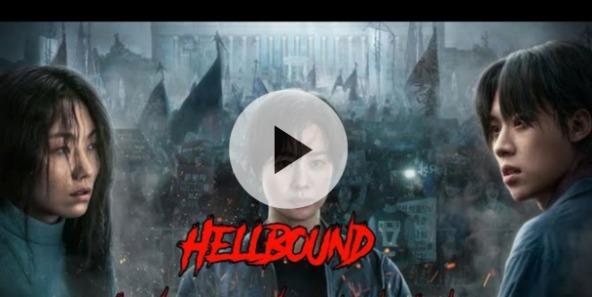
When Hellbound (Korean: 지옥) first dropped on Netflix in November 2021, it jolted viewers with its stark premise, intense visuals, and probing questions about faith, justice, and human nature. Directed by Yeon Sang-ho (of Train to Busan fame) and co-written with Choi Gyu-seok, the series is based on a webtoon of the same name.
From its first few episodes, Hellbound shines as more than just another supernatural horror show. It explores what happens when divine or supernatural power intrudes into everyday life, what people do when confronted with irreversible judgement, and how religion, fear, and power can intertwine to shape societies.
Plot Overview
Hellbound begins with unexplainable supernatural phenomena in Seoul: beings appear in public, giving people a decree—a prophecy that they are “bound for hell,” complete with the exact date and time. Soon after, three monstrous, demonic-like executors arrive and perform a horrifying act called a demonstration, killing the condemned in front of bystanders.
These events spark chaos. Fear grips society. A powerful new religious organization, The New Truth Society, emerges, led by Jung Jin-soo. He preaches that these decrees are divine, meant only for sinners, and thus justifies the deaths as necessary for purification, moral order, and divine justice. Many accept this, others reject it. Some try to help the condemned; others exploit the situation.
We follow several characters with converging storylines:
● Jung Jin-soo: Charismatic and chilling leader of The New Truth.
● Min Hye-jin: A lawyer who starts to fight for those who have been decreed, resisting the societal and religious pressure.
● Park Jung-ja: One of the first people decreed; her journey becomes central as more mysteries about resurrection and the nature of the supernatural emerge.
Season 1 ends with shocking developments: a demonstration, a baby survival, and a cliffhanger regarding resurrection—Park Jung-ja is brought back to life four years after what seemed to be irreversible death.
Season 2 escalates the stakes: social order has further deteriorated. Different factions—The New Truth, The Arrowhead (a violent vigilante group), and the rescue group Sodo—vie for power, meaning, and control. Resurrection becomes central, along with questions of who controls truth, who defines justice, and whether the phenomenon is about sin, or something more.
Themes & Motifs
1. Faith, Dogma, and Religious Manipulation
Hellbound shows how people can rush toward dogmatic belief when faced with fear and uncertainty. The New Truth Society asserts that the decrees = divine will, and uses that to gain power over public perception and policy.
2. Fear, Chaos, and Social Order
The supernatural events disrupt social norms. Civil institutions fail or struggle. Vigilante groups (like The Arrowhead) enforce what they see as moral decree. Mass media sensationalizes the events, often worsening the panic. The show asks: when law and reason fail, what do human beings do?
3. Guilt, Sin, and Redemption
Who is guilty? Who deserves judgement? Are those who are decreed always sinful, or is the process necessarily fair? The resurrection of characters prompts new questions of what it means to be “redeemed” or “resurrected,” whether second chances exist, and whether demonstration always equals moral failure.
4. Power of Narratives: Media, Spectacle & Moral Panic
Demonstrations are public spectacles. The media broadcasts them. Viewers, online commentators, conspiracy theorists, fanatic groups all take part. The show critiques how narratives—religious, governmental, media—compete, how sensationalism can warp truth, and how crowd psychology can lead to persecution.
5. Identity, Resurrection, and What Comes After
Resurrection introduces uncanny questions. If you come back, what are your obligations? Are you the same? What is your role in the new world? Hellbound uses this to explore soul, identity, trauma, and possibly whether the supernatural is less about punishing sin and more about forcing people to confront the consequences of fear and belief.
Production, Direction & Visual Style
Yeon Sang-ho, already known for powerful genre work (Train to Busan), returns to dark themes, this time with more overt supernatural horror. He co-wrote the series with Choi Gyu-seok, based on their webtoon Hellbound.
Visually, the series is stark, often brutal. The demon-like executors are terrifying, the scenes of demonstrations are graphic and intense. This isn’t horror for jump scares alone; it’s visceral, morally heavy. The use of real crowds, public chaos, media coverage, and wide shots of mass panic enhance its dystopian horror.
Reception & Impact
Hellbound received critical acclaim for its imagination and how it uses its terrifying supernatural premise to examine human failings. Within three days of release, it achieved tens of millions of viewing hours globally and topped Netflix’s Global Top 10 in many countries.
The show sparked debates about faith, justice, the role of religion, and how society would react to supernatural judgement. Its themes echo real-world discussions about belief, moral panic, cults, social media hysteria, and what happens when people seek order in chaos.
Why Hellbound Resonates
1. Universality of its core question: What would you believe if you saw incontrovertible proof that a deity—or supernatural force—punishes humans visibly?
2. Moral ambiguity: Very few characters are unambiguously good or evil, making the series provocative.
3. A mirror to present issues: The show speaks to modern anxieties—polarization, misinformation, religious extremism, media spectacle, cancel culture, fear of the other.
4. Strong writing + direction: High production values, horror visuals, tense pacing, and ethical questions make the show compelling.
5. Cliffhangers and mystery: The pacing retains enough mystery—about resurrection, the true nature of decrees, who is in control—to keep audiences hooked.
Criticisms & Weaknesses
● Shock / Violence Overload: The graphic violence sometimes overshadows the philosophical threads.
● Pacing issues: Certain episodes slow down the horror momentum.
● Exposition gaps: Many mysteries remain unresolved—some intentionally, some less so.
● Moral clarity vs ambiguity: Some audiences may find the show’s treatment of religion and supernatural justice disorienting.
Season 2 & Beyond
Season 2 builds on the cliffhangers of Season 1 with:
● Power struggles among The New Truth, Arrowhead, and Sodo.
● Resurrection playing a larger role, creating new moral and existential dilemmas.
● A deeper dive into how people behave under crisis, and how beliefs and media are manipulated.
Interpretation & Theories
● Are decrees truly tied to sin? Some argue what The New Truth claims may be false or simplified.
● Resurrection meaning: It might be a test, or a transformation rather than salvation.
● Purpose of the phenomenon: Possibly to force humanity to evolve morally or socially.
Relevant FAQ
Q: What is Hellbound about?
A: A Netflix original Korean supernatural thriller where supernatural beings deliver decrees to individuals, forecasting their death and condemning them to hell.
Q: Who created Hellbound?
A: Yeon Sang-ho and Choi Gyu-seok, based on their webtoon.
Q: When was Hellbound released?
A: Season 1 was released on November 19, 2021.
Q: Is Hellbound appropriate for all audiences?
A: No, it is graphic and deals with mature themes.
Q: What makes Hellbound different from other series?
A: Its mix of horror, religion, social critique, and moral ambiguity.
Conclusion
Hellbound is a compelling, disturbing, and thoughtful series. It's not just about demons and decrees—it’s about how humans behave under pressure: whom we trust, whom we fear, and who we become when the divide between life and death is publicly announced. It challenges notions of sin and salvation, of power and dogma, of identity and resurrection.
For those who like genre-bending shows that combine horror with philosophical and societal questions, Hellbound should be on your must-watch list.

Comments