The Complete Open Source Testing Tools Ecosystem: Implementation Guide for 2025
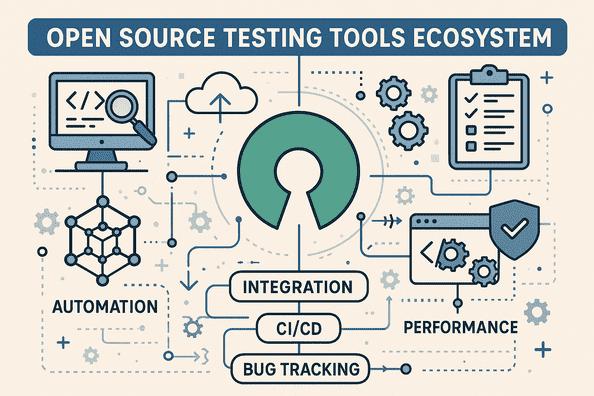
In today's competitive software world, building a strong testing infrastructure without spending a fortune has become increasingly important for organizations of all kinds. Open source testing tools have matured from simple utilities to enterprise-level tools that are comparable to commercial tools. This guide will provide you with what you need to set up a complete testing ecosystem using the best open source testing tools available in 2025.
Open Source Testing Tools Matter Now More than Ever
The movement toward open source testing isn't just for the cost savings; it comes with core benefits such as flexibility, community support, and eliminating vendor lock-in. Organizations are deciding to use these testing tools because they provide:
- Transparency regarding how testing logic works
- Infinite customization
- No licensing limits on adding team members
- Community and bug fixes in no time at all
- Integrate it with existing stack
More enterprises are adopting open source testing tools in their QA pipelines, and organizations are transitioning to entirely open source tools.
Foundation Layer: Unit and Component Testing
Code Quality and Static Analysis
Before I get into how to test functionality, I need to explain code quality basics; before you test functionality, you need some foundation of code quality. SonarQube Community Edition is arguably the leader in static code analysis — it provides thorough assurance for security vulnerabilities, code smells, and maintainability.
Implementation Recommendations:
- Include SonarQube in your CI/CD Pipeline from the get-go
- Set quality gates to stop you from deploying below a defined threshold
- Create specific custom rules based on your team's coding conventions
- Optional: Use SonarLint IDE plugins to provide in-development feedback.
Unit Testing Frameworks
Unit testing is the basis of any testing strategy. The following outlines some frameworks you can use based on technology stack.
JavaScript/TypeScript: Jest is still the gold standard and provides zero-config simplicity with built-in mocking. I recommend using Testing Library with Jest for component coverage to ensure you can focus on user behaviour and not implementation details.
Python: pytest has powerful fixtures, parameterized testing, and an extensive plugin ecosystem to integrate with coverage, parallel runtime, and custom reporting.
Java: JUnit 5 is the newest version of the modern Java testing framework. JUnit includes dynamic tests, nested tests, IDE integration, etc. Use AssertJ for fluent assertions and Mockito for stubbing dependencies.
Integration Testing Superiority
API Testing Application
REST Assured has established itself as the 'go to' standard for API testing in Java, then there's Postman's Newman that has some excellent CLI options in a JavaScript environment. However, the real winner for integration testing is Keploy, an innovative open-source testing tool continues to disrupt the quality assurance paradigm by creating test cases automatically through capturing real API traffic.
Benefits of Keploy implementation:
- No test writing efforts - automatically captures and replays API calls
- Real-life test cases based on production traffic
- Automatically mocks remote dependencies
- Regression testing with less setup and fluidity
Database Testing
Testcontainers has changed integration testing today providing lightweight; disposable database instances. Utilizing testcontainers means your tests are testing against real database engines compared to mocks and you'll avoid similar issues that a unit test would run into!
Best Practice for Database Testing:
- Use a fresh/new test containers for each test suite
- Have proper clean up in place to avoid contaminating/cleanliness
- If you have access, use database snapshots for faster test iteration
- Approach performance testing with realistic data set volumes
User Interface and End-to-End Testing
Newer Approach to E2E Testing:
I believe Playwright has fulfilled the most out-of-the-box testing solution for modern web applications for you. Playwright has true cross-browser test capabilities and handles the complexities of modern web applications as they should be handled. Playwright is an excellent option to fulfill the needs for every kind of web application testing including regression, acceptance, etc.
When thinking about how to implement Playwright, consider using the following approach:
- Start with the most critical user journeys and then expand coverage as time allows
- Encourage the use of page object model for easier maintainable test code
- Take advantage of Playwright's auto-waiting capabilities and avoid flaky tests
- Use configurations to run tests in parallel across browsers and devices.
Mobile Testing Integration
Appium continues to be the leader in mobile testing, providing a single API to test both iOS and Android where success with Appium can depend on how well you manage your test environments.
Mobile Testing Best Practices:
- Use cloud device farms to extend device coverage
- Incorporate good element identification methods
- Build tests for multiple screen sizes and orientations
- Add mobile testing to your continuous integration process
Performance and Load Testing
A Holistic Performance Strategy:
Although Apache JMeter is still the most versatile open source testing tool we have for performance testing, most of the time we have more complex tasks to deliver than simply load generation.
Advanced JMeter Implementation:
- Create realistic user behaviour using the correlation and parameterization features of JMeter
- Adopt distributed testing for larger simulated load volume
- Use custom plug ins for new protocols and for authentication
- Put performance testing results into monitoring dashboards
Monitoring and Observability
The combination of Grafana and Prometheus creates a powerful monitoring ecosystem that goes well beyond the standard usage of performance metrics. This combination provides a continuous insight into how an application behaves as conditions vary the load.
Security Testing Integration:
The use of open source security testing tools cannot be understated in today’s world of threats. A complete security testing integration should include:
Static Application Security Testing (SAST)
SemGrep provides rule based static analysis, that can pinpoint security vulnerabilities fairly early on in your development cycle. SemGrep can be configured with the flexibility to allow your teams to build custom rules to the particulars of your architecture
Dynamic Application Security Testing (DAST)
OWASP ZAP provides full dynamic application security testing capabilities. If done properly and integrated into your CI/CD pipeline, ZAP scans the application for common security vulnerabilities automatically, at every deployment.
Security Testing implementation steps:
- Include SAST tools in your IDE and pre-commit hooks
- Configure DAST scans to run against your staging environment
- Implement security regression testing against any identified vulnerabilities
- Establish security testing baselines and measure time against them.
Manage and Report Testing
Centralized test management:
Although many teams focus primarily on test execution tools, open source test case management tools can help maintain test quality and traceability. TestLink provides a feature-rich solution for organizing test cases, tracking execution, and traceability to requirements.
Test Management Implementation:
- Organize test cases by feature modules and risk levels
- Establish traceability matrices linking tests to requirements
- Configure automated reporting of test results from CI/CD pipelines
- Use metrics dashboards to evaluate testing
Advanced Reporting Solutions
The Allure Framework produces detailed test reports that provide information beyond simple pass/fail of tests. Combined with its framework integration capabilities, it makes the best single-report choice to unify reporting across the entire testing ecosystem.
CI/CD Pipeline Integration
Continuous Testing Strategy:
Open source testing tools can yield huge benefits, however, the best reward is reaped when the tools are well integrated into a continuous integration pipeline. Jenkins is still commonly used; however, more modern alternatives like GitLab CI and GitHub Actions provide better capabilities with fewer hassles.
Best Practices for implementing CI/CD Pipelines:
- Utilize parallel test execution to shorten feedback windows
- Utilize smart test selection based solely on code changes
- Tie test suites to particular pipeline stages
- Implement automated rollback based on test results
Quality Gates and Metrics
Create better defined quality gates that do not allow low-quality code to reach production:
- Unit test coverage (80%+ are critical paths)
- Integration test pass rates (100% on critical user journeys)
- Performance metrics (response time, throughput metrics)
- Security scans (zero high-risk vulnerabilities)
Team Collaboration and Best Practices
Knowledge Sharing Strategies:
It is critical to implement in an open source test management tool with a collaborative team effort, establishing best practices for collaboration will significantly enhance your organizations testing capabilities:
- Regular test reviews to check test quality:
- Team members share test data management objectives on using open source test data management tools like Faker libraries
- Patterns of testing are documented with common solutions
- Explore knowledge sharing across teams regarding specialized testing segments
Scaling Your Testing Organization
As you mature your testing practices, you can consider a few different strategies for scaling:
Team Structure Optimization:
- Place more testing capability in the development team than the testing team
- Have centres of excellence for some testing segments such as accessibility testing
- Follow a mentorship program to develop testing skills
- Regularly training on new tools and methodologies
Implementation Schedule and Phases
Phase 1: Foundation (Weeks 1-4)
- Set up unit testing frameworks and static analysis tools
- Set up basic integration for CI/CD
- Establish baseline and metrics for code quality
Phase 2: Integration Testing (Weeks 5-8)
- Deploy the API testing tools including Keploy for automatic test creation
- Implement testing with Testcontainers for database testing
- Implement basic capabilities for performance testing
Phase 3: Advanced Testing (Weeks 9-12)
- Deploy end-to-end testing with Playwright
- Integrate open source security testing tools
- Implement comprehensive reporting and testing management
Phase 4: Optimization (Weeks 13-16)
- Optimize test execution performance
- Optimize CI/CD integration
- Develop team collaborative processes and training development programs
How to Measure Success and ROI
Key Performance Indicators: To measure how successful you were with your open-source testing tools implementation, track the following metrics:
- Defect Detection Rate: Percentage of defects found before production
- Test Automation Coverage: Ratio of automated to manual tests
- Feedback Time: Time between code commit and test outcome
- Cost Savings: Reduced cost of testing tool licensing
- Team Productivity: Velocity improvements by software engineers
Continuous Improvement
Create a program of regular reviews, as follows, to continually enhance your testing ecosystem:
- Monthly review of tool performance
- Quarterly review of strategy
- Annual reviews of technology stack
- Regular training and skill upgrades of people
Conclusion
What we have proposed is an extensive open source testing tools ecosystem that is the result of a deliberate planning effort to construct a cohesive stack of tools that will facilitate continual improvement. The right open source testing tools are in your toolbox, including Kelooy the automatic test generation tool for the testing process, Playwright for E2E testing, and JMeter for performance testing, to name a few that could become part of your quality dimension of purpose.
The reality is that the merging of our purpose and process lies behind the selection of the right tools and creating integrated workflows that are linked to your team’s needs and the organization’s goals. We have provided you with this implementation plan or guide, and it’s up to you to modify the guide to meet your specific needs so that you can create a robust testing ecosystem that allows to reliably deliver software with cost savings didn't distract the teams productivity.
It is also critical to keep in mind that the open source community continues to be expanding rapidly. Although each community is a respectful environment, it is wise to follow trends on where the wizardries and innovations are evolving and contributing back if you wish to be part of the developments. Be prepared to be flexible with your proposals as many new opportunities may arise to dass the wherever they are to find solutions and utilise your imagination. Each commitment to open source test management tools and open source test data management tools will reap rewards in better quality software, lower costs, and better team capacity.
Making the leap into opening source test tools will begin with the first implementation of a tool, and then, your team will make be busy and engaged for the foreseeable future. Make wise decisions early on with your research efforts, facilitate the implementation of the tools methodically, and iterate and sustain the momentum of the build in the infrastructure results later.
Post Your Ad Here
Comments