From Data Centers to Devices: The Business Case for AI Inference Chips
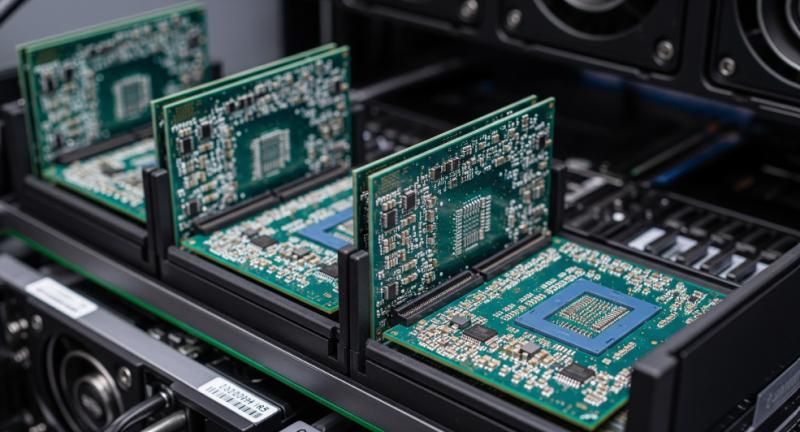
Have you ever seen an AI model run on a device no bigger than a deck of cards? It feels like watching a magic trick. There is no cloud, no distant server farm — just a small chip, quietly processing requests in real time.
The experience isn’t just impressive: it is, indeed, a quiet revolution. For years, the story of artificial intelligence has been dominated by the giants: massive data centers, rows of GPUs, and the endless hunger for power and bandwidth.
However, the real transformation is happening elsewhere, in the places where AI actually gets used. Businesses aren’t just talking about moving AI closer to the action; they’re doing it, and the tool making it possible is the AI inference chip.
These chips are changing how companies think about AI. They’re not about training models or crunching vast datasets. Their job is simpler, but no less important: taking a trained AI model and putting it to work, right where it’s needed. That could mean a factory floor, a hospital ward, a self-driving car, or even a smartphone. The shift is subtle, but its implications are anything but. When AI runs locally, on specialized hardware, the old constraints (latency, cost, reliability) begin to fade. The result is a fundamental shift in what AI can do and where it can go.
The Problem With Centralized AI
For most of its life, commercial AI has lived in the cloud. That made sense when models were experimental and data were scattered. However, as AI moved from labs to real-world applications, the limitations of centralized processing became impossible to ignore. Every time a device sent data to a distant server, waited for a response, and then acted on it, there was a delay. Sometimes, that delay was trivial. At other times, it was the difference between a seamless experience and a frustrating one, or between a safe decision and a risky one.
Just imagine a construction site using computer vision to monitor safety. If every image from a helmet camera has to travel to a data center and back before an alert can be triggered, the system isn’t just slow: it is plain dangerous!
Then there’s the cost. Moving data back and forth isn’t free. Bandwidth adds up, especially when you’re dealing with high-resolution images, video, or sensor data. And the more devices you connect, the more you’re at the mercy of your network’s capacity and reliability. For companies deploying AI at scale, those costs and risks start to look like a tax on innovation.
How Inference Chips Change the Game
Using AI inference chips changes this entire outlook completely. These chips are designed for one thing: running AI models efficiently, with minimal power and maximum speed. They’re not general-purpose processors: they are specialized, optimized for the kind of math that AI models do all day long.
The difference is most obvious in performance. An inference chip can process a request in milliseconds, without ever leaving the device. In manufacturing, it means quality control systems that can spot defects as products roll off the line, without waiting for a server’s approval. In retail, it means stores where cameras and sensors identify items instantly, even if the Wi-Fi is spotty. In healthcare, it means wearable devices that can analyze vital signs in real time, without streaming sensitive data to the cloud.
Still, speed isn’t the only advantage of AI inference chips: power efficiency matters just as much. Namely, running AI on a general-purpose CPU or GPU is like using a sledgehammer to crack a nut. It works, but it’s wasteful. Inference chips are built to do the job with a fraction of the energy. For battery-powered devices, that can mean the difference between a product that lasts hours and one that lasts days. For large deployments, it means lower electricity bills and smaller carbon footprints.
There’s also the matter of privacy and security. When data doesn’t leave the device, there’s less to intercept, leak, and regulate. For industries handling sensitive information — finance, healthcare, defense — this isn’t just a nice-to-have. It is an absolute requirement.
Success Stories
The most compelling arguments for inference chips come from the places where AI is already being used. Take agriculture, where drones equipped with AI can identify crop diseases or pests on the fly. With an inference chip on board, the drone doesn’t need to be within range of a cell tower. It can make decisions in the field, literally and figuratively. The same logic applies to logistics companies using AI to optimize routes, or to energy firms monitoring equipment in remote locations. In each case, the ability to process data locally removes a layer of complexity and a potential point of failure.
Even in more connected environments, like data centers, inference chips are proving their worth. Companies that once relied on banks of GPUs for AI workloads are now offloading inference to specialized hardware. The result is a more efficient use of resources, freeing up GPUs for the tasks they’re best at: training new models. This kind of specialization makes AI infrastructure more scalable. When not burdened by the cost or availability of general-purpose hardware, businesses can deploy more models, serve more users, and experiment more freely.
Securing the Next Wave of AI Inference
As AI inference chips drive faster decision-making at the edge and in the cloud, the conversation can’t just be about speed and efficiency. Every calculation, from powering financial predictions to running autonomous vehicles, carries sensitive information. Without strong safeguards, the same chips that accelerate innovation could also accelerate risk. This is where AI data security becomes essential — ensuring that the models, inputs, and outputs processed by inference hardware remain protected against leaks, tampering, and unauthorized access.
Different approaches to security are emerging alongside the chips themselves. Some rely on built-in encryption and isolation at the silicon level, while others use monitoring frameworks and compliance-driven policies to keep data flows safe without throttling performance. The goal is clear: protect the integrity of AI workloads while maintaining the very speed and scale that inference chips promise. For industries adopting this technology, treating AI data security as a foundational layer isn’t optional — it’s the key to unlocking trust in every accelerated decision.
Business Implications of AI Inference Chips
For executives, the appeal of inference chips comes down to three things: control, flexibility, and future-proofing. Control, because they are no longer dependent on a third party’s servers or pricing. Flexibility, because they can deploy AI in places where it wasn’t practical before. And future-proofing, because the trend is clear: AI is moving outward, toward the edges of the network.
That doesn’t mean the cloud is going away. Far from it! Training models will still require massive computational resources, and many applications will still benefit from centralized processing. All the same, the balance is shifting.
Adopting inference chips isn’t without its challenges, though. It requires rethinking how AI models are being developed, deployed, and maintained. It means investing in new hardware and, often, new skills. But the alternative — sticking with a one-size-fits-all approach — is increasingly unreliable. It’s only likely that businesses that treat AI as a monolith, something that only lives in the cloud, will find themselves at a disadvantage against competitors who can put AI wherever it’s needed… and soon at that.
The next few years are likely to bring even more specialization. We’re already seeing chips optimized for specific types of AI, like natural language processing or computer vision. As models become more efficient and as the demand for real-time AI grows, this trend will only accelerate.
There’s also the issue of standardization. With so many players entering the market, the choices can be overwhelming. Still, that is a good “problem” to have. Competition drives innovation, and innovation is what will make AI more accessible, reliable, and useful.
Post Your Ad Here
Comments