Defatted Soy Flour Demand Surges as Plant-Based Protein Market Gains Global Traction
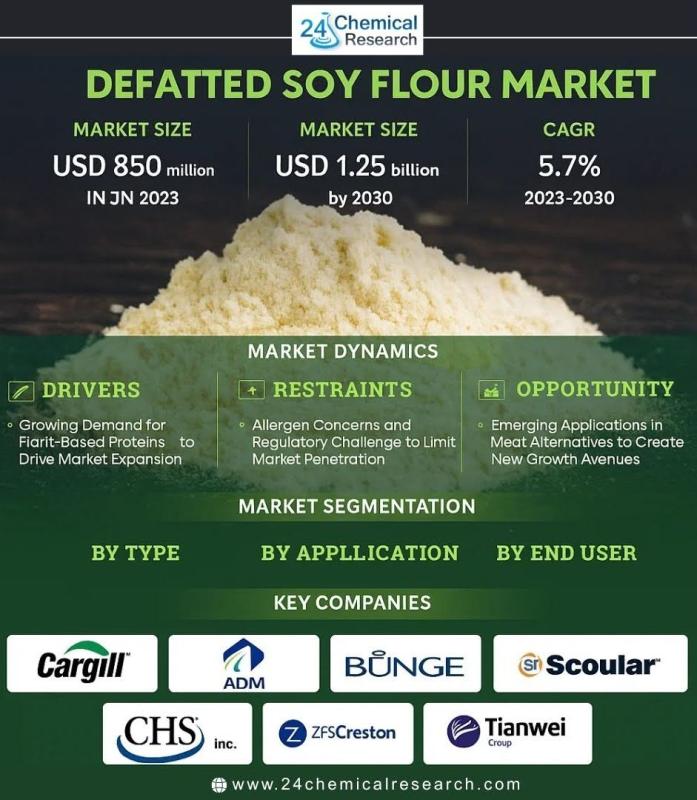
The demand for defatted soy flour is rising steadily as global consumers increasingly shift toward plant-based protein sources. With mounting interest in health-conscious and sustainable diets, this soy-based ingredient has emerged as a crucial component in modern food manufacturing.
Recent data shows the defatted soy flour market reached a valuation of USD 898.1 million in 2024, with forecasts projecting growth to USD 1.51 billion by 2032 at a CAGR of 5.7%. Its unique nutritional profile - featuring over 50% protein and less than 1% fat - combined with its functional properties like water-binding and emulsification, makes it especially useful in bakery, confectionery, and meat substitute applications.
Get Access Sample Report: https://www.24chemicalresearch.com/download-sample/196839/defatted-soy-flour-market-2023-2032-591
Recent Industry Shifts Fueling Momentum
The upward trend in the defatted soy flour market aligns with the broader expansion of the plant-based food sector. According to a recent BBC report, several major food manufacturers are investing in expanding their alternative protein portfolios due to strong consumer demand and sustainability targets.
In May 2025, U.S.-based food giant General Mills announced its commitment to increase plant protein use across all cereal and snack lines by 2030. Similarly, India's Patanjali Group reported record demand in its soy-based nutritional line amid growing urban adoption of vegetarian and vegan diets. These developments have positioned soy derivatives - including defatted soy flour - as essential raw materials for new product development.
Regional Trends Highlight Asia-Pacific Leadership
Asia-Pacific continues to dominate the global market with over 40% consumption share, led by countries like China, India, and Japan. These regions benefit from long-standing soy consumption habits, established processing infrastructure, and regional innovation in food texture and flavor profiles.
North America, particularly the United States, is seeing accelerated growth due to increasing use in sports nutrition and novel meat alternatives. The availability of cutting-edge extrusion technologies has made it easier to develop soy-based formulations with meat-like texture and high protein concentration. Europe follows with a steady rise in demand, especially for non-GMO and organic variants in markets like Germany and France.
Functionality and Applications Driving Innovation
Bakery items currently represent about 45% of total application, with meat alternatives and nutritional products accounting for 25% and 20%, respectively. Manufacturers are also experimenting with enzyme-modified and micronized variants of defatted soy flour to create smoother beverage textures and fortified products with enhanced digestibility.
Despite competition from other plant proteins like pea, chickpea, and rice, soy flour remains a preferred option due to its affordability, compatibility with existing food manufacturing systems, and strong consumer acceptance.
Segment Analysis:
By Type
DNA Polymerase Segment Leads Due to High Demand in Genetic Research and Diagnostics
The market is segmented based on type into:
DNA Ligase
Subtypes: T4 DNA Ligase, T7 DNA Ligase, and others
DNA Polymerase
Reverse Transcriptase
Restriction Enzymes
Other Enzymes
By Application
Research Applications Dominate Due to Increasing Genetic Studies
The market is segmented based on application into:
Research Applications
Clinical Diagnostics
Pharmaceutical Development
Forensic Analysis
By End User
Academic Institutions Lead Due to Extensive Research Activities
The market is segmented based on end user into:
Academic and Research Institutes
Pharmaceutical Companies
Diagnostic Laboratories
Biotechnology Companies
Key Players
Cargill, Incorporated
Archer Daniels Midland Company
Bunge Limited
CHS Inc.
Scoular Company
ZFS Creston
Tianwei Group
Makendi
Soy Austria GmbH
Key Industry Challenges
One of the major hurdles remains soybean price volatility, which has seen swings of 18–22% annually, affecting the cost structure for ingredient manufacturers. Additionally, allergen concerns and stringent labeling regulations - especially in the EU and North America - continue to shape product development.
Still, industry players such as Cargill, Bunge Limited, and Soy Austria GmbH are adapting through supply chain diversification, improved allergen management, and R&D into soy hybrids with reduced allergenic properties.
Get Full Report Here: https://www.24chemicalresearch.com/reports/196839/defatted-soy-flour-market-2023-2032-591
About 24chemicalresearch
Founded in 2015, 24chemicalresearch has rapidly established itself as a leader in chemical market intelligence, serving clients including over 30 Fortune 500 companies. We provide data-driven insights through rigorous research methodologies, addressing key industry factors such as government policy, emerging technologies, and competitive landscapes.
Plant-level capacity tracking
Real-time price monitoring
Techno-economic feasibility studies
With a dedicated team of researchers possessing over a decade of experience, we focus on delivering actionable, timely, and high-quality reports to help clients achieve their strategic goals. Our mission is to be the most trusted resource for market insights in the chemical and materials industries.
Website: https://www.24chemicalresearch.com

Post Your Ad Here
Comments